Complete Guide to Forex Trading for Beginners 2026
Forex trading for beginners explained with real numbers: pips, lots, leverage, position sizing, a 7-step first trade on EUR/USD and a 90-day plan for 2026.
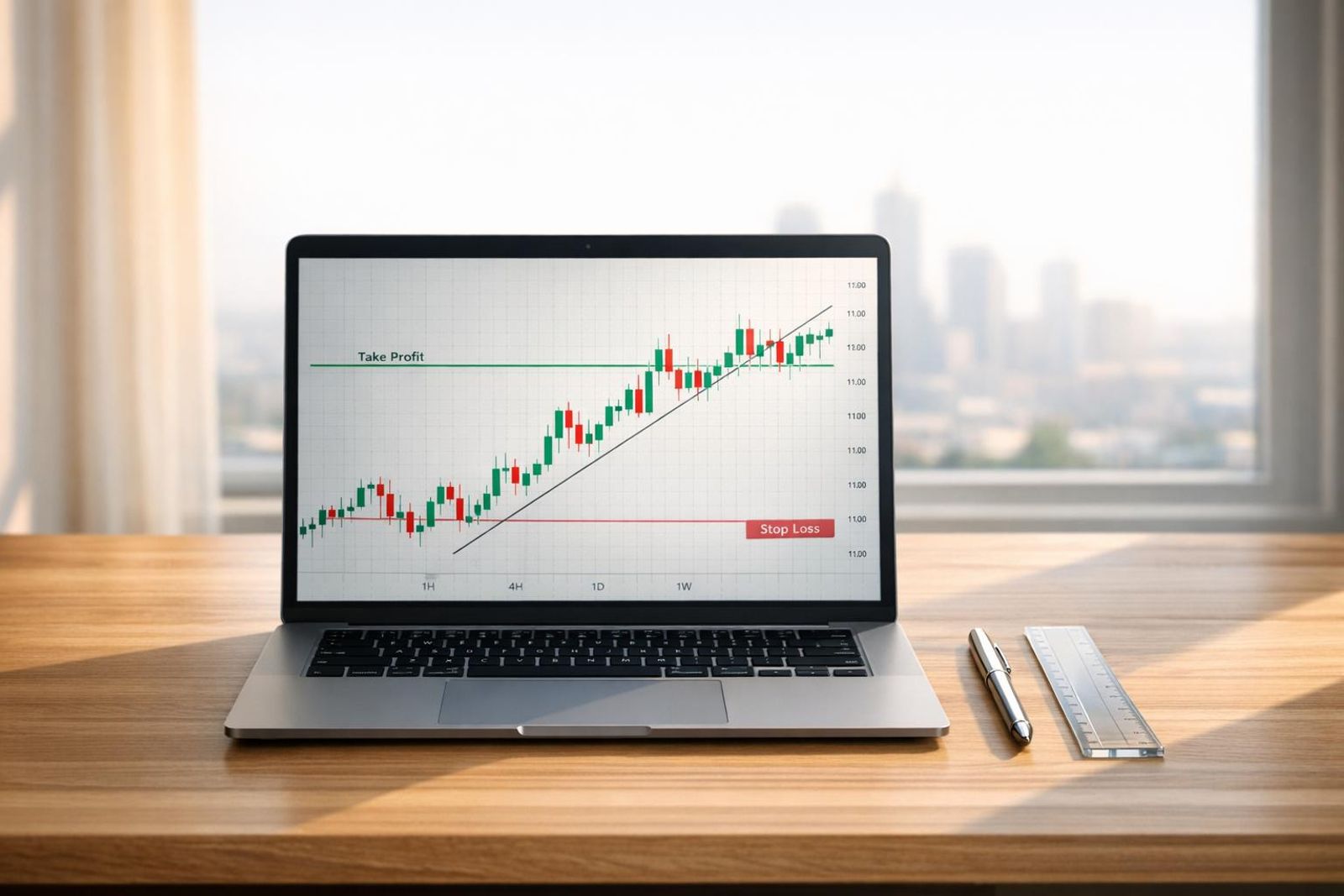
By Lenka Rož Schánová · Operations & Risk, For Traders
Forex trading is the buying of one currency against another to profit from the change in their exchange rate — you buy EUR/USD if you think the euro will strengthen against the dollar, and sell it if you think it will weaken. It runs 24 hours a day, five days a week across the $7.5 trillion-a-day global currency market, and positions are sized in lots, measured in pips, and controlled with a stop-loss.
Key takeaways
- Forex trading means taking a long or short position on a currency pair such as EUR/USD, with profit or loss measured in pips and scaled by your lot size.
- One pip on a standard lot (100,000 units) of EUR/USD is worth about $10; on a micro lot (1,000 units) it is about $1 — this arithmetic decides your position size, not your gut feeling.
- Risk 1–2% of the account per trade, place the stop around 1.5× ATR beyond structure, and target at least 1:2 or 1:3 R:R so six losses and four wins still leave you green.
- Most beginners need 6–12 months of structured practice before consistency appears, and the majority quit inside the first six months — the ones who last keep a journal and one strategy.
- Swing trading on EUR/USD, GBP/USD, USD/JPY or XAU/USD suits beginners better than scalping exotics during news releases.
- You can practise on a demo account for free, then test the same discipline under real rules — daily loss limit, max drawdown — on simulated capital through a For Traders Trading Challenge instead of depositing large personal savings.
Watch: related video
What forex trading is and how it actually works
Forex trading is the simultaneous buying of one currency and selling of another, with your profit or loss determined by how the exchange rate between the two moves after you open the position. That's the whole mechanism. When someone asks what is forex trading and how does it work, this is the one-paragraph answer to keep: you're never trading a currency in isolation, you're trading a pair — and every position you open is a bet that one side of that pair will outperform the other.
Reading a quote: base currency, quote currency and the bid/ask
Take EUR/USD 1.0850. EUR is the base currency, USD is the quote currency, and the number tells you how many dollars one euro buys. But you'll never see a single clean number on a live chart — you'll see two: a bid (say 1.0849) and an ask (1.0851). The bid is what you get if you sell right now; the ask is what you pay if you buy right now. The gap between them, 2 pips here, is the spread — effectively the cost of entry baked into the price itself, not billed separately. Buy EUR/USD and you are, in the same instant, long the euro and short the dollar. There's no way to separate the two legs; the pair moves as one unit.
Who is on the other side of your trade
Forex trading foreign exchange happens on a decentralised, interbank market — there's no single exchange floor like the NYSE. Your order gets matched through a broker or liquidity provider that's ultimately plugged into a network of banks, market makers and other participants, with global daily turnover running around $7.5 trillion according to the Bank for International Settlements' triennial survey. As a retail trader you don't access that interbank tier directly — you get exposure to those same EUR/USD price moves through a regulated broker's live-market feed, or, on a platform like For Traders, through a simulated environment that mirrors those real prices without your orders ever touching live liquidity. Either way, the price you're reading came from that same global forex exchange trade flow.
Why forex is different from stocks: 24/5 access, long or short, leverage
Three structural things separate forex from the stock account you might already have:
- 24/5 market — trading runs near-continuously from Sunday 21:00 UTC, when Sydney opens, through Friday 21:00 UTC, when New York closes. No waiting for a 9:30am bell.
- Long or short with equal ease — selling EUR/USD to open a position isn't some special "short sale" with extra borrowing steps, it's the same one-click action as buying, just betting the other direction.
- Leverage — a modest account can control a full standard lot's worth of exposure, which is exactly what makes forex accessible on a small account, and exactly why position sizing matters more here than in almost any other market.
Before you place a single trade, open a live chart of EUR/USD and just look — find the bid, find the ask, measure the spread in pips. That habit, done before strategy, before indicators, before anything else, is where every serious forex trader actually starts.
Currency pairs: majors, minors, exotics — and what a beginner should trade
The best pair for beginners is a major — EUR/USD, GBP/USD, or USD/JPY — because tight spreads and deep liquidity forgive the small mistakes you're going to make anyway. Every pair on your platform falls into one of three buckets: major, minor (cross), or exotic. That taxonomy isn't academic — it directly determines your spread cost, how hard price can move against you overnight, and whether your stop-loss actually gets filled where you placed it.
Majors: EUR/USD, GBP/USD, USD/JPY and the rest of the liquid core
Majors are any pair traded against the US dollar with the highest daily turnover — EUR/USD, GBP/USD, USD/JPY, USD/CHF, AUD/USD, USD/CAD, NZD/USD. EUR/USD alone accounts for roughly a fifth of daily forex turnover according to the Bank for International Settlements' triennial survey (bis.org), and that depth is exactly why its spread can sit at fractions of a pip during London/New York overlap. Tight spread, predictable range, tradable news calendar (NFP, FOMC) — this is the terrain beginners should live in first.
Minors and crosses: EUR/GBP, GBP/JPY and why spreads widen
Minors — sometimes called crosses — pair two non-USD currencies: EUR/GBP, GBP/JPY, EUR/AUD. No dollar leg means thinner liquidity, so spreads run wider and the average daily range often runs harder, particularly on GBP/JPY, a pair known among traders for violent, fast legs. You can trade minors once you've got majors under control, but they cost more to hold and punish a loose stop faster than EUR/USD does.
Exotics like USD/TRY — and why beginners should leave them alone
Exotics pair a major currency against an emerging-market currency — USD/TRY, USD/ZAR, USD/MXN. Spreads can be 10-50x wider than EUR/USD, and these pairs gap on central bank surprises or political headlines in ways that blow straight through a tight stop with real slippage. There's no edge in learning risk management on a pair that can move 300 pips in an hour. Skip exotics entirely until you've got a funded track record behind you.
Where XAU/USD (gold) fits in
XAU/USD — gold quoted against the dollar — isn't a currency pair, but it trades like one on your platform and it's worth learning early: gold is the single most-traded instrument on For Traders, ahead of every forex pair on the board. That popularity comes with a catch — gold's ATR is typically several times wider than EUR/USD's, so it demands wider stops and smaller lot sizes to keep risk equivalent.
| Pair type | Examples | Typical spread | Avg daily range | Beginner suitability |
|---|---|---|---|---|
| Major | EUR/USD, GBP/USD, USD/JPY | 0.1–1.0 pip | 60–90 pips | Start here |
| Minor/Cross | EUR/GBP, GBP/JPY | 1.5–4 pips | 80–150 pips | After 90 days |
| Exotic | USD/TRY, USD/ZAR | 20–100+ pips | 200–600+ pips | Avoid early on |
| Gold | XAU/USD | Varies, wider $ terms | $15–30+ per oz | Optional second instrument |
The rule: pick two instruments maximum for your first 90 days — one major, and gold if you want it. Open your watchlist right now, write down those two, and delete everything else. Fewer pairs means faster pattern recognition and cleaner backtesting — the opposite of scattering attention across a dozen charts you half-understand.
Pips, lots and pip value: the arithmetic every beginner skips
A pip is the smallest standard price move in a currency pair — 0.0001 on EUR/USD, 0.01 on USD/JPY — and its dollar value depends entirely on your lot size. Skip this math and you're sizing positions by feel, which is how a "small" trade turns into a blown daily loss limit. Get it right and every forex trade you place has a known, pre-calculated dollar risk before you click buy.
What a pip is and what it is worth in dollars
On EUR/USD, price moving from 1.1050 to 1.1051 is one pip. On USD/JPY, where the yen is quoted to two decimals, one pip is a move from 150.10 to 150.11. Pip value scales with lot size: a standard lot (100,000 units) moves roughly $10 per pip on EUR/USD, a mini lot (10,000 units) moves about $1 per pip, and a micro lot (1,000 units) moves about $0.10 per pip. The formula you actually use every day: dollars at risk = stop distance in pips × pip value × lots. A 20-pip stop on one standard lot is $200 at risk. The same stop on one micro lot is $2. Same setup, wildly different exposure — the lot size is the risk dial, not the stop.
Standard, mini and micro lots side by side
| Lot size | Units | Pip value (EUR/USD) | Margin @ 1:30 | Margin @ 1:100 | Cost of 20-pip stop |
|---|---|---|---|---|---|
| Standard (1.0) | 100,000 | ~$10.00 | ~$3,667 | ~$1,100 | $200 |
| Mini (0.1) | 10,000 | ~$1.00 | ~$367 | ~$110 | $20 |
| Micro (0.01) | 1,000 | ~$0.10 | ~$37 | ~$11 | $2 |
(Figures assume EUR/USD around 1.1000; actual margin shifts slightly with live price.)
Leverage and margin: what 1:30 and 1:100 really mean
Leverage is a margin mechanic, not free money. 1:100 leverage means you control $100 of exposure for every $1 of margin posted — which also means a 1% adverse move against your full margin wipes that margin out. It doesn't multiply your edge; it multiplies the speed at which a bad trade removes you from the market. Retail leverage caps differ by jurisdiction in 2026 — EU/UK regulators generally cap majors around 1:30 for retail accounts, while other regions permit far higher ratios. Prop evaluations layer their own limits on top, independent of what a broker in your country allows, because the firm is managing simulated-capital risk, not chasing volume. Know your account's actual cap before you size a trade — not the number you assume from a YouTube video.
Spread and slippage: the costs that come off the top
Spread is the gap between bid and ask, and it's a cost you pay on every entry before price moves a single pip in your favor. On a major pair that might be 0.8–1.2 pips in normal conditions; around NFP or an FOMC print, spreads can widen to 3-5x that as liquidity thins out. Slippage — getting filled at a worse price than you clicked — shows up the same way, usually right when volatility spikes and you can least afford it. Neither is a scandal; both are the mechanical cost of trading a live, moving market, and they come off your edge whether you account for them or not. Build them into your stop-loss and target math from day one, especially if news trading is part of your plan.
How to trade forex: 7 steps to your first risk-managed trade
The fastest way to learn how to trade forex successfully is to run one setup through the full risk-management sequence before you ever click buy. Here's the seven-step process, worked on real numbers so you can copy the arithmetic straight into your own trade.
The 7 steps
- Choose one liquid pair. Stick to majors while you're learning — EUR/USD, GBP/USD, USD/JPY — where spreads are tight and slippage is minimal.
- Pick a direction from a single defined setup. One trigger, no discretion stacking — a pullback to a moving average, a break of structure, whatever your plan defines. If it's not on your checklist, it's not a trade.
- Measure ATR and place the stop 1.5× ATR beyond structure — never on the round number. Round numbers (1.1000, 1.0900) attract stop-hunts; price often wicks through them before reversing.
- Set the target at 3R — three times your risk distance. A 1:3 risk-reward ratio means you can be wrong most of the time and still be profitable.
- Calculate lot size from the 1% risk rule and pip value. Never let position size be a guess.
- Place the order and note the type — market, limit, or stop — so you know exactly what fill behaviour to expect.
- Log the trade in your journal before price moves — entry, stop, target, reasoning. Do it before the outcome is known, or hindsight bias rewrites your reasoning for you.
Worked on EUR/USD with real numbers
Account: $10,000. Risk per trade: 1% = $100. Your setup triggers a long, ATR(14) on the 1-hour chart reads 17 pips, so 1.5× ATR ≈ 25 pips — that's where your stop-loss and take-profit orders get built. Stop goes 25 pips below entry, clear of the nearest round number and below recent structure. Target at 3R sits 75 pips above entry.
Position sizing: $100 ÷ (25 pips × $10 per pip per standard lot) = 0.4 lots. If the trade hits target, you bank +$300. If it hits the stop, you lose exactly the $100 you planned to risk — no more, no less.
A second worked example on XAU/USD (gold)
Same account, same 1% rule, different instrument. XAU/USD moves in dollars per ounce, not pips, and its ATR is naturally wider than a major forex pair's — say $8.50 on the 1-hour chart, giving a 1.5× ATR stop of roughly $12.75. Structure and volatility on gold demand that room; a tight forex-style stop gets clipped by ordinary noise.
With a standard lot on XAU/USD worth $100 per $1 move, a $12.75 stop risks $1,275 per lot — way beyond your $100 budget. Scale down: $100 ÷ $12.75 ≈ 0.08 lots. Target at 3R is $38.25 away, for a potential +$300 — identical reward-to-risk profile to the EUR/USD trade, just built around gold's own volatility instead of forcing a forex-sized stop onto it.
Order types: market, limit, stop and set-and-forget
A market order fills you immediately at current price — use it when your setup triggers now. A limit order fills only at your chosen price or better — good for entering on a pullback without watching the screen. A stop order triggers a market entry once price reaches a level — useful for breakout entries. Once all three legs — entry, stop, target — are placed, that's set-and-forget: the trade runs on your pre-defined levels, not your nerves.
Set-and-forget beats babysitting the chart for one simple reason: your plan was built with a clear head before entry, and every adjustment made mid-trade is made under the influence of open P&L. Moving a stop "just a little" or closing a winner early because it "feels toppy" is discretion creeping back in after you already did the disciplined work. Set it, log it, and let the 3R math play out.
Risk management: the rules that keep you in the game
Position sizing is the only variable in forex trading you fully control — you can't control whether NFP surprises the market or whether your setup fills before a spike reverses it. Risk 1-2% of account equity per trade, always, and you can survive the losing streaks that wreck everyone else. Risk 10% per trade, and one bad week ends the account.
The 1–2% rule and why it survives losing streaks
Position sizing 1-2% rule math is simple but the psychology behind it is what actually saves you. A losing streak isn't a possibility, it's a certainty — every trader hits six, eight, ten losers in a row eventually. The question is whether your account is still standing when the streak ends.
| Risk per trade | After 5 straight losses | After 10 straight losses | Recoverable? |
|---|---|---|---|
| 1% | -4.9% | -9.6% | Yes, easily |
| 2% | -9.6% | -18.3% | Yes, with discipline |
| 5% | -22.6% | -40.1% | Difficult |
| 10% | -41.0% | -65.1% | Effectively over |
At 1% risk, ten straight losses cost roughly 10% of the account — painful, but you're trading tomorrow. At 10% risk, that same streak takes you past the point most funded programs even allow, let alone what your own account can psychologically absorb. This is the fx trading risk management principle every profitable trader repeats because it's the one that's actually true: survive first, profit second.
Where the stop actually goes (and why round numbers get hit)
Your stop-loss goes beyond market structure, sized by ATR (Average True Range), never parked on the obvious round number. Everyone places stops just below 1.1000 or just above 150.00 — which means liquidity clusters exactly there, and price hunts it before continuing in your direction. Measure the recent ATR on your timeframe, place your stop 1.5x that distance beyond the swing high or low that invalidates your setup, and land it on an ugly number like 1.0987, not the round figure the crowd is using.
R:R in practice: the 10-trade worked example
Risk-reward ratio R:R is what makes a mediocre win rate profitable — win rate alone tells you nothing without it. Take ten trades at 1:3 R:R, risking $100 per trade with a 40% win rate, which is a genuinely below-average strike rate:
- 6 losing trades × -$100 = -$600
- 4 winning trades × +$300 = +$1,200
- Net result: +$600 on a 40% win rate
You lost more often than you won and still finished up $600. That's the entire argument for structuring every trade at 1:3 or better before you enter — the stop-loss discipline and the reward target are decided together, not improvised after the fill.
Daily loss limit and maximum drawdown as personal rules
Prop firms enforce a daily loss limit and a maximum drawdown ceiling because it works — steal the same guardrails for your own account, funded or not. Before you open the platform, write down: the dollar amount that ends your trading day, and the dollar amount that ends your trading week. Not a feeling, a number.
Write those two numbers on a sticky note on your monitor. When you hit either one, you're done — no revenge trade, no "one more setup." The number decided it before you had a losing position clouding your judgment.
Choosing a trading style: scalping, day trading, swing or position
Swing trading on the daily and 4-hour charts is the style most beginners should start with — it's the only one of the four that forgives slow decision-making, wide spreads, and a screen you can't watch all day. Scalping and day trading get the hype online because the videos show fast wins, but both punish exactly what new traders don't have yet: execution speed and tight cost control.
Style comparison: time per day, hold period, stop distance
| Style | Screen time/day | Typical hold | Typical stop (pips) | Trades/week | Beginner fit |
|---|---|---|---|---|---|
| Scalping | 4-8 hrs, constant focus | Seconds-minutes | 3-8 | 20-100+ | Poor |
| Day trading | 2-6 hrs | Minutes-hours | 10-25 | 5-20 | Moderate |
| Swing trading | 20-40 min | 1-5 days | 30-80 | 2-6 | Best |
| Position trading | 10-20 min | Weeks-months | 80-200+ | <2 | Good, slow feedback |
Why swing trading suits most beginners
Every scalp gives spread and slippage a bigger vote in your P&L than your analysis does — on a 5-pip stop, a 1-pip spread is already 20% of your risk gone before price moves. Swing trading with an 80-pip stop lets that same spread evaporate to noise. It also strips out the reflex-speed advantage that separates scalping vs swing trading: a swing entry on a 4-hour close gives you fifteen minutes to think, not half a second to click. That's why most beginner forex trading curricula, ours included, push new traders toward daily/4H swing setups before anything faster — you build a statistical edge on your own schedule instead of fighting the clock.
Sessions and timing: Tokyo, London, New York and the overlap
Forex trading sessions run in a rolling 24-hour cycle across three main centers, all measured in UTC: Tokyo opens around 00:00 UTC, London at 08:00 UTC, New York at 13:00 UTC. Most of the real work in EUR/USD and GBP/USD happens in the London–New York overlap, roughly 12:00-16:00 UTC — this is where the deepest liquidity, tightest spreads, and the bulk of the day's directional range show up. Asia-hours ranges (roughly 00:00-07:00 UTC) tend to be tight and choppy; breakout traders who jump early on a Tokyo-session range break get faked out constantly once London liquidity arrives and reprices the whole range. If you're trading majors, treat the overlap as your primary window and the Asia session as prep time, not entry time.
A simple rule for NFP and FOMC days
No new positions in the 15 minutes either side of NFP or an FOMC rate decision — spreads widen, stops slip, and the first move is frequently the wrong one. On the day itself, cut your size or sit it out entirely until you've journaled 100 trades and actually know how your strategy behaves around news spikes. This isn't caution for its own sake — it's a rule that costs you zero missed setups on 51 weeks of the year and saves your daily loss limit on the one week it matters.
Ready to trade funded capital?
Choose your path — Instant Accounts, One-Step or Two-Step Challenges — from just $23, with up to $300,000 in funded capital.
Choose your challengeTechnical or fundamental analysis: which one do you actually need?
Both — they answer different questions. Technical analysis tells you where to enter, where the stop belongs, and where the trade is invalidated. Fundamental analysis tells you why the pair is trending in the first place and when it's likely to move hard enough to blow through that stop anyway. Treat it as an either/or choice and you'll either miss the move or get run over by it.
Technical analysis: structure, levels and the indicators worth keeping
As a beginner, keep the toolkit thin. You need market structure — is price making higher highs and higher lows, or the reverse — plus horizontal support and resistance drawn from prior swing points, not guesswork. Add one moving average (the 50 or 200 EMA works fine) to gauge trend bias, and ATR (Average True Range) to size your stop objectively instead of picking a round number that the market hunts first. That's it.
Stacking five oscillators on one chart doesn't add edge — it adds confirmation bias. RSI, MACD and Stochastic are all derived from the same price data, so when they "agree" you're often just looking at the same signal three times, dressed up as consensus. A clean chart with structure, one moving average and ATR-based stops will get you further than a cluttered one, and it's a lot easier to journal and improve.
Fundamental analysis: rates, inflation and the economic calendar
Fundamental analysis, for a retail trader learning forex trading, isn't about forecasting GDP — it's risk management first. The core driver of most major-pair trends is the interest rate differential between two central banks: capital flows toward the currency offering the better real return, adjusted for inflation. When the Fed hikes faster than the ECB, dollar strength against the euro isn't a chart pattern — it's a rate story, and it can persist through technical "resistance" for months.
Inflation prints (CPI), employment data (NFP) and central bank rate decisions are the events that move differentials suddenly. This is exactly why the economic calendar belongs in your pre-session routine, not as an afterthought — check it every morning before you open a chart, and know exactly what's scheduled for the pairs you trade that day.
How the two combine on EUR/USD before a central bank decision
Picture EUR/USD coiling into a tight range for three days, compressing into a textbook triangle, ahead of an ECB rate decision. Technically, it's perfect — clean support and resistance, a breakout setup any strategy book would approve. But the fundamental catalyst sitting on the calendar means that breakout entry can still be a bad trade: if the ECB surprises with a hawkish hold when the market priced in a cut, EUR/USD can gap 40-50 pips through your stop before the candle even closes, and slippage does the rest.
That's the combination that actually works: use technicals for the entry and the stop location, use the calendar to decide whether you should be in the trade at all in the next two hours. A technically flawless setup sitting directly in front of an ECB or Fed decision isn't a high-probability trade — it's a coin flip with your stop-loss as the strike price.
How long does it take to learn to trade forex?
Most people need 6 to 12 months of structured, journaled practice to reach basic consistency, and 2 to 3 years before they're trading real size with any confidence — and the uncomfortable truth is that most of the traders reading this forex trading guide will quit inside the first six months, usually right before the part where it starts clicking. Learning how to trade forex isn't a weekend skill. It's closer to learning a musical instrument well enough to gig: mechanical repetition first, judgment much later.
Realistic timeline: months 1–3, 3–6, 6–12 and beyond
| Phase | Focus | What "done" looks like |
|---|---|---|
| Months 1–3 | Platform mechanics, pip maths, demo execution | You can place, size, and exit a trade without hesitating or fat-fingering lot size |
| Months 3–6 | One strategy, backtested and forward-tested | You have a written rule set and 100+ backtested setups showing an edge |
| Months 6–12 | Consistency, small live or simulated size | Journal shows repeatable process, not repeatable luck |
| 12+ months | Scaling size, managing psychology under pressure | Drawdowns don't blow up your process; risk stays fixed as size grows |
What the traders who make it do differently in the first six months
The forex traders who survive past year one almost never look like the ones grinding fifteen strategies across every pair on the board. They do four boring things repeatedly: they trade one strategy long enough to know its failure rate, they keep one trading journal that never skips a losing trade, they risk a fixed percentage per trade regardless of how confident they feel, and — this is the one everyone skips — they review their losers in detail instead of closing the tab and moving on. A losing trade reviewed properly teaches you more than three winners you don't examine.
Your 90-day beginner study plan
- Weeks 1–4: Learn platform mechanics and pip maths cold. Place 20 demo trades minimum, focused purely on correct execution — entry, stop, position size — not on being right.
- Weeks 5–8: Pick one strategy and stop touching it. Backtest 100 setups by hand, chart by chart, and write the entry/exit/risk rules down on paper — if you can't write the rule, you don't have a strategy, you have a hunch.
- Weeks 9–12: Forward-test the same strategy on demo, journal every trade, and review it weekly against one pass/fail metric — win rate, R:R, or max drawdown, pick one and track it honestly.
Ninety days won't make you profitable. It will tell you, with actual data instead of a gut feeling, whether your strategy and your discipline are worth building on for the next six.
How much money do you need to start trading forex in 2026?
You can technically open a live forex account with $100, but $500–$2,000 is the realistic floor for a personal account, and it still won't feel meaningful — which is exactly why most serious beginners now start on a prop evaluation instead of risking their own capital first. The math on small accounts is brutal once you actually run it.
Funding a personal account: what $500, $2,000 and $10,000 actually buy you
Take the standard 1% risk-per-trade rule and a 25-pip stop-loss. On $500, 1% risk is $5 — that's roughly 0.02 lots. At a 3R target, you're playing for $15. Real money, technically, but psychologically meaningless: it won't move the needle on rent, and it won't force you to respect a stop the way a $500 loss on a $50,000 account would.
| Account size | 1% risk per trade | Position size (25-pip stop) | Profit at 3R |
|---|---|---|---|
| $500 | $5 | ~0.02 lots | ~$15 |
| $2,000 | $20 | ~0.08 lots | ~$60 |
| $10,000 | $100 | ~0.40 lots | ~$300 |
Notice the pattern: the risk management is identical at every tier, but the dollars-per-R only start feeling like something you'd change your behavior for once you're north of $10,000. That's the account size where a losing trade actually stings enough to teach discipline — and it's also the size most beginners can't or shouldn't self-fund.
Demo account vs simulated funded capital
A demo account costs nothing and teaches you the mechanics — order types, platform navigation, how a pip actually moves your P&L. What it can't teach you is discipline, because nothing is at stake. You'll take trades on demo you'd never take with real consequences attached, and you won't find out until it's too late.
Simulated funded capital under a prop evaluation closes that gap. You're trading on simulated capital, not real money, but you're operating under real rules — a daily loss limit, a max drawdown ceiling, a profit target with a deadline. The stakes aren't your own cash; they're your account's survival. That pressure is what a free demo can't replicate.
The prop evaluation route: how a Trading Challenge works
A prop firm evaluation, or Trading Challenge, works like this: you trade a simulated account against a set of rules — hit the profit target, stay inside the daily loss limit, don't breach max drawdown — and if you pass, you move to a funded account where you earn performance rewards on simulated profits. No evaluation, no funded stage; it's a filter, not a shortcut.
For Traders: what the evaluation path looks like honestly
For Traders is an educational platform offering a Two-Step Challenge, Three-Step Challenge, and Instant Funding for traders who want to skip the evaluation phase entirely. Across the platform, gold (XAUUSD) and US indices like NSDQ dominate order flow — worth knowing before you build a strategy around EUR/USD alone.
Be blunt with yourself here: evaluation failure rates are high industry-wide, and For Traders is no exception. If you haven't finished the 90-day plan above — if you don't yet have a tracked win rate, R:R, or max drawdown number you trust — don't attempt a Challenge yet. The rules don't care about your hunches; they care about your data.
Personal account vs prop evaluation: the honest trade-off for a beginner
Pros
- An evaluation lets you trade meaningful size without depositing meaningful savings — the challenge fee is the maximum you can lose
- Rules like a daily loss limit and maximum drawdown force the risk discipline most beginners never build on their own
- All challenge trading happens on simulated capital, so mistakes cost lessons rather than rent money
- Multi-asset access means the same account can trade EUR/USD, XAU/USD, US indices and CME futures
- Passing produces a funded account with performance rewards tied to simulated trading results
Cons / risks
- Evaluation failure rates are high across the whole prop industry — most first attempts do not pass
- Fixed rules cut both ways: a single careless day can breach a daily loss limit even on a winning strategy
- It is not a shortcut past the learning curve — attempting an evaluation before 100 journaled trades usually just costs a fee
- A personal account gives you unlimited time and no external rules, which suits traders who genuinely self-police
- Trading rules and instrument specs vary by programme, so you must read the parameters before you start
Ready to trade funded capital?
Choose your path — Instant Accounts, One-Step or Two-Step Challenges — from just $23, with up to $300,000 in funded capital.
Choose your challengeFrequently Asked Questions
What is forex trading and how does it work?+
Forex trading is buying one currency while simultaneously selling another, betting that the exchange rate between the pair will move in your favor. You trade pairs like EUR/USD or GBP/JPY, and your profit or loss depends on how many pips the rate moves against your position size. The market runs 24 hours a day across London, New York, Tokyo and Sydney sessions, with no central exchange — banks, brokers and traders quote prices directly. Leverage lets you control a larger position than your account balance, which magnifies both rewards and drawdown.
How do I place my first forex trade?+
You place your first trade by picking a liquid pair, checking the spread, setting your entry, stop-loss and take-profit before you click, then sizing the position so a stop-out costs under 1-2% of your account. Open your trading platform, select the pair, choose lot size based on your risk calculation, and enter the trade with a hard stop already attached — never plan to add one later. Confirm the fill, note your R:R, and walk away from the screen instead of watching every tick. Journal the trade regardless of outcome; that record is what actually teaches you.
What is a pip and how do I calculate pip value?+
A pip is the smallest standard price move in a currency pair, typically the fourth decimal place (0.0001) for most pairs and the second decimal (0.01) for JPY pairs. Pip value depends on your lot size: a standard lot (100,000 units) is roughly $10 per pip on USD-quoted pairs, a mini lot (10,000 units) around $1, and a micro lot (1,000 units) about $0.10. Multiply pip value by the number of pips your stop-loss covers to know your dollar risk per trade before you enter. Most platforms calculate this automatically, but knowing the math yourself catches sizing errors.
How long does it take to learn to trade forex?+
Most traders need 6-12 months of consistent screen time before they can execute a strategy with real discipline, and 1-2 years before results are consistently repeatable across market conditions. The timeline depends less on hours logged and more on whether you're tracking a journal, reviewing losing trades honestly, and sticking to one strategy long enough to judge it fairly. Jumping between systems every few weeks resets the clock every time. Demo trading speeds up the learning curve on mechanics but won't teach you the psychology of risking real money — that only comes with live exposure.
How much money do I need to start trading forex?+
You can open a live forex account with as little as $100-$500, though undercapitalized accounts make proper risk management brutally hard because your position sizes get too small to matter or too large to survive a losing streak. A more realistic starting point for building real skill is $1,000-$2,000, which gives you room to risk 1% per trade without every fill feeling life-or-death. If capital is the constraint, a prop trading Challenge on simulated funds lets you prove your process and earn a Funded Account without risking your own money upfront.
Which currency pairs should a beginner trade?+
Beginners should stick to major pairs like EUR/USD, GBP/USD and USD/JPY, which offer tight spreads, deep liquidity and predictable behavior around news events. Avoid exotic pairs (USD/TRY, USD/ZAR) and thin crosses early on — wider spreads and erratic volatility punish inexperience fast. EUR/USD in particular is the most forgiving starting point: high volume keeps slippage low and price action tends to respect technical levels more reliably than exotics. Once you've built consistency on one or two majors, expanding to crosses like EUR/GBP becomes a natural next step.
What's the best trading style for beginners: scalping or swing trading?+
Swing trading is generally the better starting point for beginners because it gives you time to think between decisions instead of reacting to every tick, which is where scalping punishes inexperience hardest. Day trading sits in between and demands strict session discipline; scalping requires split-second execution and tight spreads that new traders rarely have the reflexes or capital to handle well. Swing trades held over days let you apply both technical and fundamental analysis without the pressure of constant screen-watching. Most traders find their real edge only after testing a style long enough to judge it honestly.
How do I size positions so one trade can't blow the account?+
Risk no more than 1-2% of account equity on any single trade, calculated from your stop-loss distance in pips, not from a gut-feel lot size. Divide your dollar risk (2% of balance) by your stop distance in pips times pip value to get the correct lot size for that specific trade. This means your position size changes trade to trade depending on where your stop sits — a wider stop means a smaller lot, not a bigger risk. Firms enforcing daily loss limits and max drawdown rules, like on a Two-Step Challenge, exist specifically to force this discipline before real capital is at stake.
How much leverage should a beginner use in forex?+
Beginners should cap effective leverage at 5:1 to 10:1 of actual risk exposure, even if the broker or firm offers 30:1 or higher — the leverage available and the leverage you should use are very different numbers. High leverage doesn't create losses by itself; it removes room for error, turning a normal pullback into a margin call before your thesis has time to play out. The accounts that survive long-term treat leverage as a tool for capital efficiency, not a way to trade bigger than their risk plan allows. Overleveraging is the single most common reason funded evaluations fail.
Can a beginner get funded through a prop firm challenge?+
Yes, a beginner can pursue a Funded Account through a prop trading Challenge, but the evaluation tests discipline and risk management more than raw market knowledge. You trade on simulated capital through phases with profit targets and drawdown limits, and passing earns access to larger simulated capital with Performance Rewards tied to your results. It's not a shortcut around learning — undercapitalized beginners without a tested strategy fail Challenges at high rates industry-wide. The realistic path is demo trading until your process is consistent, then attempting a Challenge once your risk management holds up under real pressure.
Written by
Lenka Rož Schánová
Operations & Risk, For Traders
Lenka focuses on the operational and risk side of running a prop trading firm — the rules behind evaluations, why drawdown limits exist, and the patterns that distinguish traders who pass from those who don't. She writes for traders who want to understand the framework they're trading inside, not just the markets they're trading.
Follow on LinkedInReady to trade funded capital?
Choose your path — Instant Accounts, One-Step or Two-Step Challenges — from just $49, with up to $300,000 in funded capital.
Choose your challengeTrade up to $300,000
Choose challenge