Ultimate Guide to Scalping for Prop Traders
Scalping risk management for prop traders: exact risk per trade, loss-budget maths, XAUUSD and MNQ position sizing, and drawdown rules that survive.
By Marcel Hambálek · Senior Trader, For Traders
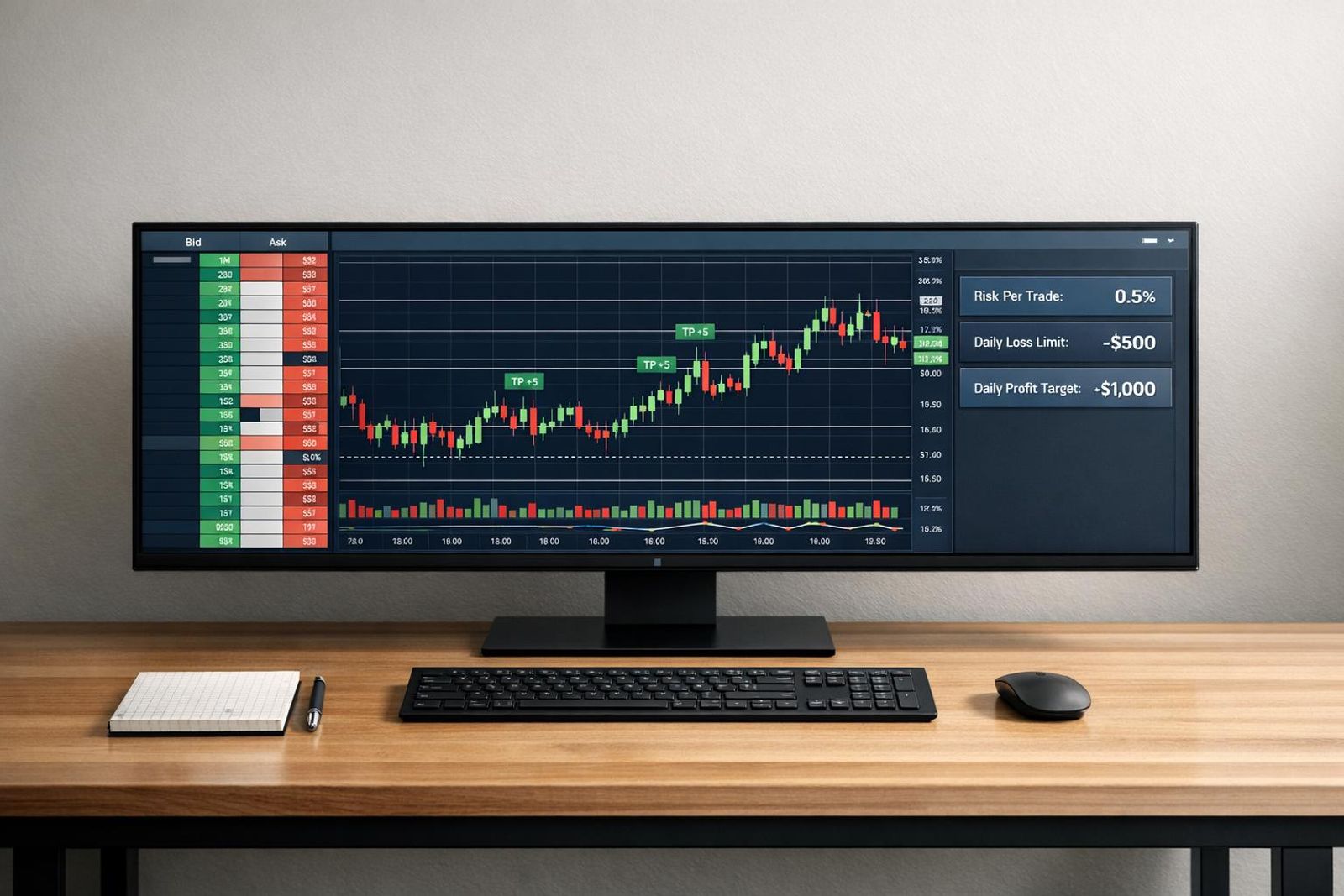
Scalping risk management is the set of pre-defined rules that cap how much a high-frequency trader can lose per trade, per session and per evaluation — typically 0.25%–0.5% risk per trade, a daily loss budget of 6–10 losing trades, and a personal stop at 60–70% of the firm's official daily loss limit. For scalpers taking 20–100+ trades a day, it is the risk frame, not the entry signal, that decides whether the account survives.
Key takeaways
- Scalping means seconds-to-minutes holds targeting 5–20 pips or ticks, 20–100+ trades a day, at a 60–80% win rate and 1:1 to 1:1.5 R:R — which only works if per-trade risk stays at 0.25%–0.5%.
- Convert your daily loss limit into a loss count before trade one: a $100,000 account with a 5% daily limit ($5,000) and 0.5% risk gives you ten losses, but your personal stop should trigger at six or seven.
- Position Size = Risk Amount / (Stop Loss Distance × Value Per Point) — the same line sizes XAUUSD, MNQ and EUR/USD, and one gold lot on a small account is a challenge-ending position.
- Spread plus commission can eat 20–40% of a 10-pip target, so your true breakeven win rate at 1:1 is well above 50% — that arithmetic, not the indicator, decides expectancy.
- Trailing drawdown moves against you every time intraday equity makes a new high, which punishes scalpers far harder than a static end-of-day threshold.
- A scalper-friendly firm means no minimum hold time, no vague HFT clause, defined news windows and execution you can measure — assess every firm, including For Traders, against those four criteria.
Watch: related video
What is scalping risk management (and why it comes before the setup)?
Scalping risk management is the set of pre-defined rules that cap how much you can lose per trade, per session and per evaluation before you ever click buy or sell — a fixed percentage risked per position, a hard stop on consecutive losses, and a personal ceiling that sits inside the prop firm's official Daily Loss Limit (DLL) and Maximum Drawdown (MDD). For a strategy built on volume rather than conviction, the risk frame is the strategy. The entry signal is almost incidental.
Everyone reading this has stacked three quick losses before 10am and doubled size on the fourth "to get it back." That's not a character flaw — it's what 20-100 trades a day does to your amygdala. Scalping risk management exists precisely to take that decision out of your hands before the session starts.
What actually counts as scalping: the numbers
Scalping is a defined trading style, not just "fast trading." Holds run from a few seconds to a few minutes. Targets sit at 5-20 pips or ticks — sometimes less on indices like the US100. Frequency is high: 20 to 100+ trades a day is normal for an active scalper. Win rates run 60-80%, because you're harvesting small, high-probability moves rather than swinging for a 1:3. Reward-to-risk is correspondingly compressed, usually 1:1 to 1:1.5. Any scalping guide for prop traders that skips these numbers is describing something else — day trading, maybe, but not scalping.
Why scalpers fail evaluations even with a winning strategy
Here's the part that surprises traders coming from swing trading: you can have a genuinely edge-positive scalping system — 65% win rate, 1:1.2 R:R, profitable on paper over 500 trades — and still bust a scalping prop firm challenge in week one. The failure mode is almost never signal quality. It's size, frequency and cost compounding inside a DLL that resets daily but an MDD that never does.
Run the math: at 40 trades a day and even a modest per-trade cost drag from spread and slippage, a small oversizing error doesn't take one bad trade to blow the daily limit — it takes four or five in a row, which happens more often than intuition suggests at 65% win rate. And because MDD is cumulative across the whole evaluation, a bad session doesn't just cost you the day. It eats into the buffer you need for every session after it.
The four pillars: per-trade risk, loss budget, cost control, hard stop
The rest of this guide builds out four pillars of scalping risk management rules, and they work as a stack — remove one and the others don't hold:
- Per-trade risk: a fixed 0.25%-0.5% of account equity per position, sized before entry, not adjusted after a loss.
- Loss budget: a session cap of roughly 6-10 losing trades or a defined percentage loss, whichever hits first.
- Execution cost control: spread, commission and slippage tracked as a real line item, because at high frequency, cost is often the difference between a profitable and unprofitable system.
- Hard stop: a personal daily ceiling set at 60-70% of the firm's official DLL, so you stop trading with room to spare — never at the edge of it.
How much should you risk per trade when scalping a challenge account?
Cap risk per trade scalping at 0.25%–0.5% of account equity, with 0.25% the sane default once you're taking 40+ trades a day. Anything higher and your loss budget doesn't just shrink — it disappears in a normal chop sequence, not even a genuinely bad session.
Why 0.25%–0.5% is the ceiling, not the target
Do the maths on a 5% daily loss limit, which most Two-Step Challenge and Three-Step Challenge structures use as the hard stop. At 1% risk per trade, five straight losers wipe the entire daily budget. Five losers in a 40-trade scalping session isn't bad luck — it's Tuesday. You'll hit that sequence in the first hour on a choppy NFP morning and never even get to test your edge for the rest of the day.
Drop to 0.25% and the same 5% budget absorbs twenty losing trades before you're done. That's the entire point: scalping risk management rules aren't there to protect you from one bad trade, they're there to keep you in the game long enough for your win rate and R:R to actually play out over a large sample. 0.5% is the outer edge for lower-frequency scalps — think 10-15 trades a day on XAUUSD rather than 60 on US100. Treat it as a ceiling you rarely touch, not a starting point.
The Two-Loss Rule: circuit breaker or crutch?
The two-loss rule trading concept is simple: two consecutive losers, you're done for the session — no exceptions, no "just one more to get it back." Be honest about what it does and doesn't do. It doesn't improve your edge. It doesn't make your entries better. What it does is remove the decision at the exact moment your judgement is at its worst — right after the second loss, when the account is down, your heart rate's up, and every part of you wants to force the next trade to be the one that fixes it.
That's revenge trading, and it's the single most common way funded evaluations die — not from bad setups, but from good setups traded at 3x normal size because the trader wanted the loss back immediately. The rule works precisely because it's mechanical. You don't get to negotiate with it in the moment, because in the moment is exactly when you'd talk yourself out of it.
Correlated scalps: when three trades are really one trade
Correlated trades are the silent budget-killer in multi-asset scalping. Run a long on US100 and NQ futures at the same time and you don't have two 0.25% risk positions — you have one 0.5% position wearing two tickets, because they move together almost tick for tick. Same story pairing XAUUSD with silver, or EURUSD with GBPUSD on a dollar-driven session.
- Before opening a second scalp, ask: does this add new opportunity, or just double the same bet?
- Treat correlated pairs as a shared risk bucket — if US100 and NQ are both live, their combined risk shouldn't exceed your single-trade ceiling.
- Correlation spikes around macro events — FOMC and NFP compress everything toward the dollar, so your "diversified" basket often isn't.
Multiplying risk without multiplying real opportunity is how a disciplined 0.25%-per-trade scalper still blows the daily limit on paper-thin correlation nobody bothered to check.
Turn your daily loss limit into a loss budget before trade one
Divide your Daily Loss Limit (DLL) by your risk per trade and you get a hard number: the maximum consecutive losses you can absorb before the day is over. On a $100,000 account with a 5% DLL — $5,000 — risking 0.5% per trade ($500) gives you exactly ten losing trades before you're out. Drop to 0.25% risk ($250) and that budget doubles to twenty. That single division is the difference between scalping with a plan and scalping until something breaks.
DLL resets daily, MDD never does
This is the distinction that catches scalpers who've cleared plenty of challenges before but never at this trade frequency. Your Daily Loss Limit resets to zero every session — yesterday's damage doesn't carry forward. Maximum Drawdown (MDD) is the opposite: it's cumulative and permanent for the life of the evaluation. A scalper who taps the daily limit three separate times hasn't had three bad days — they've burned a third of the entire account's survivable drawdown, with the clock never resetting on that number. You can fail a scalping prop firm challenge on MDD alone while never breaching a single daily limit outright, just by grinding it down 2-3% at a time across enough sessions.
The loss-budget table: how many losses can you actually take?
| Account size | DLL (5%) | Risk per trade | Survivable losing trades |
|---|---|---|---|
| $100,000 | $5,000 | 0.50% ($500) | 10 |
| $100,000 | $5,000 | 0.25% ($250) | 20 |
| $50,000 | $2,500 | 0.50% ($250) | 10 |
| $50,000 | $2,500 | 0.25% ($125) | 20 |
Run this math for your own account before the first session, not after the fifth loss. If ten losses feels uncomfortably close given your win rate and R:R, that's the market telling you to cut risk per trade, not push the limit.
Set your personal stop at 60–70% of the official limit
Never plan to trade to the exact edge of the official DLL. Slippage on a fast NFP print, a partial fill on a fat-fingered lot size, or one extra tick of spread during a news spike can turn a "controlled" tenth loss into a breach you didn't budget for. Set your own internal stop at 60–70% of the official number — on that $5,000 daily limit, you're done at $3,000–$3,500, full stop, no exceptions. That buffer exists precisely for the trade that doesn't behave the way your backtest said it would.
The hard stop time
Pick a clock time, not a P&L number, to close the terminal. Scalping past the London–New York overlap into thin, mid-afternoon liquidity is where loss budgets die — spreads widen, fills get worse, and the setups you're taking start being noise dressed up as signal. If your edge lives in the overlap, trade the overlap and walk away when it ends. The best scalpers we see pass evaluations aren't the ones who trade longest — they're the ones who know exactly when to stop.
Position sizing for scalpers: the formula and two worked examples
Position sizing for scalpers isn't a suggestion — it's the line between a rough morning and a blown daily loss limit. Get the math wrong on one oversized gold spike and you've handed back three days of grinding in ninety seconds.
The formula, in one copyable line
Position Size = Risk Amount / (Stop Loss Distance × Value Per Point)
That's the whole thing. Risk Amount is your dollar risk for the trade (0.25%–0.5% of account, per the risk frame you set before the session). Stop Loss Distance is how far price can move against you before you're out, in points, ticks, or pips depending on the instrument. Value Per Point is what one point of movement is worth per lot or contract. Nail down all three before you place a working order — not after.
Worked example: XAUUSD (gold) scalp on a $50,000 account
Gold is the single most-traded instrument on the For Traders platform, so it's worth doing this math slowly. Say you're risking 0.25% on a $50,000 account — that's $125 per trade. Your stop is $3.00 away from entry (a tight, ATR-scaled stop for a scalp, not a swing stop). Value per point on a standard XAUUSD lot is roughly $100.
Position Size = $125 / ($3.00 × $100) = 0.42 lots.
That's your ceiling for this specific setup — not a rounding target. Here's the blunt part of XAUUSD scalping risk: a full 1.00 lot on gold moves roughly $100 per dollar of price change. A single spike through your stop on a full lot isn't a $125 loss, it's potentially $300+ if slippage or a gap takes you past your level — enough to trip a daily loss limit in one trade. Scalping strategies for funded accounts only work if the lot size respects the stop, not the other way around.
Worked example: MNQ micro Nasdaq futures scalp
Same $125 risk budget, different instrument. MNQ tick value is $0.50 per tick. Your scalp stop is 20 ticks — roughly $10 in Nasdaq points, tight enough for a 1-minute momentum entry.
Position Size = $125 / (20 ticks × $0.50) = 12.5, rounded down to 12 contracts.
This is exactly why micros exist for prop accounts with trailing drawdowns. Full-size NQ carries a $5 tick value — the same 20-tick stop on one NQ contract risks $100 in a single contract, leaving almost no room to scale or average. Twelve MNQ contracts give you granularity: you can trim to 8, 6, or 4 as a session's loss budget shrinks, something one NQ contract simply can't do.
| Instrument | Value Per Point / Tick | Typical Scalp Stop |
|---|---|---|
| XAUUSD | ~$100 per $1.00 (1.00 lot) | $2.00–$4.00 |
| US100 / NQ (full-size) | $5 per tick (0.25 pt) | 10–25 ticks |
| MNQ (micro) | $0.50 per tick | 10–25 ticks |
| ES (full-size) | $12.50 per tick | 4–10 ticks |
| MES (micro) | $1.25 per tick | 4–10 ticks |
| EUR/USD | ~$10 per pip (1.00 lot) | 3–8 pips |
| GBP/USD | ~$10 per pip (1.00 lot) | 4–10 pips |
Run the formula before every session, not just once. Volatility shifts — an ATR-scaled stop on gold during NFP is not the same stop you'd use in the quiet London open — and your position size has to shift with it.
Where to place a scalping stop: ATR, spread, commission and slippage
Your stop goes 1.0–1.5× the current ATR (Average True Range) on your execution timeframe, anchored beyond the nearest structure — not on the round number everyone else is watching. Add a slippage buffer of roughly 5 pips (or 2-3 ticks on futures) on fast instruments, because your stop order and your fill are not the same price when the market gaps.
ATR-based stops instead of round numbers
Round numbers get hit first. Every retail stop cluster sits at the .00, the .50, the obvious swing high — and market makers know it. A scalping stop loss ATR-based approach sidesteps that crowd: measure the 14-period ATR on your 1-minute or 5-minute chart, multiply by 1.0–1.5, and place the stop beyond the nearest structural point plus that distance. On XAUUSD with a 1-minute ATR of 80 cents, a 1.2× multiplier gives you roughly a $0.96 cushion — wider during London/NY overlap, tighter in the Asia session. The stop moves with volatility instead of sitting at a fixed distance that's either too tight for the current chop or absurdly loose for a quiet range.
The 5-pip slippage buffer and why it is not optional
Slippage isn't a rare event on fast instruments — it's the default during NFP, FOMC, or the first tick of a gold breakout. Skipping the slippage buffer means your backtest numbers and your live fills diverge exactly when it matters most: high-volatility, high-volume moments where you're already scalping for edge measured in single pips. Build the buffer into your stop distance before you size the position, not after a bad fill teaches you the hard way.
Round-turn cost: what spread and commission do to a 10-pip target
Spread cost and commission drag eat a bigger slice of a scalp than most traders admit. On a major FX pair with a 0.3-pip spread plus a commission equivalent to 0.5 pips round-turn, that's 0.8 pips gone before price moves at all. Against a 10-pip target, that's 8% of gross R vanished on entry and exit alone. On gold or an index during a news spike, spreads can widen to 3-5x normal — suddenly that "10-pip" target is really a 6-7 pip net move after cost.
| Instrument | Typical round-turn cost | 10-pip/tick target | Net after cost |
|---|---|---|---|
| EUR/USD | ~0.8 pips | 10 pips | 9.2 pips (92%) |
| XAUUSD (normal) | ~3 pips | 10 pips | 7.0 pips (70%) |
| XAUUSD (news spike) | ~9-12 pips | 10 pips | 0-1 pip (0-10%) |
| US100 (index) | ~2-3 points | 10 points | 7-8 points (70-80%) |
Your real breakeven win rate at 1:1
At a clean 1:1 reward-to-risk with zero cost, breakeven win rate is 50%. Add 8-10% round-turn drag and the math changes fast: you now need roughly 54-55% just to break even, before any edge. That's the trap — a "55% win rate" strategy that looked profitable on a cost-free backtest can bleed out live, because the gap between raw win rate and breakeven win rate is exactly where spread cost and commission drag live.
This is also why choppy, low-ATR sessions quietly kill winning systems. Cost per trade stays fixed — the spread doesn't shrink because the range did — but your average target shrinks with volatility. Scalp a 6-pip range with 0.8 pips of fixed cost and you've just raised your required win rate well past what your edge can deliver.
Ready to trade funded capital?
Choose your path — Instant Accounts, One-Step or Two-Step Challenges — from just $23, with up to $300,000 in funded capital.
Choose your challengeTrailing vs static drawdown: which one a scalper can actually survive
Static drawdown measured from your starting balance is far more survivable for a scalper than an intraday-trailing model — because every new equity high you post doesn't move the floor. It just sits there, fixed, until you either grow the account past it or breach it. Trailing drawdown does the opposite: it follows your best moment of the day upward and never comes back down. For someone taking 40 trades in a session, that difference decides whether one bad afternoon ends the evaluation or just dents it.
How trailing drawdown moves against you mid-session
You know this session. You're up 3% by 10:30, feeling sharp, size feels right, the tape is giving you clean fills. Then three quick losses hand back half of it. Nothing reckless — just normal variance on a normal day. Except under an intraday-peak trailing model, your drawdown floor rode up with that 3% equity high and never reset. So when you give back 1.5%, you're not measuring the loss against your starting balance anymore — you're measuring it against a peak that no longer exists on your account. The floor that was theoretically 5% below your start is now sitting almost exactly where your start used to be. You haven't lost money relative to day one. You've lost the account.
Static (initial-balance) drawdown and end-of-day trailing
Static Maximum Drawdown (MDD) is calculated once, from your initial balance, and doesn't move regardless of how high your equity climbs intraday. A 5% max drawdown on a $100,000 evaluation means your floor is $95,000 — full stop, whether you were up $4,000 at noon or flat the whole session. End-of-day trailing is the middle ground: the threshold only ratchets up at the daily close, using closed-equity, not the intraday high-water mark. That means the 3%-up-then-giveback scenario above never touches your floor at all under end-of-day trailing — only your close matters, and your close that day might still be positive.
| Model | Floor moves on | Scalper risk |
|---|---|---|
| Intraday-peak trailing | Every new equity high, in real time | Highest — unrealised peaks become live risk |
| End-of-day trailing | Daily close only, if it's a new high | Moderate — intraday swings don't count against you |
| Static (initial-balance) | Never — fixed from day one | Lowest — floor is known and constant |
Which model suits 20–100 trades a day
At scalping frequency, static wins on survivability, and it isn't close. For Traders challenges are built on a 5% max drawdown structure calculated as static MDD from the starting balance — your floor is fixed, known on day one, and doesn't punish you for a strong open that fades. That structure matters most for high-frequency styles precisely because volume amplifies the trailing-drawdown trap: more trades means more equity highs, and more equity highs means more chances for the floor to creep up under an intraday-peak model before you've locked anything in.
The practical adaptation, regardless of which structure you're trading: bank partials once you hit a defined intraday gain rather than letting the full unrealised move sit exposed, and cut size after that threshold instead of pressing bigger. Treat any equity high you haven't closed out as fake equity — it's a number on the screen, not money you can spend, and under a trailing model it's actively working against you the moment it prints.
Three scalping strategies that fit tight drawdown rules
Pick your entry method to fit your daily loss budget, not the other way round — momentum scalping burns through a budget fastest in chop, price action scalping burns it fastest on failed breakouts, and trend scalping burns it fastest fading a strong tape. Here's what each family actually costs you when it's wrong, and where scalping strategies for funded accounts tend to hold up or fall apart.
Momentum scalping: 5-8-13 ribbon, EMA crossover with RSI filter, VWAP + MACD
The 5-8-13 moving average ribbon (three EMAs stacked and fanning in one direction) gives you the cleanest visual read on momentum scalping strategy setups — you're looking for the ribbon to fan out with separation, not compress and overlap. Stack an EMA crossover with an RSI filter (only take crossovers where RSI is above 50 for longs, below 50 for shorts) and you cut a chunk of the false signals a raw crossover throws off in a ranging session. VWAP + MACD adds a third confirmation layer: price above VWAP with MACD histogram expanding is the highest hit-rate overlap in this family — but it's also the setup most scalpers over-trade because it looks clean on every timeframe.
Where it fails: chop. When the ribbon flattens and MACD oscillates around zero without committing, momentum scalping generates rapid-fire false signals — this is where a 6-8 trade daily loss budget disappears in under an hour if you keep forcing entries on a ribbon that hasn't actually fanned out.
Price action scalping: liquidity zones, DOM reads and the Break of Structure retest trap
Price action scalping works off liquidity zones — areas where resting orders cluster, visible on the Depth of Market (DOM) or Level 2 as size sitting above or below current price. Reading the DOM tells you where the market is likely to pause or reverse before a candle confirms it, which is the entire edge over lagging indicators.
The trap here is the break of structure (BoS) retest. Price breaks a swing high, chasers pile in on the breakout, price pulls back to retest the broken level — and if that retest fails to hold, it's not a pullback, it's a trap that reverses hard against the breakout crowd. Reading the DOM before you chase the break tells you whether real size backed the move or whether it was a stop-run with nothing behind it.
Where it fails: thin liquidity and news spikes, where DOM reads become unreliable in milliseconds and BoS levels get run through without any real retest at all. This family eats your daily budget fastest when you chase breakouts without checking the book first.
Trend scalping: EMA 50 bias anchor and the VWAP bounce
Trend scalping uses the EMA 50 as a bias anchor — price above it, you only take longs; price below it, you only take shorts. It filters out half your bad trades before you even look at an entry. The VWAP bounce is the entry trigger within that bias: price pulls back to VWAP, holds, and you enter with the trend rather than against it.
Where it fails: the first pullback after a strong directional push, when price undercuts VWAP briefly before resuming — a scalper without a defined stop distance eats that wick as a loss, then re-enters and eats it twice. This is the setup that consumes a daily loss budget fastest when traders fade strength instead of waiting for the bounce to actually hold.
Instruments and sessions: range without ruinous slippage
Not every instrument deserves a scalper's stop. Pick the vehicle for its volatility profile and its spread, not because it's the one your Discord group posts charts of — XAUUSD gives you range but eats undersized stops, index futures give you leverage that micros were built to tame, and EUR/USD gives you the cleanest fill on the board. Sequence matters as much as the instrument: trade the wrong one at the wrong hour and your risk plan is theoretical.
XAUUSD: the platform's most-traded instrument and its ATR problem
XAUUSD is the single most-traded instrument on the For Traders platform, and it's not close — gold's intraday range routinely dwarfs a major forex pair on the same day. That's the draw for scalpers: more range means more opportunity to hit a 1:1.5 R:R in twenty minutes instead of two hours. But XAUUSD scalping risk isn't static. A 200-point stop that comfortably absorbed noise last week can get run over today because gold's ATR expands hard around US CPI prints, Fed commentary, and risk-off flows into the dollar. Anchor your stop to a live ATR reading, not last week's number — recalculate it every session, ideally every few hours during news-heavy weeks. Traders who hardcode a fixed point-stop on gold are the ones who blow a daily loss limit on a single expansion candle.
Index futures: NQ/MNQ, ES/MES and intraday margin
US indices are the second-biggest cluster on the platform, and futures prop trading is the fastest-growing segment overall, especially among US-based traders. US100 Nasdaq futures (NQ) and E-mini S&P 500 (ES) move fast and trend cleanly intraday, which is exactly what a scalper wants — but one NQ tick is worth real money, and a string of full-size contracts against a 5% max drawdown can wipe an evaluation in a handful of trades. That's precisely why micros exist: MNQ and MES are sized at a tenth of the notional risk, letting you scale position size to your account rather than forcing your account to absorb the contract's size. Check intraday margin requirements before the session — they widen around FOMC and can shrink your available size without warning.
| Instrument | Typical scalping edge | Main risk factor | Best fit for |
|---|---|---|---|
| XAUUSD | Large intraday range | ATR expansion, wide spread in news windows | Experienced scalpers comfortable resizing stops daily |
| NQ / MNQ | Strong trend legs, high liquidity | Tick value, margin swings | Traders wanting index exposure sized to a small account |
| ES / MES | Smoother, less erratic than NQ | Lower per-trade range | Risk-averse scalpers building consistency |
| EUR/USD, GBP/USD | Tight spread, predictable slippage | Range compression outside overlap | Beginners learning scalping mechanics |
Forex majors and the London–New York overlap
EUR/USD and GBP/USD remain the cleanest instruments for a beginner scalper because the spread is tight and slippage is predictable — you know roughly what you'll pay to get in and out, which matters when your edge is measured in single-digit pips. The catch is timing: outside the London–New York overlap, roughly 8:00 AM–12:00 PM EST, these pairs can go quiet enough that your stop-to-target ratio stops making sense. That four-hour window is when both centers are live and volume actually supports fast entries and exits. Outside it, and especially into FOMC, NFP or CPI releases, spreads widen and fills slip — scalping through those windows isn't discipline, it's gambling with your daily loss budget attached.
What makes a prop firm genuinely scalper-friendly?
A scalper-friendly prop firm has no minimum hold time, a narrowly defined HFT clause instead of a vague "abusive strategy" catch-all, published news-trading rules, measurable execution quality, and a payout cadence you can actually build a business around. Everything else — bonuses, marketing, "unlimited time" language — is noise until those five boxes are checked.
The four criteria: hold time, HFT clauses, news windows, execution
When you're screening for the best prop firms for scalping, run every candidate through this checklist before you pay for a scalping prop firm challenge:
- Minimum hold time — if a firm requires trades to stay open 1-3 minutes, you're locked out of true tick-scalping. Look for zero minimum hold time explicitly stated in the rulebook, not implied.
- HFT ban clause — a genuine HFT ban prop firm policy names specific behaviors (latency arbitrage, tick-scalping exploiting feed delays, copy-trading across accounts) rather than a blanket "high-frequency trading is prohibited" line that a compliance team can apply retroactively to any winning session.
- News windows — clear, published blackout periods around NFP, CPI and FOMC, with exact minutes before/after, not "trade news at your own risk."
- Execution and slippage — published average fill times and slippage tolerance on the exact instruments you scalp (XAUUSD, NAS100, EURUSD), not generic "institutional-grade execution" claims.
Platforms that hold up under fast fills: MetaTrader 5, cTrader, DXtrade, TradeLocker
The platform layer matters as much as the firm's rules. MetaTrader 5 gives you one-click trading and a mature EA ecosystem for building your own scalping bots, though its native DOM is thin compared to purpose-built platforms. cTrader is the scalper's default for a reason — Level II depth-of-market, detailed spread and volume charts, and a match engine built for high order-flow environments. DXtrade is newer but handles fast order entry cleanly and is increasingly favored for multi-asset scalping across CME futures and crypto. TradeLocker brings a lighter, mobile-first interface with fast order tickets — useful if you scalp from a phone between desk sessions, though its charting depth trails cTrader's.
For Traders assessed against the same criteria
Here's how For Traders scores against its own checklist — no minimum hold time, an HFT clause that names latency arbitrage and copy-trading specifically rather than banning "fast trading" outright, defined news windows rather than a blanket restriction, and a bi-weekly payout cadence you can plan a scalping business around. Challenge routes start from $23 and scale to $300,000 in simulated capital, with a 5% max drawdown ceiling. That 5% figure is the honest constraint: it forces smaller size and tighter per-trade risk than a 10% drawdown firm would, so if you're running wide-stop scalps on gold, you'll need to size down accordingly. All trading during the evaluation runs on simulated capital — the education and community layer around it helps close the gap between paper discipline and funded-account behavior.
| Criteria | MetaTrader 5 | cTrader | DXtrade | TradeLocker |
|---|---|---|---|---|
| DOM / Level II | Limited | Strong | Moderate | Basic |
| One-click execution | Yes | Yes | Yes | Yes |
| EA / bot support | Extensive | cAlgo (moderate) | Limited | Limited |
| Mobile fast-entry | Good | Good | Good | Best-in-class |
Ready to trade funded capital?
Choose your path — Instant Accounts, One-Step or Two-Step Challenges — from just $23, with up to $300,000 in funded capital.
Choose your challengeIs scalping the right route through a prop firm evaluation?
Pros
- High trade frequency means the sample size builds fast — you learn whether the edge is real in days, not months
- Small stops let you keep per-trade risk at 0.25%–0.5% while still targeting a meaningful daily R total
- Overnight and weekend gap risk is eliminated, which matters under a hard maximum drawdown
- Works on the instruments with the deepest liquidity — XAUUSD, US indices and the forex majors
- Fits the London–New York overlap, so a full trading day can be four focused hours
Cons / risks
- Spread and commission drag scale with frequency and can turn a 55% win rate into negative expectancy
- Slippage on fast instruments can breach a daily loss limit that your stop placement said was safe
- Trailing drawdown models punish intraday equity swings harder than any other trading style
- Sustained screen focus makes tilt and revenge trading far more likely after two quick losses
- Some firms restrict hold times, news trading or HFT-adjacent behaviour — read the rules before you build the strategy
Frequently Asked Questions
How much should you risk per trade when scalping?+
Cap risk at 0.25%–0.5% of account balance per trade when scalping, well below the 1–2% ceiling that works for swing traders. Scalpers run 20–100 trades a day, so variance compounds fast — a string of five losses at 1% each burns half your daily loss limit before lunch. At 0.25%–0.5%, the same losing streak stays inside a manageable drawdown band and leaves room to recover within the session. Most scalper busts trace back to sizing for a swing trader's risk tolerance while trading at scalper frequency.
How do you turn a daily loss limit into a trade count?+
Divide your daily loss limit by your per-trade risk to get a hard number of losing trades you can absorb before you're done for the day. If your daily loss limit is 4% and you risk 0.4% per trade, that's a loss budget of 10 losing trades — not 10 trades total, 10 losses specifically. Set that number before the session opens, track it live, and stop the moment you hit it regardless of setup quality. Traders who skip this step keep trading past the point where math says the day is unrecoverable.
What's the difference between trailing and static drawdown for scalpers?+
Static drawdown measures your floor from the initial balance and never moves, while trailing drawdown recalculates the floor as your equity climbs, tightening the cushion just as you're up. Scalpers firing dozens of trades a day hit trailing drawdown floors far faster than swing traders because each winning trade shrinks the room for the next loss. A static-drawdown account is generally more survivable for high-frequency scalping since a strong morning doesn't quietly raise your stop-out level. Always check which model a prop firm uses before choosing a scalping-heavy approach.
Where should a scalper place stops to survive spread and slippage?+
Place scalping stops beyond spread plus expected slippage plus commission, not at the mathematically 'clean' technical level, or a 1:1 setup quietly becomes negative expectancy. On XAUUSD a 1-2 pip spread plus slippage during volatile windows can eat 20-30% of a tight scalp stop if you don't account for it upfront. Add commission per round-turn into your breakeven calculation before sizing the trade. Scalpers who backtest on clean chart prices but ignore transaction costs consistently overestimate their real win rate once live fills are factored in.
Does the Two-Loss Rule actually prevent revenge trading?+
The Two-Loss Rule — stopping after two consecutive losing trades in a session — works less as a mathematical edge and more as a circuit breaker against revenge trading. Two losses back-to-back often signal the session's conditions don't match your setup, whether that's low range, choppy price action, or a news window working against you. Stepping away after two losses protects the remaining loss budget for a session where conditions actually favor your strategy. It's a discipline tool first, a risk tool second — the real value is removing the decision from an emotional state.
What win rate do scalpers need to beat commission drag?+
A scalper trading roughly 1:1 R:R generally needs a 55%+ win rate to overcome commission and spread drag across dozens of trades a day, while a 1.5:1 R:R can work with win rates closer to 45-50%. The exact threshold depends on instrument cost structure — futures commission per contract, or spread plus swap on forex/gold. Run the math on your specific cost-per-trade before assuming a strategy is profitable on paper. Many scalping strategies that look solid on a clean backtest fail once real commission is subtracted from every single fill.
What makes a prop firm genuinely scalper-friendly?+
A scalper-friendly prop firm allows short hold times without penalty, doesn't restrict high-frequency trading (HFT) styles, offers tight spreads with reliable execution, and doesn't force flat positions around every news release. Some challenge providers ban trades held under a set number of seconds or add rules specifically targeting scalping bots, which can catch discretionary scalpers in the same net. Check the specific rulebook for minimum hold-time requirements, news-trading restrictions, and execution model (ECN vs. dealing desk) before committing capital to a scalping-focused evaluation.
What common mistakes fail scalpers in evaluation phase one?+
Oversized positions relative to daily loss limits are the top cause of phase-one failure for scalpers, followed by ignoring transaction costs and trading through low-liquidity windows with wide spreads. A trader sizing for a 1% swing-trade risk while scalping 30 trades a day will blow the daily loss limit on a single bad morning. Trading straight through news releases without adjusting for spread widening is a close second. The traders who pass phase one aren't the ones with the best win rate — they're the ones whose sizing survives a bad streak without breaching the rules.
Written by
Marcel Hambálek
Senior Trader, For Traders
Marcel trades Futures and Forex day-trading setups on funded accounts and writes about the executional details most traders skip — order types, slippage, session timing, platform quirks on MT5 and NinjaTrader. Pragmatic, mechanics-first, no fluff.
Follow on LinkedInReady to trade funded capital?
Choose your path — Instant Accounts, One-Step or Two-Step Challenges — from just $49, with up to $300,000 in funded capital.
Choose your challengeRelated Blog Posts
Trade up to $300,000
Choose challenge