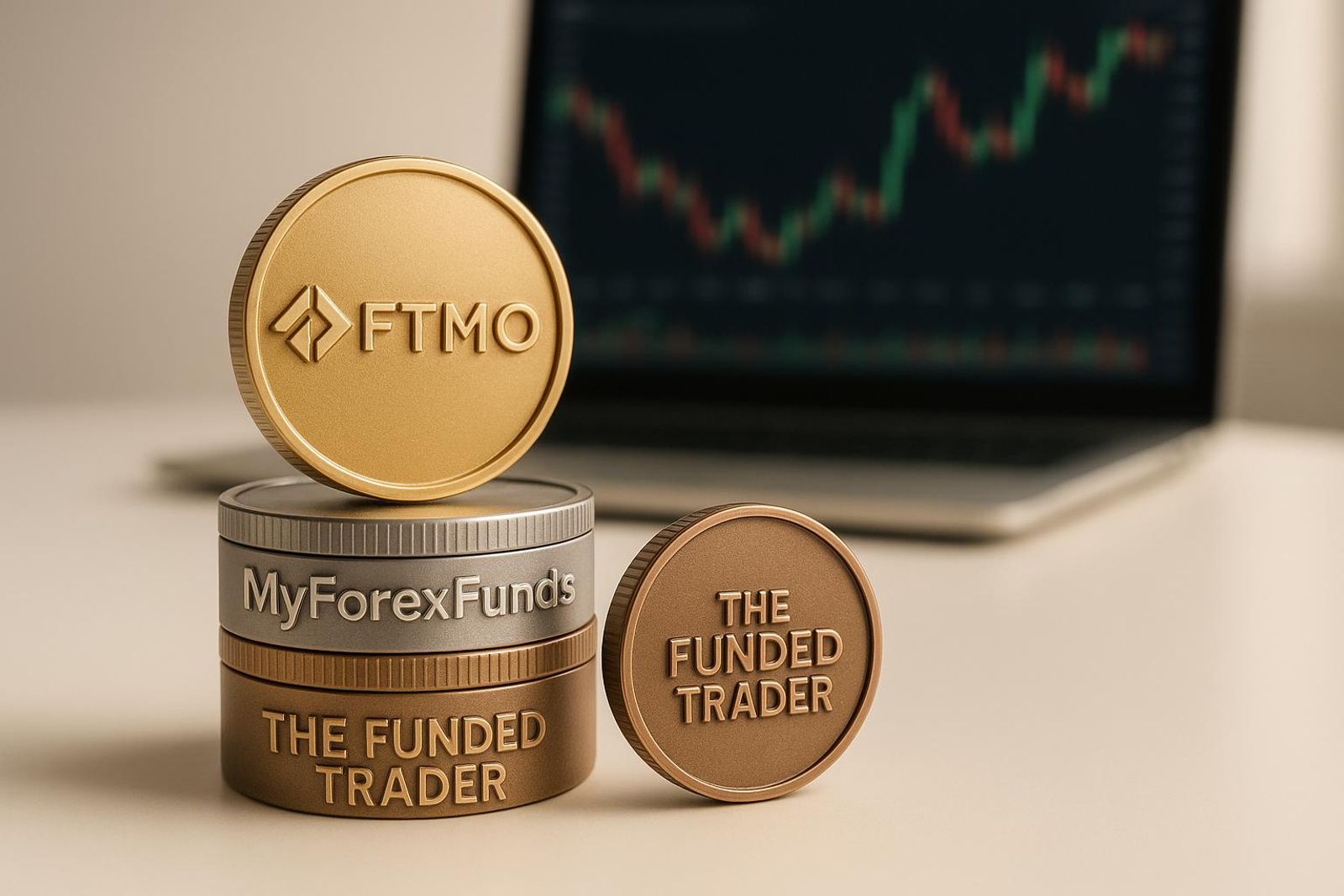
FTMO vs MyForexFunds vs The Funded Trader: Which Pays More?
FTMO profit split in 2026: 80% base, up to 90% on the scaling plan. Payout frequency, fee refunds, real take-home on $100k — and who now pays faster.
By Marcel Hambálek · Senior Trader, For Traders
FTMO's standard profit split is 80% of simulated profits, rising to 90% once you hit the Scaling Plan, with payouts available on a bi-weekly cycle and on-demand after the first reward. MyForexFunds has not operated since the CFTC's August 2023 action against Traders Global Group; The Funded Trader relaunched after its 2024 payout backlog and now advertises splits up to 90%. On a $100,000 account with $5,000 in simulated profit, FTMO pays roughly $4,000 plus your refunded evaluation fee on the first payout.
Key takeaways
- FTMO pays 80% of simulated profits as standard and 90% once the Scaling Plan triggers, alongside a 25% account balance increase.
- Payouts run on a bi-weekly cycle by default, can be moved on-demand after your first reward, and typically process within one to two business days once approved.
- Your FTMO evaluation fee is refunded with the first payout — that refund is worth more than a few percentage points of split on small accounts.
- MyForexFunds has not been an active option since the August 2023 CFTC action; any comparison page still quoting its 75–85% split is out of date.
- The Funded Trader is trading again post-relaunch with splits advertised up to 90%, but the 2024 backlog is a legitimate reason to weight payout history alongside percentage.
- Several firms — For Traders, Breakout, OFP, BluFX — now beat FTMO on entry price or payout cadence; the headline split is rarely the number that decides your take-home.
Watch: related video
FTMO profit split, payouts and fees at a glance (2026)
The FTMO profit split starts at 80% of simulated profits and moves to 90% on the Scaling Plan; The Funded Trader now advertises up to 90% as well, while MyForexFunds hasn't processed a payout since the CFTC shut down its parent, Traders Global Group, in August 2023. That single sentence is why "profit split" alone can't be your decision metric — you need entry fee, refund policy, and payout cadence sitting next to it.
The one-table comparison
| Firm | Split range | Max split | Entry fee (100K) | Fee refunded? | Payout frequency | Processing time | 2026 status |
|---|---|---|---|---|---|---|---|
| FTMO | 80% standard | 90% (Scaling Plan) | ~$540 | Yes, on first payout | Bi-weekly, then on-demand | 24–48h typical | Active |
| MyForexFunds | 75–85% (historic) | 85% | N/A | N/A | N/A | N/A | Not operating (CFTC action, Aug 2023) |
| The Funded Trader | 80–90% | 90% | ~$500 (varies) | Yes, conditional | Bi-weekly | 1–5 days reported | Relaunched post-2024 backlog |
| For Traders | Up to 90% | 90% | Varies by challenge type | Yes, on eligible plans | Bi-weekly, on-demand after first reward | Fast-track processing | Active |
How to read the numbers
A 90% headline split means nothing if the firm sits on your first payout for three weeks or trims it through a rule technicality you didn't catch in the fine print. The real gap between the FTMO payout percentage and, say, the funded trader profit split isn't the 5–10 percentage points you see on the pricing page — it's whether your evaluation fee comes back to you, and how fast the first reward actually clears once you're eligible.
Fee refunds matter more than they look on paper. FTMO refunds your entry fee on your first payout, which on a standard 80% split effectively pushes your realized take well past what a firm offering 85% with no refund policy would net you. Run the math on a $5,000 simulated profit before you sign up anywhere — a $540 refund is real money in your pocket that a bare split percentage doesn't capture.
Rule strictness is the other silent variable in any prop firm profit split comparison for 2026. Daily loss limits, consistency rules, and news-trading restrictions decide whether you ever collect a payout at all — a 90% split you never reach is worth less than an 80% split you clear on schedule. Compare max drawdown rules and first-payout eligibility windows with the same scrutiny you'd give the split itself.
Terms checked August 2026 — prop firm fee structures and split percentages change without much notice, so confirm current numbers on each firm's official terms page before you pay for a challenge. All figures above refer to simulated capital and performance rewards; no real-money trading profits are generated during an evaluation.
What is FTMO's profit split, and how the Scaling Plan takes you to 90%
FTMO's standard profit split is 80% of simulated profits to you, 20% retained by the firm — this is the base rate on every FTMO Account from your first payout request. Hit the Scaling Plan and that split climbs to 90%, with your simulated account balance growing 25% on top. It's not automatic, and it's not immediate — here's exactly how it works.
The 80% base split explained
Pass your evaluation, get funded, and 80% is what you keep on every payout cycle from day one. On a $100,000 account with $5,000 in simulated profit, that's $4,000 in performance rewards to you, $1,000 to FTMO. No tiers to unlock, no volume thresholds — 80% is the floor, not a promo rate that decays. Most traders comparing prop firms fixate on the headline 90% number and miss that the 80% base is already competitive against firms advertising lower starting splits with harder scaling requirements bolted on.
Scaling Plan: the 90% trigger and the 25% balance increase
The FTMO Scaling Plan rewards consistency, not a single lucky month. Deliver sustained profitability across FTMO's defined review period — profitable trading in four out of the trailing eight payout cycles, broadly speaking — and two things happen at once: your simulated account balance increases by 25%, and your split moves to 90%. Trade a $100,000 account well over that window and you could be trading $125,000 at a 90% split instead of $100,000 at 80%. That's the compounding mechanic that separates traders who treat funded accounts as a one-off test from those building it as a repeatable income stream. It rewards the same discipline that got you through the evaluation in the first place — no revenge trading, no oversized lots after a red week, just repeatable process.
What the split does not cover
The 80% or 90% split applies to net simulated profit at the point of your payout request — not to peak equity you touched intraday and gave back. If you were up $8,000 mid-month and closed at $5,000 net, your split is calculated on $5,000, not $8,000. Swaps and commissions are already netted into your account balance before the split is applied, so there's no separate deduction line hiding after the fact — what you see in your simulated balance is what the percentage is calculated against. This is the detail that trips up traders reading FTMO's terms too fast: 90% isn't a starting condition you negotiate for, it's a milestone you earn through the Scaling Plan's review period. Walk in expecting 90% on account one and you'll be comparing yourself to a number that doesn't apply yet.
FTMO payout frequency, schedule and how fast money actually lands
FTMO's default payout schedule is bi-weekly — you can request a payout every 14 days from your first trading day, and once you've collected your first reward, you can switch to an on-demand payout schedule and request whenever you like. The number that actually matters isn't the split percentage, it's the gap between request date and funds in your account, and that's where the three firms diverge harder than their marketing pages suggest.
The bi-weekly cycle and on-demand payouts
Every FTMO Challenge starts you on the standard bi-weekly payout schedule tied to your funded account's activation date. Hit day 14, request your payout, and FTMO's team reviews it against your trading activity before releasing funds. After your first successful payout clears, FTMO unlocks on-demand payouts — you can request the moment you're sitting on simulated profit, no more waiting out the two-week clock. This is a meaningful edge if you're trading a strategy that front-loads gains early in a cycle; you're not sitting on unrealized reward waiting for a calendar date.
First payout eligibility and KYC
The first payout is where traders lose time they didn't plan for. FTMO requires a minimum number of active trading days on the funded account before the first request is even eligible, and — separately — full KYC verification (ID, proof of address, sometimes a liveness check) has to be completed and approved before any payout processes. If you haven't done KYC during your Challenge or verification phase, budget an extra few business days for document review before your first payout even enters the approval queue. Traders who complete KYC on day one of funding routinely get paid faster than traders who wait until they've already got a reward request sitting in the system.
Withdrawal methods and processing time
FTMO pays via bank transfer, Skrill, and crypto rails; The Funded Trader offers a similar spread. Processing time is driven far more by the withdrawal method than by which firm you're with — crypto and Skrill tend to clear in hours to a couple of days, while bank wires can take three to five business days depending on your bank's own processing, not the prop firm's.
| Withdrawal method | Typical processing time | Notes |
|---|---|---|
| Crypto (USDT/BTC) | A few hours to 1 business day | Fastest rail across all three firms |
| Skrill | 1–2 business days | Widely supported, low friction |
| Bank transfer | 3–5 business days | Bottleneck is usually your bank, not the firm |
Run the math before you get seduced by a headline split. A 90% profit share that arrives three weeks late because KYC wasn't sorted or you're waiting on a slow bank wire is worth less to a trader compounding capital than an 80% share that lands in 48 hours. Speed of capital recycling is its own edge — factor it into any ftmo profit split comparison, not just the percentage on the page.
FTMO funded account price by size — and whether the fee is really refunded
The FTMO Challenge runs roughly €149 to €1,000+ depending on account size, and the fee comes back to you as part of your first payout if you pass — making a successful evaluation effectively free, and a failed one the full sticker price. That refund mechanic is the single most misunderstood line item in every "ftmo challenge cost" search, so let's get the numbers straight before comparing splits.
The fee ladder: $10k to $200k
FTMO prices its evaluation in USD and EUR tiers that scale with account size, not linearly — the jump from $100k to $200k costs proportionally less per dollar of buying power than the jump from $10k to $25k. That's the same curve you'll see across most two-step challenge providers, including our own Two-Step Challenge pricing.
Normal and Aggressive
FTMO's Normal and Aggressive challenge modes sit at roughly the same entry fee per account size — Aggressive doesn't cost more, it just doubles the profit target and the daily/max loss limits. You're buying more room to move, not a cheaper ticket. A trader running a tight, mechanical system with small stops usually gets more value from Normal; someone trading wider swings on XAUUSD or NSDQ futures with room for a deeper pullback often prefers Aggressive's extra drawdown cushion, accepting the steeper target in exchange.
| Account size | Normal fee (approx.) | Aggressive fee (approx.) | Cost per $1,000 simulated capital |
|---|---|---|---|
| $10,000 | €/$ ~155 | ~155 | ~$15.50 |
| $25,000 | ~250 | ~250 | ~$10.00 |
| $50,000 | ~345 | ~345 | ~$6.90 |
| $100,000 | ~540 | ~540 | ~$5.40 |
| $200,000 | ~1,080 | ~1,080 | ~$5.40 |
Notice the cost-per-$1,000 column flattens out above $50k — that's where the ftmo funded account price starts making more sense per unit of simulated capital than the small accounts do. If you're deciding between ftmo account sizes on a tight budget, the $10k tier looks cheap in absolute terms but is actually the most expensive way to buy buying power.
How the evaluation fee refund works
Pass both phases, get funded, and take your first withdrawal — FTMO adds your original evaluation fee to that first payout. Run the math from the intro: on a $100,000 account with $5,000 in simulated profit, you're paid roughly $4,000 (80% split) plus the ~$540 fee back, so the challenge itself cost you nothing net. Fail the evaluation, and there's no refund — the fee is gone, full stop. This is the real risk calculus behind any prop firm entry fee: you're not paying for a guaranteed outcome, you're buying a shot with asymmetric downside limited to the ticket price.
Cost per $1,000 of simulated capital
Add-ons don't play by the same rules. Extras like additional leverage, a lower profit split trade-off, or reset fees after a breached daily loss limit are typically not refunded on the same terms as the base evaluation fee — some resets discount against your next attempt rather than returning cash. Read the refund policy on the specific add-on before you assume the whole checkout total comes back on your first reward.
What actually happened to MyForexFunds
MyForexFunds is not an active prop firm, and no comparison table should list it next to FTMO as a live option. In August 2023, the CFTC filed an action against Traders Global Group Inc., the company operating as MyForexFunds, and the firm's payment processors froze operations almost immediately. If you're still asking "is MyForexFunds still active," the plain answer is no — and that closure is the single most important data point in any conversation about who pays more.
The August 2023 CFTC action against Traders Global Group
The CFTC's complaint alleged that Traders Global Group Inc. misrepresented how customer funds were handled and how simulated trading capital was actually deployed. Within days of the filing, MyForexFunds lost access to the payment rails it needed to process trader payouts, and the firm publicly stated it could no longer serve customers. The case has continued moving through the US court system since 2023, and outcomes in enforcement litigation can change — asset freezes get modified, settlements get reached, appeals get filed. If you're researching this for due diligence rather than nostalgia, check the CFTC's public docket directly rather than trusting the summary on any comparison page, including this one.
What MyForexFunds' profit split was
Before the shutdown, the MyForexFunds profit split was one of the more aggressive in the industry — a tiered structure starting at 75% and climbing to 85% for traders who scaled up, with payouts processed bi-weekly. In the my forex funds vs FTMO comparisons that circulated in 2022 and early 2023, that tiered split was the headline argument for choosing MyForexFunds: a slightly better cut than FTMO's standard terms at the time, on a faster cycle. Plenty of traders passed evaluations and got paid on those terms right up until the CFTC action froze everything.
What traders should take from it when judging any firm
A profit split percentage tells you nothing about whether you'll ever collect it. MyForexFunds offered a split that looked competitive against FTMO on paper, and traders who'd been paid reliably for months had no way of knowing a regulatory action would halt operations within days. The lesson isn't "avoid high splits" — it's that split percentage, payout cadence, and firm survivability are three separate variables, and only one of them shows up in a marketing headline.
- Check how long the firm has operated and whether it discloses its corporate entity clearly — Traders Global Group's structure became relevant only after the shutdown, when it was too late for traders holding open payouts.
- Look for a public payout track record, not just a stated split — a firm can advertise 85% and still fail to move money if its banking relationships are shaky.
- Treat any prop firm shutdown as a reminder that simulated capital and performance rewards depend entirely on the firm staying solvent and compliant, not on the number in its pricing table.
This is history worth knowing, not a live recommendation — weigh current firms on stability and payout record first, split percentage second.
The Funded Trader in 2026: split, payouts and the backlog question
The Funded Trader currently advertises a profit split of up to 90% on select account tiers, with payout cadence restored to a stated bi-weekly schedule after its 2024 restructure — but the firm's payout backlog from that year is recent enough that it should shape how much size you put on the table first. Weighing FTMO vs MyForexFunds vs The Funded Trader means putting operational history next to the numbers, not just comparing split percentages in isolation.
Current split tiers and entry costs
The Funded Trader profit split structure is tiered by account type and phase. Entry-level splits typically start around 80%, with the higher 90% tier available on specific programmes once you've cleared evaluation and, in some cases, after a scaling milestone — similar in spirit to how FTMO's Scaling Plan lifts its own split from 80% to 90%. Entry costs vary by account size and by whether you're running a one-step or two-step evaluation, so check the live pricing page rather than relying on cached figures — prop firm fee structures shift quarterly, and a number that was accurate in Q1 can be stale by Q3.
Payout cadence post-relaunch
The Funded Trader payout cadence, as stated post-relaunch, runs on a bi-weekly cycle for most funded traders, moving toward faster or on-demand options at higher account tiers or after a track record of clean withdrawals — again, a structure that echoes what FTMO offers after your first successful payout. The key word is stated: cadence on a terms page is a policy, not a guarantee, and the only way to know it's holding is to check community payout proof threads dated within the last one to two months before you fund a larger account.
The 2024 payout backlog, honestly
In 2024, The Funded Trader ran into a payout backlog serious enough to trigger a pause in new challenge sales while it worked through the queue. That's not a rumor to wave away — it happened, it affected real traders waiting on real payout requests, and it's exactly the kind of event this comparison exists to flag rather than bury. The firm relaunched under revised terms afterward, with adjustments to how payouts are processed and, by most accounts, tighter controls on the funding pipeline that fed the backlog in the first place.
What changed operationally matters more than the apology. Before funding anything beyond a small account, verify three things directly on the firm's current terms page: the live payout cadence as written today, a payout proof cadence you can cross-check against trader communities (not just marketing testimonials), and support responsiveness — send a real question through their ticket system before you pay for an evaluation, and time the reply. The Funded Trader relaunch may well have fixed the structural issue that caused 2024's delays. But "may well have" is a reason to start on a smaller account size and scale your simulated capital as your own payout history with them builds, not a reason to skip the homework.
Worked example: $100,000 account, $5,000 simulated profit — what you actually keep
On a $100,000 account with $5,000 in simulated profit, the split percentage decides your gross reward — but the fee refund on your first payout decides who actually wins the comparison. Run the same $5,000 through FTMO, The Funded Trader, and For Traders, and the gap between an 80% and a 90% split shrinks fast once you account for what you got back on day one.
FTMO at 80% and at 90%
FTMO's standard split is 80% of simulated profit. On $5,000, that's a $4,000 reward. Hit the Scaling Plan and the split moves to 90%, turning the same $5,000 into $4,500 — a $500 gap for otherwise identical trading. But FTMO also refunds your evaluation fee (roughly $540 on a standard $100,000 challenge) on your first successful payout. Add that back and the 80% trader nets $4,540 on their first cycle; the 90% trader nets $5,040. The $500 split gap is real — but it's smaller than the refund itself.
The Funded Trader and For Traders side by side
The Funded Trader advertises splits up to 90% post-relaunch, which on $5,000 works out to the same $4,500 gross reward as FTMO's scaled tier. Its typical $100,000 evaluation fee runs close to $499, so a first-payout refund lands the trader around $4,999 net — competitive on paper. For Traders runs an 80% standard split with a lower entry fee near $437 on a comparable $100,000 challenge, netting roughly $4,437 on the same $5,000 in simulated profit once the fee refund lands. None of these numbers move the needle on their own — the profit split calculation only tells half the story.
| Firm | Split | Entry Fee (approx.) | Gross Reward | Fee Refund (1st payout) | Net First-Payout Cash |
|---|---|---|---|---|---|
| FTMO (standard) | 80% | $540 | $4,000 | $540 | $4,540 |
| FTMO (Scaling Plan) | 90% | $540 | $4,500 | $540 | $5,040 |
| The Funded Trader | up to 90% | $499 | $4,500 | $499 | $4,999 |
| For Traders | 80% | $437 | $4,000 | $437 | $4,437 |
Days-to-cash, not just dollars
A bigger number sitting in a request queue for three weeks isn't worth more than a smaller number that clears in three days — your prop firm take home pay has a time value too. FTMO runs a bi-weekly cycle for the first request and moves to on-demand payouts after that, so plan on roughly 14 days for cycle one. The Funded Trader's 2024 backlog pushed some requests well past that window before the relaunch, so verify current turnaround with a live support ticket rather than the marketing page. For Traders processes most verified payout requests within a few business days once documentation clears — ask any firm for their actual median, not their best-case claim, before you commit capital to an evaluation.
The number most comparison pages skip: on a first $100,000 funded account payout, a refunded evaluation fee can be worth more than the entire dollar gap between an 80% and a 90% split. Judge the whole cycle, not just the headline percentage.
Ready to trade funded capital?
Choose your path — Instant Accounts, One-Step or Two-Step Challenges — from just $23, with up to $300,000 in funded capital.
Choose your challengeWho's beating FTMO on payout speed and profit splits in 2026
On split alone, several firms now match or beat FTMO's 80-90%; on payout speed and entry cost, the field has genuinely opened up. If you're screening ftmo alternatives 2026, the honest answer is that no single firm wins on every axis — you're trading off entry price, split, cadence, and rule strictness depending on what you actually need from a funded account.
For Traders — lowest entry, fast reward cycle, multi-asset
Challenges start at $23, scaling up to $300,000 in simulated funded capital, with both One-Step and Two-Step Challenge routes depending on how much evaluation friction you want to trade for a cheaper entry. If you'd rather skip the evaluation phase entirely, Instant Funding gets you into a funded account immediately at a higher entry price — a straight trade of cash for time. Coverage spans XAUUSD, US100/NSDQ index CFDs, and CME futures, so gold and index traders aren't bolted on as an afterthought. What we don't do: we're not the biggest name in the room yet, and our trading-day track record is shorter than FTMO's — worth knowing before you judge us purely on price.
Breakout vs FTMO, OFP vs FTMO and BluFX compared
Breakout leans on a subscription-style model for repeat evaluations, which lowers the cost of retrying after a bust but adds a recurring fee if you're slow to pass. OFP prices its instant-funding tier aggressively but pairs it with tighter daily loss rules than most Two-Step programs, so the cost saving comes with less room for a bad day. BluFX splits differently — a flat monthly subscription rather than a one-off challenge fee — which suits traders who plan to run the evaluation multiple times but adds up if you clear it on the first try.
| Firm | Typical split | Entry model | Payout cadence | Trade-off |
|---|---|---|---|---|
| FTMO | 80% → 90% scaled | One-off challenge fee | Bi-weekly, then on-demand | Higher entry, longest track record |
| For Traders | Up to 90% | From $23; Instant Funding available | Fast reward cycle | Shorter history, less brand scale |
| Breakout | Up to 90% | Subscription-style retries | Varies by tier | Recurring fee if retries drag |
| OFP | Up to 85% | Aggressive instant-funding pricing | Standard cycle | Tighter daily loss limits |
| BluFX | Up to 85% | Flat monthly subscription | Standard cycle | Costs more if passed quickly |
Where FTMO still wins
Scale, trading-day history, and a payout record long enough to be boring — that's FTMO's actual edge, not the split percentage everyone quotes. When a firm has been paying out for years across hundreds of thousands of accounts, "boring" is the highest compliment a prop firm can earn. If your priority is the deepest evidence trail before you commit simulated capital, FTMO's longevity is hard to argue with — the alternatives above compete hardest on price and speed, not tenure.
The rules that eat your payout before the split ever matters
A 90% split on a rule set you keep breaching pays you nothing. An 80% split on a rule set you can actually trade around pays you every cycle. The profit split is the number every prop firm markets — the consistency rule, daily loss limit, and maximum drawdown definition are the numbers that decide whether you ever see that split. Traders comparing FTMO, The Funded Trader, and whatever replaces MyForexFunds usually anchor on the headline percentage and skip the clause that actually gates the payout.
Here's the practical order of operations: your account has to survive the drawdown rule, hit the profit target, and satisfy the consistency rule — in that order, every evaluation cycle, before the split percentage does anything at all. Get the rule set wrong for your style and a 90% headline is worse than an 80% one you can actually pass.
Consistency rules and how they cap a good month
A consistency rule caps how much of your total profit can come from a single day — commonly 20–40% of the cumulative gain, depending on the firm and account type. Say you're up $4,000 for the evaluation and one clean NFP scalp nets $1,800 of that in a single session. If the cap sits at 30%, you've just blown past it on one trade, and that payout gets flagged for manual review or withheld outright — even though you passed every other rule cleanly. The fix isn't avoiding good trades; it's sizing news plays so no single session can carry the whole month, and checking the exact consistency percentage before you scale into a high-conviction setup near month-end.
Daily loss limit vs maximum drawdown
These two rules fail you on completely different timelines. The daily loss limit resets every session and kills fast — one bad Friday with oversized lots can end an evaluation in an hour. Maximum drawdown is the slow death: a ceiling on total account decline from peak or starting balance that accumulates across weeks of mediocre trading, not one blowup. A trader who never touches the daily limit can still get closed out by grinding maximum drawdown down 2% at a time over a month of chop.
Trailing vs static drawdown
Trailing drawdown vs static drawdown is the distinction that surprises the most funded traders after the fact. Static drawdown is anchored to your starting balance — a $100,000 account with a 10% static max always fails at $90,000, full stop. Trailing drawdown follows your equity highs upward, so if you grow the account to $106,000 and it trails by 10%, your floor has now risen to roughly $95,400. Trail too aggressively after a hot streak and you can breach a rule that didn't exist when you opened the trade.
| Rule | Resets? | Danger speed | What it protects against |
|---|---|---|---|
| Daily loss limit | Yes, every session | Fast | Revenge trading, oversized single-day risk |
| Maximum drawdown (static) | No | Slow | Cumulative bleed from starting balance |
| Maximum drawdown (trailing) | No, follows equity highs | Slow, then sudden after a hot streak | Giving back gains after a strong run |
| Consistency rule | Per evaluation cycle | Silent — only surfaces at payout | One lucky trade carrying the whole target |
Size to the drawdown type, not the account size. A $200,000 static-drawdown account and a $50,000 trailing-drawdown account can demand near-identical risk discipline depending on how far price has run. Read the consistency clause and the drawdown definition in the prop firm rules before you ever compare split percentages — that's the part that decides whether the split is real money or a number you never collect.
FTMO profit split and payouts: pros and cons
Pros
- 80% base split rising to 90% on the Scaling Plan, with a 25% simulated balance increase attached
- Evaluation fee refunded with the first payout, making a passed challenge effectively free to enter
- Long, public payout history and enough scale that operational risk is low relative to newer firms
- On-demand payout option available after the first reward, plus multiple withdrawal rails
- Clear, well-documented rule set with static maximum drawdown rather than trailing
Cons / risks
- Entry fees are among the higher in the market before the refund lands, and resets add up
- 90% is a milestone, not a starting split — most traders never reach the Scaling Plan
- First payout requires minimum trading days plus completed KYC, so cash is slower than the cycle suggests
- Restrictions and limitations apply to clients in certain jurisdictions, including US clients
- Bi-weekly default cadence is slower than several 2026 competitors offering same-week or on-demand rewards
Ready to trade funded capital?
Choose your path — Instant Accounts, One-Step or Two-Step Challenges — from just $23, with up to $300,000 in funded capital.
Choose your challengeFrequently Asked Questions
What is FTMO's profit split in 2026?+
FTMO starts every funded trader at an 80% profit split, with the trader keeping 80% of simulated profits and FTMO retaining 20%. Its scaling plan raises the split to 90% after two consecutive profitable payout cycles, alongside account size increases. There's no extra fee to unlock the higher split — it's automatic once you hit the consistency and profitability thresholds. Compare that to firms whose 90% splits are marketing headlines but come with tighter consistency rules or capped payout amounts that claw the number back down in practice.
How often does FTMO pay out and how long does it take?+
FTMO runs on a 14-day payout cycle for your first request, then switches to on-demand payouts you can request anytime after that. Processing is typically fast — most payout requests are reviewed and released within 24 hours once approved, though weekends and high volume can push it slightly longer. There's no minimum profit threshold to request a payout, which sets it apart from firms that batch payouts monthly or require you to hit a floor before cashing out.
What was MyForexFunds' profit split, and is it still operating?+
MyForexFunds advertised profit splits up to 85%, scaling with account performance, before the CFTC and SEC shut the firm down in 2023 over fraud allegations tied to how client funds were handled. MyForexFunds is not operating today, and any site or app still using the name is not affiliated with the original entity. This is the cautionary tale in prop trading comparisons — a headline split means nothing if the firm can't reliably pay out or stay in business.
What profit split does The Funded Trader offer now?+
The Funded Trader currently offers profit splits ranging from 80% up to 90% depending on the challenge type and scaling tier selected. In 2024 the firm hit a well-documented payout backlog that delayed trader withdrawals for weeks, which forced a restructuring of its payout terms and internal processing capacity. Traders evaluating The Funded Trader today should check current payout processing times directly, since headline split percentages recovered faster than trust in payout reliability did.
On a $100k account with $5,000 profit, what do you actually get?+
At FTMO's 80% split you'd keep $4,000 of that $5,000, rising to $4,500 once you scale to 90%. The Funded Trader's 80-90% range lands in the same ballpark, $4,000-$4,500, assuming no payout delays. MyForexFunds isn't a live comparison point since it no longer operates. The real gap between firms shows up not in this math but in how fast that money actually lands in your account and whether daily loss or consistency rules block the payout in the first place.
How much does an FTMO account cost and is the fee refunded?+
FTMO evaluation fees scale with account size, running roughly from under $100 for a $10k account up to several hundred dollars for a $200k account. The fee is refunded in full with your first payout once you're funded and request a withdrawal — it's not a permanent cost if you pass and trade successfully. If you fail the evaluation, the fee is not refunded, which is standard across the industry and why picking a challenge size that matches your risk tolerance matters.
Which firm pays more once fees and payout speed are factored in?+
No single firm wins on every metric — FTMO leads on payout speed and track record, The Funded Trader competes on split percentage, and newer entrants like For Traders combine competitive splits with faster evaluation structures and fee-refund policies. The headline percentage only tells part of the story; a 90% split that takes six weeks to process pays you less in practical terms than an 80% split paid in 24 hours. Judge firms on total payout received per month, not the split alone.
Who is beating FTMO on payout speed and profit splits?+
For Traders, Breakout, OFP, BluFX, and Fill88 all compete directly with FTMO on speed and split structure, each with different tradeoffs. For Traders offers competitive performance rewards splits with fast payout processing and transparent fee-refund terms on its Challenge products. Some smaller firms match or edge out FTMO's headline split but haven't been tested at FTMO's scale or trader volume, so payout reliability under load is the real differentiator to check before committing capital to any evaluation.
Is FTMO available for traders in the US, Pakistan, India, and MENA?+
FTMO accepts traders from most countries globally, including Pakistan, India, and the broader MENA region, with no restriction based on those locations. US traders can access FTMO's challenges, though as with any prop firm, US-based traders should check current regional terms since compliance rules shift periodically. Country availability is one of the practical filters worth checking before you pay for any evaluation — a great profit split doesn't matter if the firm doesn't onboard traders from your region.
Written by
Marcel Hambálek
Senior Trader, For Traders
Marcel trades Futures and Forex day-trading setups on funded accounts and writes about the executional details most traders skip — order types, slippage, session timing, platform quirks on MT5 and NinjaTrader. Pragmatic, mechanics-first, no fluff.
Follow on LinkedInReady to trade funded capital?
Choose your path — Instant Accounts, One-Step or Two-Step Challenges — from just $49, with up to $300,000 in funded capital.
Choose your challengeRelated Blog Posts
Trade up to $300,000
Choose challenge