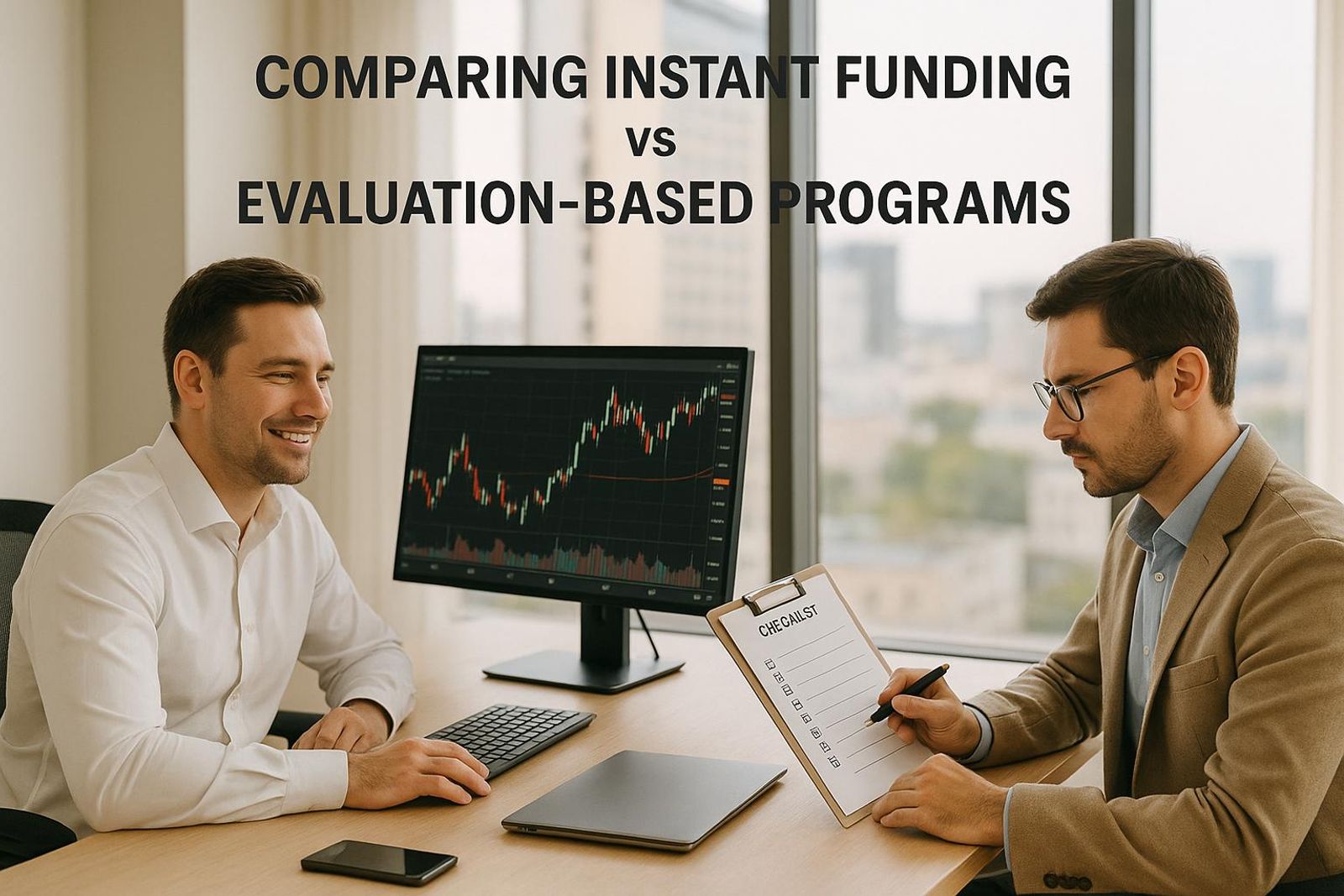
Comparing Instant Funding vs Evaluation-Based Programs
Instant funding vs evaluation, compared on real numbers: cost per $100k, drawdown type, pass rates, time to first payout, plus a decision matrix by trader type.
By Marcel Hambálek · Senior Trader, For Traders
An "eval" (evaluation) in trading is a paid test on a simulated account where you must hit a profit target without breaching drawdown rules to earn a simulated funded account. Instant funding skips that test — you pay a higher fee and trade simulated capital from day one, usually under tighter risk limits.
Key takeaways
- "Eval" is futures-prop shorthand for what forex prop firms call a challenge — both are paid tests on simulated capital, not real money.
- Evaluations cost less upfront but you pay again on resets; instant funding costs more per $100k of simulated capital but removes the target-hitting stage.
- Instant funding almost always runs tighter risk parameters — trailing drawdown, lower daily loss limits and stricter consistency rules are the trade-off for speed.
- Most accounts die in phase one, and the usual cause is position size, not strategy — the traders who clear evals risk a fraction of what the rules allow.
- Time to first performance reward is driven by minimum trading days plus the payout cycle, not by how fast you hit the target.
- Choose instant funding only if your edge is already proven and journaled; choose an evaluation if you want the cheapest route to prove consistency first.
Watch: related video
What does "eval" mean in trading?
An eval — short for evaluation — is a paid test on a simulated trading account where you hit a profit target while staying inside drawdown rules, in order to unlock a simulated funded account. That's eval meaning in trading, full stop. No live capital changes hands at any point; you're paying for structured access to a challenge, not buying a market position.
Eval vs funded account: the two-stage structure
Every evaluation-model product runs on two stages, and mixing them up is where most confusion about evals meaning comes from:
- Evaluation account — the test phase. You get a profit target (say 8-10% for a first stage), a max drawdown ceiling, and a daily loss limit. Hit the target without breaching the rules, you move on. Breach a rule, you fail and either buy a reset or start over.
- Simulated funded account — the reward phase. Same simulated capital structure, same risk framework, but now you're eligible for a payout cycle tied to performance rewards on that simulated balance.
The eval vs funded account distinction matters because the rules often loosen slightly post-pass — but the capital is simulated in both stages. That's the part traders coming from spot forex sometimes miss: nothing here is your money or the firm's money sitting in a live market position.
Where the term came from (CME futures prop)
"Eval" isn't a marketing word — it migrated out of the futures prop space, where firms trading products cleared through the CME Group built structured evaluation programs long before retail forex challenges existed. Futures desks called the qualifying phase an "evaluation," and the term stuck as retail multi-asset platforms adopted the same model for forex, gold, indices, and crypto. That's also why you'll hear futures traders say "eval" and forex traders say "challenge" for structurally near-identical products — same two-stage skeleton, different vocabulary depending on which corner of prop trading you came up through.
What you are actually buying when you pay for an eval
The fee buys you an evaluation process — access to a rules-based simulated environment, a target to prove discipline against, and a shot at a payout-eligible simulated funded account if you pass. It is not a deposit, not a stake in a fund, and not a guarantee of anything. You're paying for the infrastructure and the opportunity to demonstrate you can trade within risk parameters that mirror what a real funded desk would demand — nothing more, nothing less.
Instant funding vs evaluation: the numbers side by side
Instant funding costs roughly 2-4x more per $100k of simulated capital than a two-step challenge, but it hands you a live-style account on day one instead of after 10+ trading days of proving it. That's the trade-off in one sentence — speed versus price, with the rulebook staying just as strict either way.
Normalised comparison table
Comparing a $25k one-step challenge to a $200k three-step challenge on sticker price alone is meaningless — you're comparing different amounts of simulated buying power. Normalise everything to a $100k account and the picture gets honest:
| Product | Cost per $100k | Profit target | Max drawdown type | Daily loss limit | Min trading days | Time to first reward | Profit split |
|---|---|---|---|---|---|---|---|
| Instant Funding | Highest of the group | None (no eval phase) | Static, tighter % | Tighter, often fixed $ | None | Immediate — first payout cycle | Lower end of the range |
| One-Step Challenge | Mid-high | Single target, higher | Often trailing | Moderate | Usually none or low | Fast, one pass | Mid range |
| Two-Step Challenge | Mid | Split across two phases, lower each | Static, more forgiving | Moderate | ~5-10 days per phase | Slower, two passes | Higher end |
| Three-Step Challenge | Lowest | Split across three phases, lowest each | Static, most forgiving | Wider | ~5-10 days per phase | Slowest | Highest |
| Futures Sim Eval (CME-linked) | Varies by contract size | Set per contract tier | Trailing, contract-based | Tick-based, tight | Varies | Fast if consistent | Mid-high |
How to read cost per $100k of simulated capital
Cost per $100k is just entry fee ÷ (account size / 100,000). A $500 fee on a $100k account is $500 per $100k. That same $500 fee on a $25k Instant Funding account is $2,000 per $100k — four times the price for the same notional exposure. This is the only fair way to line up an instant funding vs evaluation decision when account sizes and currencies differ across products. Skip this normalisation and you'll compare a cheap three-step $200k challenge against an instant funding $10k account and conclude the wrong one is "expensive."
What the table cannot tell you
A 90% profit split on paper doesn't mean much if the maximum drawdown rule is a trailing 4% that chases every green day downward — you can be sitting on unrealized reward and still get stopped out by your own equity curve. Static drawdown, calculated once from the starting balance, gives you room to breathe; trailing drawdown recalculates the floor as your balance climbs, which is exactly the kind of clause that turns a good trading day into a closed account. This is the piece marketing pages gloss over and the table above can only flag, not fully capture — you have to read the actual rules document for each product before funding it.
Understanding instant funding meaning in practice: it compresses the timeline, not the rulebook. You skip the multi-day proving period, but the daily loss limit and drawdown ceiling are usually tighter, not looser, because the firm is taking on simulated risk from trade one instead of after you've already demonstrated restraint. Whether that trade-off suits you depends on how fast you need capital deployed versus how much room you need to trade your normal size — a decision worth making deliberately, not by default.
Terminology decoder: challenge, evaluation and sim funded futures accounts
The difference between challenge, evaluation, and sim funded futures accounts comes down to which corner of the industry coined the term — futures prop and forex/CFD prop grew up speaking different dialects, and the words don't always map one-to-one. Get the translation wrong and you'll misread a rulebook at the worst possible moment.
Futures-prop language vs forex-prop language
A CME futures evaluation is priced monthly, resets on a recurring cycle, and talks in ticks and contracts. A forex/CFD challenge is usually a one-off fee, priced per account size, and talks in pips and lots. Same underlying idea — pass a test on simulated capital, get a sim funded account — but the vocabulary diverges enough that a forex trader reading a futures rulebook (or vice versa) can misjudge risk limits entirely.
| Futures-prop term | Forex/CFD-prop term | What it means |
|---|---|---|
| Eval | Challenge | Paid test phase on simulated capital |
| Sim funded account | Funded account | Simulated capital you trade after passing |
| Trailing threshold | Max DD (static) | Drawdown ceiling that can move with equity |
| Tick | Pip | Smallest price increment, contract-specific value |
| Contract limit | Lot cap | Maximum position size allowed |
Trailing threshold, static DD and end-of-day DD
This is where the structural gap actually bites. Futures evals commonly use a trailing threshold — the drawdown ceiling ratchets up as your unrealized equity climbs, then locks in place once you hit a set profit buffer. Forex/CFD challenges typically run a static or end-of-day drawdown calculated off your starting balance or daily close, which doesn't move against you intraday the same way. A trailing threshold can quietly tighten around an open position even while you're in profit — read the exact mechanics before you size up on a green trade.
Terms that mean different things on different platforms
"Funded" is the word that trips up the most people. On both sides of the fence — futures and forex/CFD — a sim funded futures account or funded account still runs on simulated capital. Performance rewards are paid out from the firm, not from real client deposits moving through a live market. No prop firm hands you actual brokerage capital during or after the eval; that distinction matters for how you frame the risk to yourself, and it's why we never use the word "broker" to describe this business.
Futures prop is currently the fastest-growing segment on the platform, and that's exactly why this vocabulary gap now matters to traders who've only ever known forex or CFD challenges. As more forex-native traders migrate into CME futures evaluations chasing tighter tick-based costs or contract liquidity, mixing up a static DD with a trailing threshold isn't a semantic slip — it's the kind of misread that busts an account on a trade that would've survived under the other set of rules.
How evaluation-based trader funding actually works, step by step
Evaluation-based funding runs on a fixed sequence: pick your account size, pay the fee, hit a profit target inside drawdown limits over a minimum number of days, then repeat that discipline in a second phase before you touch a first payout. That's the honest answer to how does evaluation-based trader funding work — it's a nine-step process, and skipping steps is exactly what Instant Funding sells instead.
Step 1–3: choose size, pay fee, get credentials
You start by picking an account size — $10K, $50K, $100K, whatever matches your risk appetite and strategy's tick or pip requirements. Then you pay the challenge fee, which scales with size and is refundable on most Two-Step Challenge structures once you pass. Within minutes you get login credentials for a simulated account on your platform of choice — MT5, cTrader, or a futures-specific platform if you're trading CME contracts. No live capital changes hands here. You're trading demo funds against a rulebook, full stop.
Step 4–6: profit target, minimum trading days, rule compliance
Phase one is a simple question: can you make money without blowing up? You're chasing a profit target — commonly 8–10% on a Two-Step Challenge — while respecting a daily loss limit (the cap on how much you can lose in a single session) and a max drawdown (the total ceiling on losses across the whole evaluation, which may be static or trailing). These aren't the same guardrail, and confusing them is how traders who migrate from CFDs into futures evaluations get blindsided.
Most challenges also enforce a minimum trading days requirement — typically 3–5 trading days minimum — so a single lucky trade can't fast-track you. Consistency rules matter here too: firms increasingly flag accounts where one outsized trade drives the majority of gains, because that's not a repeatable edge, it's a lottery ticket. And around high-impact releases like NFP or FOMC, expect either a news-trading restriction or wider required stops — slippage during those windows is real, and rulebooks are written around that reality.
Step 7–9: verification phase, funded account, first payout
Phase two — verification — asks a different question: can you do it again, with less risk on the table? Profit targets here often drop to 4–5%, but the daily loss limit and drawdown rules stay just as strict, sometimes tighter. Pass it, and you receive a funded account: still simulated capital, but now eligible for performance rewards instead of just a pass/fail outcome.
First payout eligibility isn't instant. You'll typically need to trade through at least one full payout cycle — commonly a 14-day or monthly window — before your first reward request clears. This is the detail traders underestimate: the calendar, not your profit target, usually sets your real timeline from purchase to payout. Hit your target in week one and you can still be waiting on the cycle to close.
What instant funding really is — and what you're paying for
Instant funding meaning, in plain terms: you pay one fee and start trading a simulated funded account the same day — no profit target to clear first, no evaluation phase to pass. That's the entire pitch. You skip the test. But you don't skip the risk — the provider just prices it back in somewhere else, and that somewhere else is usually your drawdown room.
No evaluation phase, same simulated capital
A standard Two-Step Challenge has you clear a profit target on simulated capital across two phases before you touch a funded account. Instant funding removes that gate entirely. You're on simulated capital from day one — same instrument access, same XAUUSD and NSDQ liquidity you'd trade in a challenge, just without the qualifying run. That's the whole value proposition for a day trader looking to trade without evaluation hurdles: time-to-market beats everything else.
Why instant funding runs tighter risk parameters
Here's the part providers don't lead with. An evaluation phase does two jobs at once — it filters out traders who'd blow the account anyway, and it makes you pay for your own reset if you fail. Instant funding removes both filters. So the provider compresses the instant funding drawdown ceiling, tightens the daily loss limit, and often layers in stricter consistency rules — capping how much of your total gain can come from a single trading day. You'll also frequently see a lower initial profit split until you've proven a track record, then it steps up. None of this is arbitrary. It's the mechanical offset for skipping the phase that used to weed out the account-blowers before they ever got funded.
Refundable vs non-refundable fee models
The fee itself splits two ways, and it materially changes your effective cost:
- Refundable fee: your activation fee gets credited back once you hit a set profit milestone on the funded account — effectively making the challenge free if you perform. Your real cost is the opportunity cost of capital tied up until that milestone clears.
- Non-refundable fee: you pay once, it's gone regardless of performance — priced lower up front, but there's no clawback if you're profitable. If you fail and want another shot, that's a fresh reset fee, not a discount.
Run the math before you buy: a refundable instant funding fee at a tighter drawdown can still beat a cheap Two-Step Challenge if you're confident in your edge and the milestone is realistic. If your strategy needs room to breathe — wider stops, occasional bigger losing days — the compressed risk parameters on instant funding can disqualify you faster than an evaluation ever would. The premium buys you speed, not slack.
Drawdown mechanics: the silent killer on instant funding accounts
Static max drawdown sets one floor and never moves it; trailing max drawdown drags that floor up every time your equity — or in some cases your closed profit — makes a new high. On paper both look like "don't lose more than X%." In practice, trailing drawdown is what breaches accounts that are still green.
Static vs trailing max drawdown
Take a $100,000 simulated account with a 10% max drawdown, or $10,000. Under a static rule, your floor is fixed at $90,000 for the life of the account — full stop. Grow the balance to $115,000 and you can still draw down to $90,000 before you're out.
Under a trailing rule, that $90,000 floor climbs with you. Push equity to $115,000 and the floor trails up to $105,000. Give back $10,001 from that peak — even while sitting on $105,000 of unrealized gains — and you've triggered a drawdown breach. You can be up $5,000 on the account and still get shut down. That asymmetry is what catches traders who size for the balance instead of the rule.
Intraday vs end-of-day calculation
The other variable that decides whether you survive a pullback is when the platform marks your equity against that floor.
- End-of-day trailing (common on futures evaluations, CME-listed products) checks your equity once at the daily close. A sharp intraday spike against you that recovers by settlement never touches the floor.
- Intraday equity trailing (common on CFD instant funding accounts across forex, gold, and indices) marks every tick. A stop-run on XAUUSD during the London-New York overlap can breach you in real time, then price reverses and closes the day fine — for everyone except you.
| Drawdown type | Floor behavior | Typical use | Where it bites |
|---|---|---|---|
| Static | Fixed from initial balance | Two-Step Challenge, Three-Step Challenge | Large single loss |
| Trailing (EOD) | Follows daily closing equity/profit | Futures evals | Multi-day drawdown streak |
| Trailing (intraday) | Follows live equity tick-by-tick | Instant Funding on CFDs | Intraday spike, even if it closes fine |
Sizing for the rule, not the balance
The fix isn't a tighter stop-loss on principle — it's sizing from the distance between current equity and the drawdown floor, not from the account balance. If your trailing floor sits $2,400 below current equity, that number is your real risk budget, not 1% of $100,000.
- Measure ATR on your instrument (14-period is standard) before setting stop distance.
- Set stops at 1.5-2x ATR from entry — never on the round number, which gets swept first.
- Reduce lot size until the ATR-based stop fits inside your remaining distance-to-floor, factoring in the daily loss limit as a secondary ceiling.
Traders who blow instant funding accounts almost never do it on one bad trade — they do it by sizing for the $100,000 headline instead of the shrinking gap to a floor that's been quietly trailing them upward all week.
Can traders pass evaluations easily? What the pass rates say
No — most traders don't clear a prop firm evaluation, and it's not close. Industry-wide pass rates for two-step challenges sit in the single digits to low teens depending on the firm and the target size. Across For Traders evaluations, the pattern is the same one you'll hear from any serious challenge provider: the market didn't beat these accounts, sizing and psychology did.

Which phase kills most accounts
Phase one is the graveyard. Most accounts that fail do so within the first ten trading sessions — not because the target is unreachable, but because traders front-load risk trying to hit it fast. Once you clear phase one, pass rates on phase two climb noticeably, because the traders left standing have already proven they can size correctly under a drawdown ceiling. The filter isn't the profit target. It's whether you can hold your size steady while your equity curve dips.
The four repeat failure patterns
Look at any batch of busted evaluations and four habits show up over and over:
- Moving the stop. Price gets close, you widen the stop "just a bit," and the loss that should've been 0.5R becomes 2R.
- Revenge trading. A loss triggers a bigger, faster re-entry with no setup behind it — doubling size to "get it back" instead of resetting.
- Trading NFP or FOMC with no plan. Volatility spikes, spreads widen, and traders who had no pre-defined level get chopped up in the first five minutes.
- Racing the target instead of respecting minimum trading days. Traders push size to hit the profit target in three days when the challenge allows twenty, then have nothing left in the drawdown budget when a losing streak hits.
Gold ties into this directly. XAUUSD is the single most-traded instrument on our platform, and its ATR routinely runs several times wider than a major forex pair on any given session. Traders who carry over position sizing from EURUSD or a quiet index leg get punished fast — a stop that felt reasonable on a calmer instrument gets swept by normal gold volatility before the setup even has room to work.
What the traders who clear evals do differently
The minority who pass treat risk per trade as non-negotiable — usually 0.25–1% of account size, sized down further on XAUUSD to account for its wider range. They journal setups before entry, not after the fill, so there's a record of the plan versus what actually happened. And critically, they treat the daily loss limit as a hard stop they respect at 50–60% of the actual rule, not a line they trade right up against. If the limit is $1,000, they're done for the day at $500–600 drawn, well before revenge trading has a chance to turn one bad session into a blown account.
Ready to trade funded capital?
Choose your path — Instant Accounts, One-Step or Two-Step Challenges — from just $23, with up to $300,000 in funded capital.
Choose your challengeCost per pass: what the cheap route actually costs
The cheapest evaluation on paper is rarely the cheapest evaluation in practice — once you factor in resets, a $49 one-step and a $200 instant funding fee can land within a few dollars of each other. The real number you want isn't the entry fee. It's cost per attempt multiplied by the attempts you'll realistically need to pass.
Modelling resets into the true cost
Most challenge providers sell a reset — a discounted re-entry after you breach the daily loss limit or max drawdown — at 50-70% of the original fee. That's the number evaluation pricing pages don't lead with in 2026, and it's the number that decides whether the "cheap" challenge was actually cheap. If a $99 two-step challenge needs one reset at $65, you're at $164 before you've touched a funded account. Needing two resets — which industry pass-rate data suggests is closer to the median than the exception — pushes that same challenge past $250.
One-step vs two-step vs three-step on expected spend
The one-step vs two-step challenge decision usually comes down to speed versus margin for error. One-step programs carry a higher single profit target (often 10%) and tighter drawdown rules, but only one gate to clear — fewer chances to fail, fewer chances to need a reset. Two-step splits the target across two smaller phases (commonly 8% then 5%), giving you more room to breathe but doubling the number of places you can trip. Three-step drops the entry price further and the per-phase target lower still, which is exactly why it attracts traders who expect to need multiple runs at it.
| Model | Entry fee | Reset fee | Attempts to pass (typical) | Expected cost |
|---|---|---|---|---|
| One-step | $150 | $100 | 1.4 | ~$190 |
| Two-step | $99 | $65 | 1.8 | ~$150 |
| Three-step | $59 | $40 | 2.6 | ~$160 |
| Instant Funding | $249 | — | 1 (no eval gate) | $249 |
Notice the three lowest-headline-price rows converge on nearly the same expected spend. That's the trap in comparing best single step evaluation programs by sticker price alone — the model that looks 60% cheaper on the landing page can cost the same once you're honest about attempts.
When instant funding is the cheaper option
The break-even is simple math: divide the instant funding fee by the cost per attempt of the evaluation route. In the table above, instant funding wins outright the moment you need three or more tries at a one-step, or the moment a two-step trader is on their second reset with no funded account yet. If you're genuinely confident you pass on attempt one or two, the evaluation route is cheaper — full stop. If you've reset twice already, needing a third try is telling you something about readiness that a lower entry price won't fix. At that point, paying more upfront for Instant Funding and skipping the gate isn't impatience — it's the rational spend.
Evaluations with realistic profit targets: how to judge "realistic"
The single number that tells you whether a profit target is achievable is target divided by max drawdown — call it the target-to-drawdown ratio. An evaluation with realistic profit targets keeps that ratio at or below roughly 1:1. Anything pushing past 1.5:1 is asking you to run a sustained winning campaign with zero room for a losing streak, which isn't how real trading works.
Target-to-drawdown ratio, the only number that matters
Take an 8% profit target against a 5% max drawdown. That's a 1.6R ask — you need to be up 8% while never dipping more than 5% underwater, meaning your equity curve has to be almost entirely one direction. Compare that to a 10% target with 10% max DD (a 1:1 ratio), which gives you room to eat two or three losing trades before recovering. The lower the ratio, the more the rules let you trade like you actually trade — with drawdowns, pullbacks, and recovery legs — instead of demanding a flawless streak.
| Target | Max DD | Ratio | Read |
|---|---|---|---|
| 8% | 5% | 1.6:1 | Aggressive — near-zero room for losing streaks |
| 10% | 10% | 1:1 | Realistic — standard industry baseline |
| 6% | 8% | 0.75:1 | Generous — favors consistency over home runs |
Time pressure, minimum days and hidden constraints
Ratio alone doesn't tell the full story. Check whether the challenge carries a hard time limit — some cap Phase 1 at 30 days, forcing you to rush setups instead of waiting for your edge to show up. Also check minimum trading days: a rule requiring 10 minimum days across the evaluation is a soft guardrail against one lucky session carrying the whole pass. Look closely at the consistency rule too — if it's percentage-based on your best single day (commonly capping any one day's profit at 20-30% of total gain), it directly restricts swing-for-the-fences trading and rewards a steady drip of smaller wins instead.
Red flags in the rulebook
- Trailing intraday drawdown paired with an aggressive target. If your max DD trails your equity peak intraday rather than resetting daily, and the target still sits above 1.5R, you're being set up to fail on a single bad hour, not a bad week.
- Undisclosed consistency rules. If the best-day cap or lot-size limits aren't published upfront and only surface in a support ticket after you've already breached one, that's a firm hiding the real difficulty of the test.
- News trading restrictions buried in fine print. Many firms restrict trading around NFP and FOMC releases — reasonable given the volatility, but it needs to be stated in the rules, not discovered mid-drawdown when a position gets stopped out on a spike you weren't told to avoid.
- Payout gates that only appear after you pass. Minimum trading days on the funded account, profit splits, or withdrawal minimums that weren't disclosed during the evaluation stage are a sign the marketing target was never the real target.
Run any challenge you're considering through this checklist before you pay the fee — the target-to-drawdown ratio, the time limit, the consistency rule, and the news restrictions. If two or more of the red flags above show up in the same rulebook, the profit target advertised on the landing page isn't the number that actually governs your pass rate.
Instant funding vs evaluation: pros and cons at a glance
Pros
- Instant funding: no profit target to clear before you are payout-eligible
- Instant funding: single fee, no reset spiral, no multi-phase timeline
- Instant funding: fastest realistic route from payment to first performance reward
- Evaluation: lowest entry cost per unit of simulated capital
- Evaluation: often static drawdown, which gives swing and position traders room to breathe
- Evaluation: the structure itself forces the consistency most traders lack
Cons / risks
- Instant funding: higher upfront cost per $100k of simulated capital
- Instant funding: usually trailing drawdown and tighter daily loss limits
- Instant funding: a proven edge is assumed — the account will find out quickly if it isn't there
- Evaluation: high failure rate, and most accounts die in phase one
- Evaluation: reset fees can push true cost above instant funding after three attempts
- Evaluation: minimum trading days plus payout cycle pushes the first reward weeks out
Ready to trade funded capital?
Choose your path — Instant Accounts, One-Step or Two-Step Challenges — from just $23, with up to $300,000 in funded capital.
Choose your challengeFrequently Asked Questions
What does 'eval' mean in trading?+
Eval is trader shorthand for evaluation — the assessment phase you trade through on simulated capital before earning a funded account. The term spread from prop trading firms who structure their programs as one or more graded phases with profit targets, max drawdown limits, and daily loss limits. You're not trading real firm capital yet during the eval; you're proving you can hit targets while respecting risk rules. Pass the eval, and the firm allocates a funded account tied to those same rules.
What is the difference between an eval account and a funded account?+
An eval account is a simulated demo environment used to test whether you can meet profit targets without breaching drawdown rules, while a funded account is what you receive after passing — the stage where your simulated trading results generate real performance rewards. Rules like daily loss limits and max drawdown typically carry over from eval to funded, sometimes loosened slightly. No live capital changes hands at either stage; the funded account still trades on simulated capital, but payouts from your performance become real.
How does evaluation-based trader funding work step by step?+
You pay a fee, get a simulated account with a set balance, and trade it against a profit target while respecting a max drawdown and daily loss limit. Most Two-Step Challenge structures require a smaller target in phase one and a slightly lower one in phase two, each with no strict time limit on most platforms. Pass both phases, submit verification, and the firm issues a funded account. From there, consistent, rule-compliant simulated trading earns you performance rewards through scheduled payouts.
What is instant funding and what are you really paying for?+
Instant Funding skips the evaluation entirely — you pay a fee and get a simulated funded account from day one, no profit target to clear first. What you're paying for is speed and the removal of a pass/fail gate, not lower risk; providers offset that by using tighter drawdown limits, lower initial simulated balances, or higher fees relative to account size. It suits traders confident in their edge who don't want weeks of eval grinding, but the cost-per-dollar-of-capital is usually higher than a Two-Step Challenge.
What's the difference between a challenge, an evaluation, and a sim funded futures account?+
Challenge is the umbrella product name for the paid evaluation process itself, evaluation refers to the graded phase(s) inside that challenge, and a sim funded futures account is the funded stage specific to CME futures instruments traded on simulated capital. Futures programs often use per-contract risk limits and trailing drawdown mechanics instead of the percentage-based rules common in forex/gold challenges. All three terms describe stages of the same funnel — pay, prove, get funded — just with futures-specific mechanics layered on the funded stage.
Can traders pass evaluation-based funding challenges easily?+
No — pass rates across the prop trading industry commonly sit in the single digits to low double digits, and high failure is the norm, not the exception. Most traders who bust an eval do it by oversizing after a drawdown or moving a stop hoping price reverts. Traders who pass tend to under-risk relative to the daily loss limit, treat the profit target as a byproduct of consistency rather than a deadline, and stop trading once they hit a bad day rather than revenge-trading it back.
How can a day trader access funding without an evaluation?+
Instant Funding products let you skip the profit-target phase and start on a simulated funded account immediately after payment, trading live from day one instead of clearing an eval first. The trade-off is usually a smaller initial simulated balance, tighter max drawdown, or a higher fee relative to account size compared to a Two-Step Challenge. It fits day traders and scalpers who want fast market access and are confident enough in a tested strategy to skip the practice run an eval effectively provides.
What's the fastest realistic route from payment to first payout?+
Instant Funding is the fastest route on paper since there's no profit target to clear before the funded stage starts, but the fastest route to an actual payout is still consistent, rule-compliant trading — not the product type. A skilled trader can clear a Two-Step Challenge in days if targets are hit organically across normal trading. Payout timing then depends on the provider's payout schedule (weekly, biweekly) rather than which funding route you chose.
Is an instant funded crypto account better than a crypto evaluation challenge?+
Neither is universally better — it depends on whether you value speed or a lower entry cost relative to account size. Instant Funding on a Crypto Challenge gets you trading crypto futures on simulated capital immediately, useful if you're confident in a tested setup and want to skip the eval grind. A crypto evaluation challenge costs less upfront relative to the simulated balance you can unlock but requires clearing profit targets first. Volatility in crypto makes the max drawdown rule the deciding factor either way.
Written by
Marcel Hambálek
Senior Trader, For Traders
Marcel trades Futures and Forex day-trading setups on funded accounts and writes about the executional details most traders skip — order types, slippage, session timing, platform quirks on MT5 and NinjaTrader. Pragmatic, mechanics-first, no fluff.
Follow on LinkedInReady to trade funded capital?
Choose your path — Instant Accounts, One-Step or Two-Step Challenges — from just $49, with up to $300,000 in funded capital.
Choose your challengeTrade up to $300,000
Choose challenge