5 Benefits of Real-Time Alerts for Traders
Real-time trading notifications explained: the 5 benefits, delivery channels and latency, plus copy-able XAUUSD and US100 alert recipes tied to prop risk limits.
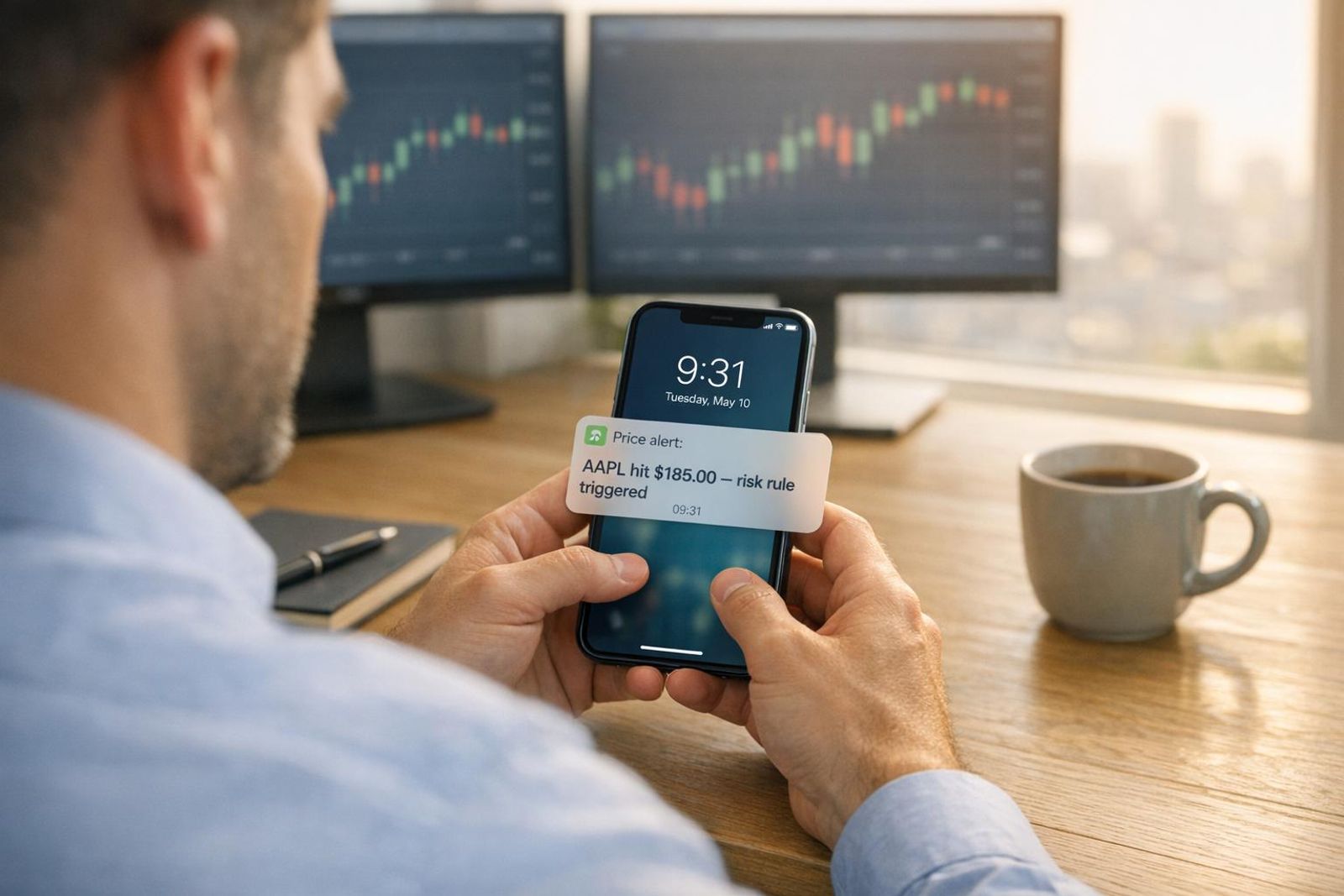
By Lenka Rož Schánová · Operations & Risk, For Traders
Real-time trading notifications are automated messages a platform sends the moment a price, volatility, news or account-level condition you defined is met — delivered in-platform, by mobile push, SMS, email or webhook, typically within 1-15 seconds of the trigger. The five benefits are better risk management, faster decisions, efficient multi-market monitoring, rule compliance and reduced emotional trading.
Key takeaways
- A real-time trading notification differs from a basic price alert because it can fire on multi-condition logic — price plus volume plus volatility — and on account-level data like equity, margin level and drawdown, not just a number on a chart.
- Delivery channel decides whether the alert is useful: in-platform and webhook are near-instant, mobile push is usually 1-5 seconds, SMS and email can lag 10-60 seconds and fail silently.
- The highest-value alerts most traders never set are account-level: 50% and 80% of your daily loss limit, drawdown buffer remaining, margin level below 200%, and unplanned position size.
- Multi-condition filtering — price above VWAP + RVOL above 1.8× + close above resistance — cuts false triggers dramatically compared with a single price-cross alert.
- XAUUSD and US100 need instrument-specific stacks: gold's session gaps and news sensitivity, the index's first-15-minute open volatility and ATR expansion.
- Too many alerts recreates the overtrading they were meant to prevent — cap active alerts per session and delete anything you ignored twice.
Watch: related video
What Real-Time Trading Notifications Actually Are
Real-time trading notifications are automated messages a platform fires the instant a price, volatility, news, or account-level condition you predefined is actually met — pushed to your phone, inbox, or webhook, usually within 1-15 seconds of the trigger. That's the whole mechanism. What separates a serious setup from a basic chart alert is everything wrapped around that trigger: how many conditions it can check at once, what data it's allowed to read, and where it can send the message. The five payoffs you get from getting this right: tighter risk management, faster decisions, efficient multi-market monitoring, better rule compliance, and less emotional trading.
Notification vs ordinary price alert: the three differences
A plain price alert — the kind you set on a basic chart tool — checks one condition, fires once, and dies. Set "XAUUSD crosses 2,410" and that's it: single trigger, single channel, no memory of context. A real-time notification system built for actual trading work differs in three ways:
- Multi-condition logic — combine price with an indicator reading or account state ("gold above 2,410 AND RVOL over 1.5") instead of one lonely trigger.
- Account-level awareness — a real alert can watch your equity, margin level, or open drawdown, not just the chart.
- Multi-channel, repeatable delivery — push, SMS, email, or webhook, with control over whether it fires once, repeats, or expires after a set window.
Platforms like TradingView alerts, MT5 price alerts, and cTrader's notification engine all sit somewhere on this spectrum — TradingView leans strongest on multi-condition and multi-channel logic, while native MT5 alerts are closer to the simple end unless you're running an EA layer on top.
The data a modern alert can read
What you can actually trigger on has expanded a long way past "price touched a line." A capable alert engine evaluates:
- Price data — bid/ask, last traded price, spread.
- Indicator values — VWAP deviation, ATR expansion, RVOL spikes, moving average crosses.
- Account metrics — equity, margin level, open P/L, proximity to your daily loss limit.
- Economic calendar events — NFP, FOMC releases, CPI prints, scheduled minutes before the number even drops.
Stack these and a real-time trading notification stops being a chart toy and starts functioning like a second set of eyes across every instrument and account metric you actually care about.
Latency: what "real-time" means in practice
Be honest with yourself about what "real-time" means: trigger evaluation itself is near-instant — tick-by-tick on price feeds, or per-bar-close if your condition is indicator-based. The delay you feel — that one to fifteen second gap between the market moving and your phone buzzing — is delivery latency, not detection latency. Your broker's feed already saw it; the notification pipeline (server processing, push network, your phone's OS) is what adds the wait. Understanding that distinction matters because it tells you where real-time alerts genuinely replace screen-watching, and where — in a fast-moving breakout — you still need eyes on the chart yourself.
The 5 Key Benefits of Real-Time Trading Alerts
The benefits of real-time alerts for traders come down to five mechanical edges: earlier risk warnings, faster decisions, wider coverage, enforced discipline, and fewer emotion-driven entries. None of these are abstract — each one changes a specific number in your trading, whether that's R multiple, reaction time, or instruments monitored.
1. Risk management: the early-warning layer before the stop
A stop-loss tells you a trade already failed. A risk-off alert tells you it's heading there — while you still have a decision window instead of just a fill notification. Set a price alert at 70% of the distance to your stop, or an ATR-based alert when volatility expands beyond your normal range, and you get a heads-up 30-90 seconds before the stop would trigger. That's alert-based risk management in practice: you can tighten the stop, hedge, or exit manually on your terms rather than getting stopped out at a worse level during a slippage-prone spike. Real-time risk alerts don't replace your stop — they give you a second decision point before it fires.
2. Faster decisions: cutting reaction time from minutes to seconds
Screen-watching means you catch a pullback entry when you happen to glance at the chart — often 15-20 pips late. On a typical 1:2 setup with a 30-pip stop, entering 20 pips late doesn't just cost 20 pips; it compresses your reward-to-risk from 2R to roughly 0.7R, because your stop distance grows while your target stays fixed. A price alert firing the instant the level is tapped closes that gap to seconds, preserving the R multiple the setup was built for.
3. Efficient monitoring: covering more instruments than eyes allow
Watching six instruments manually means splitting attention six ways, which in practice means missing moves on at least two or three of them at any given moment. Running six conditional alerts means each instrument gets checked continuously by the server, not by you. The math is simple: one trader, one set of eyes, versus six always-on conditions running in parallel — that's the real leverage of efficient monitoring across gold, indices, and futures at once.
4. Rule compliance: alerts as an external referee
A 3-5-7 threshold — alert at 3% drawdown, hard warning at 5%, forced review at 7% — turns a soft mental rule into a hard trigger you can't rationalize past. Mapped against a prop firm's daily loss limit, this same structure fires before you get anywhere near breaching it, protecting the evaluation instead of your emotions. Trading discipline stops being a willpower exercise when the alert — not your judgment in the moment — is the one enforcing the line.
5. Reduced emotional trading: the alert decides, not the feeling
The alert is set when you're calm, reading a clean setup with no position on. It fires when you're not calm — mid-trade, adrenaline up. That's the point: you pre-commit the decision while rational, so reduced emotional trading isn't about staying calm under pressure, it's about removing the need to decide anything under pressure at all.
How Platforms Deliver Personalised Real-Time Alerts
Platforms deliver personalised real-time notifications through five main pipes — in-platform pop-up, mobile push, SMS, email, and Telegram bot or webhook — each firing anywhere from under a second to a couple of minutes after your condition triggers. You build the condition once (price cross, volatility spike, drawdown level, margin call threshold), pick your channels, and the system handles delivery. The catch is that no single channel is bulletproof, which is why serious traders tier and duplicate.
Channel comparison: latency, reliability and best use case
| Channel | Typical Latency | Reliability | Best Use Case |
|---|---|---|---|
| In-platform pop-up (TradingView, MetaTrader 5) | <1 second | High only if app is open | Active screen-time monitoring |
| Mobile push alerts trading | 1-5 seconds | Medium — OS-dependent | Primary channel for most traders |
| SMS alerts | 5-60 seconds | Medium — carrier queue delays | Backup for critical, no-data-signal scenarios |
| 10 seconds-several minutes | Low for urgency | End-of-day summaries, non-urgent confirmations | |
| Telegram bot / webhook | <2 seconds | High if endpoint is up | Automation, custom dashboards, multi-account routing |
Where each channel fails silently
The failure modes are boring and that's exactly why they catch people out. Your phone on silent or Do Not Disturb swallows a mobile push without a trace — no error, no retry, just a notification sitting unread while your stop gets tested. Android and iOS battery optimisation routinely kills background apps, so a push alert never even fires. SMS alerts get queued behind carrier traffic during high-volume news windows — the same NFP release that makes the alert urgent is the moment carriers are most congested. Email lands in Promotions or gets caught by a spam filter, especially if you're using a shared inbox. And webhook alerts — the backbone of Telegram bot notifications and most custom trading notifications setups — fail completely silent if the receiving endpoint is down; no bounce message, no retry unless you've built one in.
Building redundancy: pairing two channels per alert tier
Personalisation isn't just picking a channel — it's the condition builder (price, indicator cross, volatility band, account equity), repeat frequency (once, every bar, cooldown period), expiry (session-only, GTC), and message templating with dynamic variables so the alert reads "XAUUSD hit 2,410.50, +1.2% from entry" instead of a generic ping. Once that's dialled in, tier your delivery:
- Informational alerts (watchlist levels, session opens) — one channel is enough. Mobile push or in-platform pop-up.
- Risk-critical alerts (margin call, daily loss limit approaching, stop about to trail) — duplicate across two channels with different failure profiles. Mobile push paired with SMS, or Telegram bot paired with email, so a dead battery or a DND setting doesn't cost you the trade.
The logic is simple: two independent channels rarely fail at the same moment for the same reason.
The Five Alert Types and What You Do When Each Fires
Every real-time price alert you set falls into one of five buckets — price, volatility, volume, risk/account, or news — and each one demands a different next move. Bundling them all as "notifications" is how traders end up either ignoring everything or reacting to noise. Below is the map we use internally when we audit a trader's alert setup during a For Traders evaluation review.
| Alert Category | Example Trigger Condition | Required Next Action |
|---|---|---|
| Price / Level | Price touches or closes through a defined level (support, resistance, prior day high) | Check confluence, then execute or stand down — no discretionary re-drawing of the level |
| Volatility | ATR(14) rises above 1.3× its 20-period average | Widen stops, reduce size, or flag a regime change on higher-timeframe bias |
| Volume | RVOL (relative volume) exceeds 1.8× the 20-day average at that time of day | Confirm the move has participation before trusting the breakout |
| Risk / Account | Daily loss limit at 80%, margin utilization above threshold | Stop trading for the session — non-negotiable, no override |
| News / Calendar | 15 minutes before NFP, FOMC, or CPI release | Flatten or reduce exposure, widen stops, or step away from the screen entirely |
Price and level alerts
These are the baseline of any automated trade alerts system — VWAP reclaim, a prior swing high, a round number that's acted as a magnet three sessions running. The trigger is objective; your job is to have already decided, before the alert fires, exactly what you do when it does. If you're still asking "should I take this?" when the alert pings, the level wasn't specific enough.
Volatility and volume alerts (ATR, RVOL)
ATR expansion — current ATR climbing above 1.3× its 20-period average — is your regime-change flag. It tells you the market you were trading an hour ago isn't the market you're trading now, and your stop distance needs to catch up. RVOL does a different job: it confirms whether a price move has real participation behind it or whether it's a thin, low-conviction poke that reverses the second liquidity dries up. A breakout on 0.6× RVOL is a trap more often than not.
Multi-condition filters that kill false signals
Single-condition alerts generate noise; stacked conditions generate signal. A setup we see work well: price above VWAP, RVOL above 1.8×, and close above resistance — all three, on the bar close, not an intrabar touch. Intrabar wicks get hit constantly and reverse before the candle closes; waiting for confirmation on the close costs you a few ticks of entry but removes the majority of false triggers. Multi-condition alerts are slower by design — that's the point.
News and calendar alerts (NFP, FOMC, CPI)
The economic calendar alert you want isn't a reaction alert — it's a warning shot. Set it 15 minutes before NFP, FOMC, or CPI, not at release. That window gives you time to flatten a position, widen a stop past the spread you know is about to blow out, or simply step back and let the first spike pass before you touch anything.
Real-Time Risk Alerts: The Account-Level Layer Most Traders Skip
A real-time risk alert is tied to your account state, not the market — it fires on equity, margin, or open P&L crossing a line you set, regardless of what price is doing. Most traders wire up market alerts (breakouts, news, price levels) and never touch this layer, which is exactly backwards: the market alert tells you an opportunity exists, the account alert tells you whether you can still afford to take it.
Equity, free margin and margin level thresholds
Three numbers deserve their own alert, separate from any trade-specific notification:
- Margin level below 300% — your first warning tier, well before anything urgent.
- Margin level below 200% — a second, tighter tier that says reduce exposure now, not later.
- Free margin below a fixed cash figure — not a percentage, a hard dollar number, because percentage-based alerts can lag when your equity is swinging fast on a leveraged multi-asset book.
An equity alert set at a hard floor — say, the point where one more losing leg breaches your daily loss limit — does the same job for account size that a margin level alert does for leverage room.
Open P&L and drawdown percentage alerts
Set a drawdown alert for open P&L worse than 1R combined across positions, not per trade. A single position down 0.5R is normal noise; three positions each down 0.5R against you at the same time is a correlated move eating your account, and that's a different decision entirely. This is the alert that catches the "death by a thousand cuts" drawdown that no single trade would have flagged.
Margin call alerts and why they arrive too late
A margin call alert is a last-resort signal, not a management tool — by the time it fires, the platform has effectively made the decision for you. Treat it the way you'd treat a hard stop-out: useful as a backstop, useless as a plan. Build your real warning tiers well above it (the 300%/200% margin level alerts above exist specifically so the margin call notification never has to do any real work).
Compliance and employee-trade surveillance alerts (and why they're different)
The word "alert" covers two very different systems. Institutional desks run platforms offering real-time alerts for employee trades — surveillance tools that flag restricted-list breaches, pre-clearance violations, and personal-account dealing conflicts, feeding compliance teams under frameworks the European Securities and Markets Authority and equivalent regulators require. That's a governance layer, built for firms, not individual risk management.
Prop evaluation rules — daily loss limits, max drawdown caps, consistency rules — sit much closer to the retail side of this divide. They're account-state thresholds you monitor yourself with real-time risk alerts, not a surveillance system watching you from above. Know which system you're actually in before you assume someone else is catching your breaches for you.
Ready to trade funded capital?
Choose your path — Instant Accounts, One-Step or Two-Step Challenges — from just $23, with up to $300,000 in funded capital.
Choose your challengeWiring Alerts to Your Daily Loss Limit and Max Drawdown
Set two alert tiers on your daily loss limit — one at 50% used, one at 80% — and a third alert that recalculates every time your equity makes a new high. This is the single highest-stakes use case for real-time trading notifications, because breaching a hard rule doesn't cost you a bad trade, it costs you the whole For Traders Challenge account.
Run the arithmetic on a $100,000 simulated account with a 5% daily loss limit and a 10% maximum drawdown, the structure most prop firm risk rules follow:
| Tier | Threshold | Dollar Level | Action |
|---|---|---|---|
| Daily loss limit | 100% | $5,000 down | Account breached — day is over |
| Alert tier 2 | 80% of daily limit | $4,000 down | Close the platform, no more entries today |
| Alert tier 1 | 50% of daily limit | $2,500 down | Halve position size on remaining trades |
| Max drawdown | 10% from peak equity | $10,000 below high-water mark | Trailing — recalculates after every new high |
The 50% / 80% daily loss limit tiers
A daily loss limit alert firing at $2,500 down isn't a warning to stop trading — it's a signal to cut size in half and tighten your stops. The $4,000 alert (80%) is different: that's a hard stop, close the platform, don't look at another setup until the session resets. Traders who bust evaluations rarely blow through the full 5% in one impulsive trade — they bleed out in increments after the 50% mark because nothing told them to change behavior.
Trailing drawdown buffer alerts
Trailing drawdown is where most traders miscalculate. The $10,000 buffer doesn't sit at a fixed dollar figure from your starting balance — it moves with your peak equity. Push the account to $104,000 and your max drawdown floor moves to $93,600, not $90,000. Every new high-water mark shrinks your room to breathe if you don't recalculate. Drawdown alerts tied to a static number are stale the moment you close a winning trade — set the alert to reference peak equity, not day-one equity.
Unplanned position size and over-exposure alerts
Add a trigger that fires the instant an order size exceeds your planned lot size — this is where most evaluation failures actually start. A trader down $1,800 on the day doubles up to "get it back" on the next setup, and that one oversized fill is what turns a recoverable red day into a breach. An over-exposure alert catches the sizing mistake before the fill, not after.
Turning alerts into an end-of-session checklist
Close every session with a wrap alert that logs where you ended against both limits: percentage of daily loss limit used, distance to the trailing drawdown floor, and largest single position taken. This is alert-based risk management doing the boring part of the job — the same review a disciplined desk runs manually, done automatically, every day, whether you remember to check or not.
Copy-Able Alert Stacks for XAUUSD and US100
Steal these thresholds and set them up before your next session. No theory, just the exact numbers we run for gold and Nasdaq futures alerts, ready to paste into MT5 price alerts or TradingView alerts today.
Gold (XAUUSD): session gaps, round numbers and news sensitivity
- Sunday gap alert: trigger when the Sunday open sits more than 0.4% above or below Friday's cash close. XAUUSD gaps this size tend to either fill in the first 90 minutes or run — you want to be watching, not asleep.
- Round-number magnet alert: set a price alert $5 either side of every $50 round number (2650, 2700, 2750...). Round levels get hit first because stops and limit orders cluster there — being early beats chasing the wick.
- Pre-news alert: fire 15 minutes ahead of CPI and FOMC releases. This isn't a trade signal, it's a "flatten or widen your stop" reminder — gold's spread and slippage both blow out in that window.
- ATR expansion alert: trigger when 14-period ATR exceeds 1.3× its 20-day average. That's your cue that the range has genuinely expanded and yesterday's stop distance is now too tight.
US100 / NSDQ: the first 15 minutes and ATR expansion
- Pre-open alert: 5 minutes before the cash open (9:25am ET). Gets your platform, watchlist and order ticket live before the bell instead of scrambling at 9:30.
- Opening-range break alert: trigger when price clears the first 15-minute high or low with RVOL above 2.0. Relative volume is the filter — a breakout on 0.8x average volume is noise, the same break on 2x+ is participation.
- VWAP reclaim alert: after an opening flush below VWAP, alert the moment price reclaims it on a 5-minute close. That reclaim is one of the cleanest continuation signals US100 NSDQ alerts can give you intraday.
A six-alert baseline stack you can build today
If you only build one stack this week, make it this one — two price, one volatility, one news, two account-level:
- XAUUSD round-number alert ($5 buffer either side of the nearest $50 level)
- US100 opening-range break with RVOL > 2.0
- ATR expansion alert (14-period ATR > 1.3× 20-day average) on whichever instrument you trade most
- Pre-news alert, 15 minutes ahead of CPI/FOMC/NFP
- Daily loss limit alert at 50% and 80% used
- Trailing drawdown distance alert when you're within 20% of the floor
Six alerts, five minutes to configure, and you've covered every category that actually matters — price, volatility, news and account risk — instead of staring at charts hoping you notice the same things manually.
Alert Fatigue, Automation Limits and How Many Alerts Is Too Many
More than 10-12 active alerts per session usually backfires — you stop reading them and start reacting to the buzz instead of the setup. This is the paradox nobody mentions when they sell you on real-time trading notifications: a stack built to stop overtrading becomes the thing that manufactures it, because every notification carries an implicit "do something." Get enough of them firing and your brain starts treating the phone buzz as the signal, not the price action underneath it.
The signs you're over-alerted
- You dismiss notifications without reading the actual trigger — swipe-and-forget becomes muscle memory.
- You check your phone between setups even when nothing fired, because you're half-expecting something to.
- You take trades outside your plan because "the phone buzzed and it felt urgent" — that's overtrading wearing a risk-management costume.
- You've muted an entire category (news, price, account) rather than fix the noisy alert causing the problem.
If two or more of those sound familiar, the stack is working against your trading discipline, not for it.
A cap rule: how many active alerts per session
Keep total actionable alerts in single digits per session — six to nine is a workable range for most multi-asset traders running gold, indices and a couple of FX pairs at once. The pruning rule is simple and unforgiving: if you've ignored an alert twice, delete it. Not mute — delete. An alert you consistently swipe past isn't informing your decisions, it's just training you to ignore notifications generally, which defeats the one you actually need at 2:29pm before NFP. Audit weekly. Every alert should map to a specific action you'd actually take — tighten a stop, skip an entry, close a leg — not just "interesting to know."
From alert to order: where to stop short of full automation
Webhook alerts can bridge straight into automated trade alerts that fire an order without you touching anything — TradingView webhooks into a broker API is the common setup. It's tempting, and for pure set-and-forget mechanical strategies it can work. But here's the line: automating entries removes the discretion the alert existed to serve in the first place. The whole point of customizable trading notifications was to keep a human in the loop for judgment calls — spread widening, news risk, correlated exposure across your book. Strip that out and you've just built a faster way to be wrong.
The specific place accounts break is unattended automation running through high-impact news — CPI, FOMC, NFP. Spreads widen, slippage spikes, and a webhook that fires a market order at the exact moment liquidity thins out can blow through a daily loss limit before you've even seen the notification. If you automate, disable the bridge manually around scheduled news, or gate it with a volatility filter that pauses execution when ATR spikes past a threshold. The alert should still reach you first — the order execution is where you decide how much trust the algorithm has earned.
Ready to trade funded capital?
Choose your path — Instant Accounts, One-Step or Two-Step Challenges — from just $23, with up to $300,000 in funded capital.
Choose your challengeReal-Time Trading Alerts: Where They Help and Where They Hurt
Pros
- Fires an early warning before your stop, giving you a decision window instead of a fill notification
- Lets you cover XAUUSD, US100 and a forex basket without staring at six charts
- Turns a daily loss limit into an enforced rule rather than a number you remember after the fact
- Multi-condition logic (price + RVOL + VWAP) filters out most single-touch false signals
- Pre-commits the decision while you're calm, which removes the FOMO entry
Cons / risks
- Delivery latency is real — SMS and email can lag long enough to change the fill you get
- Push alerts fail silently when the phone is on Do Not Disturb or the app is backgrounded
- Too many alerts recreates overtrading; the notification feed becomes the setup
- Account-level alerts depend on platform support — not every terminal exposes margin level or equity triggers
- Automating alerts straight into orders removes the discretion that justified the alert in the first place
Frequently Asked Questions
What are real-time trading notifications?+
Real-time trading notifications are instant alerts pushed to you the moment a pre-set condition triggers — price hitting a level, volatility spiking, or an open position moving against your stop. They differ from ordinary price alerts because delivery is measured in milliseconds to a few seconds, not the delayed refresh you get checking a chart manually. A basic price alert might just ping when XAUUSD crosses 2,650; a real-time system can stack conditions — price plus volume plus volatility — so you're not reacting to noise. The value is speed married to relevance.
What are the 5 benefits of real-time alerts for traders?+
The five core benefits are faster reaction to breakouts and reversals, tighter risk control on open positions, reduced screen time without missing setups, fewer emotional decisions because the alert does the watching, and better discipline around daily loss limits or max drawdown rules. Each one compounds — catching a breakout 20 seconds earlier can be the difference between a clean fill and chasing slippage. For prop traders specifically, alerts tied to account metrics (equity, margin, drawdown) keep you inside Challenge rules automatically instead of relying on memory during a fast session.
How do trading platforms deliver personalized real-time alerts?+
Platforms deliver personalized alerts through push notifications, SMS, email, Telegram bots, or webhooks that fire into third-party automation tools — the fastest of these (push and webhook) land in under a second from trigger to device. You set the condition once (price level, indicator cross, account metric) and the platform's engine monitors it continuously against live feed data, not delayed quotes. Personalization comes from layering conditions — instrument, timeframe, and account state — so the alert only fires when it's actually actionable for your setup, not on every minor tick.
What is a real-time risk alert and what triggers it?+
A real-time risk alert is a notification tied to account-level risk metrics rather than price — margin level dropping below a threshold, daily loss approaching your limit, or drawdown nearing the maximum allowed on a Challenge. Common triggers include equity falling a set percentage from the daily high, open floating loss exceeding a fixed dollar or R amount, and margin utilization crossing 50-70%. These alerts matter more than price alerts for capital preservation because they warn you before a rule breach happens, not after you've already failed an evaluation.
How do you set alerts for a prop firm daily loss limit?+
Set the alert at a buffer below the actual limit — for example, if your Challenge daily loss limit is 5%, trigger a notification at 3.5-4% so you have room to close positions manually before an automatic breach. Do the same for maximum drawdown, alerting at roughly 80% of the allowed threshold. This buffer accounts for slippage and the few seconds it takes to react. Traders running the Two-Step Challenge or Three-Step Challenge on For Traders often stack this with a hard stop-out rule in their trading plan so the alert is a backup, not the only safeguard.
What platforms offer real-time alerts for employee trade surveillance?+
Compliance-grade platforms built for employee trade surveillance — used by regulated firms — monitor staff trading activity against internal policy, flagging conflicts of interest, restricted lists, or unusual size in real time to a compliance officer, not to the trader themselves. That's a different function from retail trading alerts, which exist to help you manage your own positions and risk. Retail and prop trading alerts are trader-facing and actionable (price, volatility, account metrics); surveillance alerts are oversight-facing and regulatory. For Traders operates in the retail/prop education space, not compliance surveillance.
Where can I get a trading plan with built-in risk alerts?+
A solid trading plan with integrated risk management pairs your entry/exit rules with specific alert thresholds — daily loss limit, max drawdown, and per-trade risk in R — written down before you trade, not improvised mid-session. Educational platforms and prop firms that run Challenges often publish rule frameworks you can adapt; For Traders' Challenge structure gives you the loss-limit and drawdown numbers to build alerts around directly. The plan should specify what the alert means you do next — reduce size, stop trading for the day, or close the position — not just that it fires.
Can trading alerts be automated into orders?+
Alerts can be automated into orders through platform-native automation or third-party bridges (webhooks into an execution API), turning a triggered condition straight into a market or limit order without you clicking anything. This works well for mechanical, rules-based setups — breakout entries, trailing stop adjustments — where discretion adds no value. It works poorly for discretionary reads on news, FOMC, or NFP volatility, where a human filter catches false triggers a rigid script can't. Most experienced traders automate the mechanical layer and keep a manual kill-switch for anything involving judgment calls.
How many trading alerts is too many?+
Once you're getting more than 5-8 actionable alerts a day across your watchlist, you're likely into alert fatigue territory — the point where you start ignoring or muting notifications, including the ones that matter. The fix is fewer, higher-quality conditions: combine price with volume or volatility filters instead of single-condition triggers, and separate account-risk alerts (daily loss, drawdown) from setup alerts so the critical ones never get lost in noise. If you're silencing your phone during trading hours, that's the signal your alert list needs pruning, not more discipline.
Written by
Lenka Rož Schánová
Operations & Risk, For Traders
Lenka focuses on the operational and risk side of running a prop trading firm — the rules behind evaluations, why drawdown limits exist, and the patterns that distinguish traders who pass from those who don't. She writes for traders who want to understand the framework they're trading inside, not just the markets they're trading.
Follow on LinkedInReady to trade funded capital?
Choose your path — Instant Accounts, One-Step or Two-Step Challenges — from just $49, with up to $300,000 in funded capital.
Choose your challengeTrade up to $300,000
Choose challenge