The Truth About “Instant Funding” Prop Firms
Instant funding prop firms offer fast capital but come with higher nonrefundable fees, tighter drawdowns, lower profit splits and frequent account failures.
Instant funding prop firms let traders skip evaluation phases and start trading immediately after paying a fee. While they offer quick access to capital, they come with steep costs, stricter rules, and higher failure rates. Here's what you need to know:
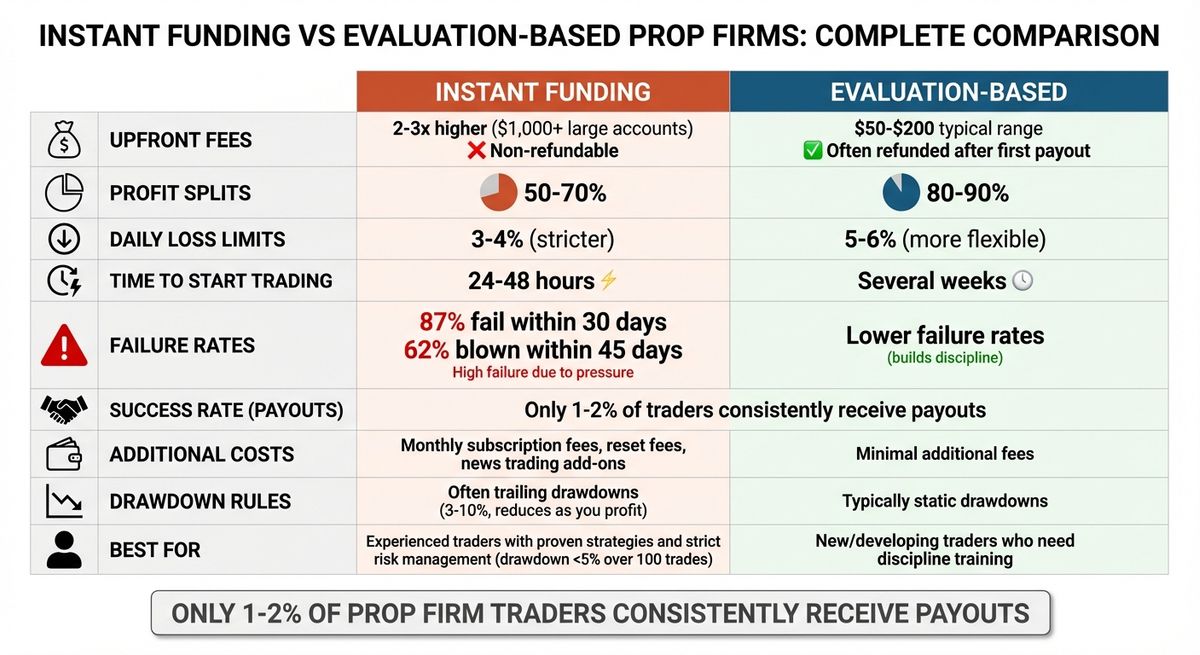
- Fees: Upfront costs are 2-3x higher than traditional models, often exceeding $1,000 for large accounts. Fees are non-refundable.
- Risk Limits: Daily loss limits are tighter (3-4%), with trailing drawdowns reducing your safety margin as profits grow.
- Profit Splits: Typically lower (50-70%) compared to evaluation-based firms (80-90%).
- Failure Rates: 62% of accounts are blown within 45 days, and 87% fail within 30 days.
- Payouts: Rules often include minimum profit thresholds, waiting periods, and consistency requirements. Some firms cap monthly payouts.
While instant funding can save time, the stricter conditions and high costs make it unsuitable for many traders. Make sure to evaluate the firm’s rules, fees, and transparency before committing.
INSTANT Funding Prop Firms - Is It REALLY WORTH IT?
How Instant Funding Works
To get started, you choose an account size ranging from $2,000 to $50,000 and pay an upfront fee that's two to three times higher than what you'd pay for evaluation accounts. For example, a $100,000 account might cost you over $1,000 in fees.
Once you've paid, you'll need to sign a Simulated Trader Agreement and complete identity verification. After that, the firm provides login credentials - usually for platforms like MT4, MT5, or NinjaTrader - within 24 to 48 hours. Unlike evaluation models, which can take weeks, this setup allows you to start trading almost immediately.
"The fees are steeper because the prop firm takes on more risk. They're handing you serious capital without first checking if you can trade profitably." - DayTradingInsights
However, this quick access comes at a price. Profit splits are typically lower, ranging from 50% to 70%, compared to the 80% to 90% offered to traders who pass evaluations. Additionally, some firms charge monthly subscription fees to maintain access to the account, turning what might seem like a one-time payment into an ongoing expense.
Now, let’s break down the fees and account setup details.
Fees and Account Setup
The fees vary depending on the account size, starting at around $79 for smaller accounts and exceeding $1,000 for larger ones.
But the upfront fee isn’t the only cost to watch out for. Some firms require monthly payments to keep your account active, while others charge reset fees if you violate trading rules - allowing you to restart without buying a new account. There may also be activation fees, although firms like MyFundedFutures waive these for certain plans.
When it comes to account setup, the parameters are fixed. Drawdown limits range from 3% to 10% of your starting balance, and your profit split is locked in at the time of purchase. Login credentials are provided immediately but come with strict conditions.
Beyond fees, the trading rules and limits shape how you’ll operate.
Trading Rules and Limits
Daily loss limits are tighter than in evaluation accounts, typically set at 3% to 4% (compared to 5% to 6%). Many firms use systems like "Smart Drawdown" or "Trailing Drawdown", which adjust as your account grows. For instance, your drawdown might start at 10% but decrease to 5% once you hit a specific profit target, leaving less room for error as you progress.
Position sizing is also heavily restricted. "Max Lot Rules" cap the total volume you can trade per asset class. For example, a $10,000 account might limit you to 4 lots for forex, 0.3 lots for commodities, 2 lots for indices, and 1 lot for crypto. Exceeding these limits leads to immediate account termination.
Certain trading strategies are outright banned. High-Frequency Trading (holding trades for less than 60 seconds), Martingale strategies (doubling positions after losses), and grid trading are commonly prohibited. News trading is often restricted too, with many firms disallowing trades within 4 minutes of major economic announcements unless you purchase an add-on.
Inactivity is another factor to keep in mind. If you don’t place a trade within 30 to 60 days, your account could be closed without a refund of your setup fee.
With these rules in place, understanding how payouts work is crucial.
How Payouts Work
Payouts come with strict conditions. You can only request a payout after closing all positions and meeting the minimum profit threshold, which is typically 1.5% to 5% of your starting balance or a flat $25. This is followed by a mandatory 14-day waiting period. Afterward, payout schedules vary: InstantFunding.io offers "On-Demand" withdrawals, while Trusted Prop Funds uses a tiered system - from monthly payouts for Level 1 traders to weekly payouts for Level 4 and above.
Some firms also require a minimum number of "Active Trading Days" - usually 5 to 10 - before you’re eligible for a payout.
Consistency is key. Many firms enforce a "Best Day" rule, which states that no single day's profit can account for more than 15% to 40% of your total gains. If your largest winning day exceeds this limit, your payout request may be denied.
"On-Demand Payouts let you withdraw profits whenever you choose - no need to wait for scheduled payout dates." - Instant Funding
Once approved, payouts are processed within 24 to 48 hours. However, you’ll need to complete KYC verification before your first withdrawal, and payouts are considered self-employment income for tax purposes. Be aware that some firms reset your Maximum Loss Limit to $0 after a withdrawal, further tightening your risk parameters.
Pros and Cons of Instant Funding
Instant funding offers traders a tempting proposition: immediate access to trading capital without the hassle of lengthy evaluations. For seasoned traders with well-tested strategies, this can ease the stress of meeting rigid profit targets within tight deadlines. But as appealing as it sounds, this convenience comes with a hefty price tag and stricter rules.
Upfront fees for instant funding are usually two to three times higher than those for evaluation-based programs. Unlike evaluation models, where fees are often refunded upon successful completion, instant funding fees are almost never returned. On top of that, the rules governing these accounts are notably stricter, creating additional challenges for traders.
Here’s a sobering statistic: nearly 87% of traders using instant funding fail within the first 30 days. For example, a common rule like the 20% daily consistency requirement can make withdrawals difficult. If you earn $3,000 in one day, you may still need to accumulate $15,000 in total profits before you can make a withdrawal. Additionally, some firms impose permanent monthly payout caps - usually between payout caps - usually between $1,500 and $3,000,500 and $3,000 - regardless of how much you earn.
"The shortcut often becomes the longest road to failure." - Phidias Prop Firm
Let’s take a closer look at the benefits and drawbacks of this funding model.
Main Benefits
Speed is the standout advantage. With instant funding, you can start trading and generating withdrawable profits almost immediately. Unlike evaluation-based programs, there are no profit targets you need to hit before gaining access to funds. This removes a significant psychological barrier, especially for traders who are prepared to pay the higher upfront fees.
Main Drawbacks
The downsides, however, are hard to ignore. The higher fees required for instant funding are non-refundable. Traders also face stricter rules, such as tighter drawdown limits and hidden consistency requirements, which can disqualify earnings even when trades are profitable. Some firms include prohibited strategies in their fine print, leading to immediate account termination for even minor violations. Additionally, because certain firms operate with simulated capital, they may profit when traders fail, raising questions about their business practices.
Pros vs. Cons Comparison
Here’s a quick comparison of the key advantages and limitations:
Ready to trade funded capital?
Choose your path — Instant Accounts, One-Step or Two-Step Challenges — from just $23, with up to $300,000 in funded capital.
Choose your challengeHidden Risks and Warning Signs
Beyond high fees and strict rules, there are often hidden risks buried in the fine print. Understanding these potential pitfalls can help safeguard your capital from firms that prioritize their own profit over your success.
Unrealistic Targets and Trailing Drawdowns
Some firms implement trailing drawdowns that adjust as your account balance increases. This means your loss limit moves upward with your highest balance, effectively shrinking your available buffer as you earn profits. For instance, on a US$10,000 account with a 5% trailing drawdown, your initial cushion is US$500. If your balance rises to US$11,000, the loss limit shifts to US$10,500, significantly reducing your safety net. This setup often pressures traders into riskier decisions. As Team Topstep puts it:
"Trailing drawdowns that reset with every withdrawal... aren't merely inconvenient; they encourage prolonged risk exposure." - Team Topstep
This shifting limit can make it much harder to maintain your account, especially after making withdrawals. A 2023 study revealed that 62% of instant-funded accounts at major firms are wiped out within just 45 days. To avoid this, check whether a firm uses balance-based or equity-based drawdowns. Balance-based rules tend to be less punishing since they don’t penalize unrealized profits.
Lack of Transparency
Poor transparency can further complicate your trading experience. A major warning sign is when a firm conceals basic operational details. If you can’t easily find information about their leadership team, registration, or physical address (relying only on a P.O. box), consider it a red flag. For example, in August 2025, the CFTC charged My Forex Funds (Traders Global) with fraud, alleging that the firm manipulated execution prices using specialized software. The investigation uncovered that the company had collected over US$310 million in fees from 135,000 users.
To protect yourself, verify a firm’s background through regulatory bodies like the SEC, FCA, or ASIC. Look for verified payout reviews on platforms like Trustpilot instead of relying on curated screenshots from the firm’s website. Testing their customer support can also reveal potential issues - poor or non-existent service is often a red flag. These opaque practices highlight the importance of conducting thorough checks before committing to a prop trading platform.
Hidden Fees and Restrictions
Hidden costs and restrictive policies can also chip away at your profits. Many instant funding firms charge extra for services that should be standard. For example, you might face additional fees to trade during major news events, hold positions over the weekend, or even activate your live account after meeting qualifications. Some firms also charge account reset fees for specific rule violations.
Inactivity fees are another concern. Some firms close accounts after 60 days of inactivity, causing you to lose your investment entirely. Be sure to review the checkout page for hidden add-ons and read prop firm terms to scrutinize vague rules listed under "Prohibited Practices." Ambiguous terms like "consistency" or "one-sided bets" can give firms an excuse to disqualify traders and withhold payouts. When evaluating a firm’s payout policy, ask yourself:
"Who benefits more when it's your time on the line?" - Team Topstep
How to Choose a Reputable Prop Trading Platform
What to Look for in a Platform
When selecting a proprietary trading platform, it's crucial to prioritize safety and transparency. Start by checking the firm's corporate registration and physical address. If all they provide is a P.O. box, consider it a warning sign. For added security and liquidity, opt for firms backed by brokers regulated across multiple jurisdictions.
Next, investigate the platform's payout history. Independent review sites like Trustpilot and trading forums can offer valuable insights into recent withdrawal experiences, particularly within the last 90 days. Keep an eye out for recurring complaints about delayed payouts or sudden account closures. A firm with a well-established reputation is less likely to engage in unethical practices. As FX2 Funding puts it:
"A firm that took years to build up a good reputation is less likely one day to decide just to take all the clients' money and run away than a firm that was created yesterday." – FX2 Funding
Transparency is key when it comes to costs. Make sure all fees - such as evaluation fees, reset charges, and platform fees - are clearly disclosed upfront. Many reputable firms even refund your initial challenge fee after your first successful payout. Be cautious if a firm charges significantly above the typical $50–$200 range for evaluation accounts without a clear explanation.
Also, review the firm's trading rules. Look for clear profit targets, well-defined risk limits, and specific guidelines on drawdowns. Avoid platforms with vague "consistency rules" that could lead to arbitrary disqualifications. Pay attention to whether they use static drawdowns (fixed) or trailing drawdowns (which adjust with your peak balance). Trailing drawdowns, in particular, can increase the likelihood of losing your account.
To minimize risk, it's always a good idea to start small before committing more capital.
Start with Small Accounts
Before diving in with significant funds, test the platform using its smallest account option. Many firms offer entry-level accounts in the $50–$200 range. This allows you to assess critical factors like trade execution, spreads, slippage, and the responsiveness of customer support.
During this trial period, it's also wise to test the firm's withdrawal process. Request a small payout to see if withdrawals are processed within the promised timeframe - usually 24 to 48 hours for reliable platforms. If you experience delays, unclear responses, or additional review requirements, consider it a red flag. It’s worth noting that only about 1–2% of traders consistently receive payouts from prop firms. Starting small helps you identify potential issues before risking larger amounts.
Conclusion: Is Instant Funding Right for You?
Weighing the Benefits and Risks
Instant funding offers the advantage of speed, allowing traders to bypass lengthy evaluation processes and start trading within 24–48 hours. But that convenience comes with trade-offs, including higher fees and stricter risk parameters. For example, profit splits can dip as low as 50%, compared to the more generous 70–90% splits typically offered by evaluation models.
Risk limits are also tighter. Daily loss caps often hover around 3–4%, with maximum drawdowns restricted to 6–8%. If you're an experienced trader who has maintained a drawdown under 5% over your last 100 trades, you might navigate these limits successfully. On the other hand, if you're still refining your strategy, skipping the evaluation phase could mean missing out on a valuable "trader boot camp" that fosters discipline and proper risk management.
The statistics are sobering: only 1–2% of traders consistently secure payouts from prop firms. Additionally, 62% of instant-funded accounts at major firms are blown within just 45 days. As BabyPips aptly notes:
"Prop firms don't need you to succeed. They just need you to try."
These realities highlight the importance of aligning instant funding with your trading strategy and risk tolerance by picking the right prop firm.
Final Advice
When considering instant funding, weigh the appeal of speed against the costs and risks involved. Before committing, make sure the higher fees and lower profit splits align with your financial goals. For instance, calculate your required account size using this formula: (Target Monthly Income) ÷ 0.06 ÷ 0.80. If the numbers don’t work, it may be worth reconsidering.
Hidden fees and strict rules can quickly eat into profits, so prioritize transparency and due diligence. Look into the firm's corporate registration, read recent payout reviews on platforms like Trustpilot, and carefully examine the fine print for restrictions like prohibited news trading or trailing drawdowns. If you're new to trading, an evaluation model might be a safer way to build skills and confidence. And always remember: capital in your personal bank account is more secure than equity managed on a firm's server.
FAQs
What risks should traders consider with instant funding prop firms?
Instant funding prop firms might seem like a quick path to trading capital, but they come with some hefty drawbacks. For starters, these accounts usually require non-refundable upfront fees ranging from $500 to $2,000. Once you’re in, the rules can be harsh - expect strict drawdown limits (often between 5% and 8%) and rigid daily performance requirements. Even small missteps can result in your account being terminated, with no chance of getting your money back.
On top of that, many firms tack on hidden fees, enforce monthly payout caps (commonly between $1,500 and $3,000), and apply restrictive risk rules that can severely limit your earning potential and trading flexibility.
The mental strain these programs create is another big issue. Traders often feel pressured to take bigger risks to hit aggressive profit targets, which can lead to overtrading and, ultimately, significant losses. With failure rates reportedly as high as 97%, these programs can end up being an expensive and stressful route for most traders. Before diving in, it’s essential to thoroughly review the fine print and make sure the terms align with your trading goals.
What is a trailing drawdown, and how does it impact my trading strategy?
A trailing drawdown is a flexible risk management tool that adjusts as your account balance grows. Unlike a fixed stop-loss, this threshold moves upward as you secure profits. But here's the catch: if your equity falls back to this trailing level, the prop firm might close your account or pause payouts. This can make risk management tricky, as one big loss after a streak of wins could wipe out the cushion you've built.
To handle trailing drawdowns wisely, aim for consistent, low-risk trades, keeping your risk per trade at around 1% of your account balance. Locking in profits regularly can push the drawdown threshold higher, giving you more breathing room to absorb potential losses. Adjusting your trading strategy to align with these rules is crucial to maintaining funding and staying eligible for payouts in a fast-paced funding setup.
What should I consider when choosing a trustworthy prop trading platform?
When picking a prop trading platform, the first thing to consider is their pricing and fees. Reliable platforms are upfront about costs, which typically range from $500 to $2,000, and they clearly explain what you’ll get for your money. Be wary of platforms that hide extra charges in the fine print or lure you in with “free” funding offers only to hit you with unavoidable fees later.
Next, review their trading rules and payout terms. The best platforms provide realistic and transparent guidelines, like a 5–8% maximum drawdown, along with fair profit-sharing arrangements. Be cautious of firms that impose tight withdrawal limits - such as capping payouts at $1,500–$3,000 per month - or attach hidden performance conditions to your access to funding.
Lastly, take time to investigate the firm’s reputation and support. Look for feedback from traders who’ve had positive experiences, responsive customer service, and clear legal documentation, including terms of service and risk disclosures. A trustworthy platform prioritizes openness and delivers real value instead of relying on excessive fees or empty promises.
Ready to trade funded capital?
Choose your path — Instant Accounts, One-Step or Two-Step Challenges — from just $23, with up to $300,000 in funded capital.
Choose your challengeTrade up to $300,000
Choose challenge