Is It Too Late to Start Funded Trading in 2026?
Funded trading is still viable in 2026: flexible evaluations, AI tools, low-cost simulated challenges, and disciplined risk management boost your chances.

No, it’s not too late to start funded trading in 2025. In fact, the industry is thriving with more opportunities than ever, thanks to evolving rules, accessible challenges, and advanced tools. Here’s why:
- Market Saturation Isn’t an Issue: With a $7.5 trillion daily forex turnover, firms are still looking for traders who can manage risk and deliver consistent results.
- Flexible Rules: Unlimited evaluation periods and improved drawdown rules give traders more time to succeed without pressure.
- AI and Tools: Advanced AI-powered insights, risk management tools, and automated systems are making trading more efficient.
- Affordable Entry: Simulated challenges start as low as $50, offering virtual capital of up to $1,000,000.
- Success Rates: While only 7–15% pass evaluations, those who focus on discipline and risk management can succeed.
The key is preparation. Learn the general rules, test your strategies, and focus on consistency over quick wins. Funded trading in 2025 rewards discipline, patience, and smart risk management - not luck.
Why Market Saturation Isn't Stopping Funded Trading Growth
Funded Trading Growth Continues in 2025
With the global forex market averaging a staggering $7.5 trillion in daily turnover as of April 2022, the demand for skilled traders remains constant. The real challenge isn’t the number of participants but the scarcity of traders who can consistently manage risk and deliver results. Funded trading firms operate much like talent scouts, searching for individuals who can generate steady profits over time.
Here’s the reality: only about 7% to 15% of traders successfully pass the evaluation process, and fewer than 20% manage to stay profitable in the long run. These firms make their money by taking a share of the traders' profits - typically 10% to 30% - which means they’re always on the lookout for traders who can safeguard capital while achieving consistent returns. This dynamic has paved the way for simulated challenges, which are reshaping the funding landscape by making it more accessible to aspiring traders.
How Simulated Challenges Create More Opportunities
Simulated trading challenges have opened doors to institutional-level funding for a wide range of traders. For fees ranging from $50 to $500, depending on the account size, participants can compete for funding that scales anywhere from $5,000 to $1,000,000. This approach removes traditional barriers, such as the need for substantial personal savings or a formal background in finance.
The numbers speak volumes. FundedNext has paid out over $150 million to more than 43,000 traders. Goat Funded Trader has distributed upwards of $9.1 million, supporting a community of over 98,000 traders. Meanwhile, Topstep reported 81,177 payouts to traders in 2024 alone. These aren’t lucky lottery winners but individuals who demonstrated the ability to manage risk effectively using simulated accounts before earning access to real capital.
In 2025, the removal of rigid 30-day time limits has created even more opportunities. Traders now have the flexibility to wait for optimal setups instead of rushing trades to meet tight deadlines. This shift addresses a major hurdle in the evaluation process: the psychological pressure that often leads to overtrading and emotional decision-making, highlighting the importance of trading psychology for challenge success. By reducing this stress, traders are better positioned to focus on long-term success.
Prop Firms 2025: How To Pass The Challenge & Actually Get Paid - E145
What's Changed in Funded Trading for 2025
The funded trading world in 2025 is seeing some major updates. From cutting-edge technology to trader-friendly rule changes, these shifts are reshaping how traders enter and succeed in the markets.
AI and Automation in Modern Trading
Artificial intelligence is now at the heart of funded trading. Platforms are using advanced models on 5- and 15-minute timeframes to filter market noise and highlight high-probability setups. By mid-2025, AI-powered trading agents boasted win rates of over 85%, proving their ability to give newer traders a serious edge.
Risk management tools have also stepped up. Built-in features like daily loss caps, automatic stop-loss settings, and account lockouts are now standard. On top of that, tools like real-time sentiment tracking and order flow analysis - once exclusive to big institutional players - are now widely available. These features make it easier for traders to confirm their setups before putting money on the line.
"AI trading agents now outperform human strategies in both accuracy and speed." - Tickeron Inc.
These advancements in technology have paved the way for new rules and processes designed to make trading more accessible.
More Flexible Rules for New Traders
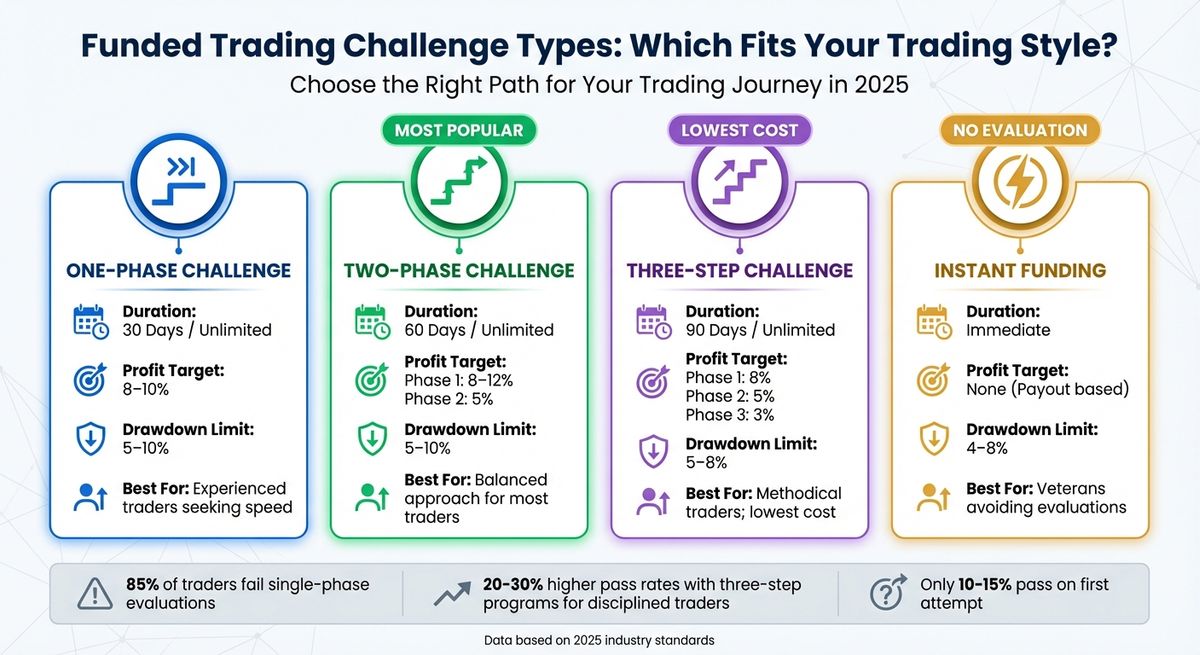
The rigid 30-day evaluation periods of the past are gone. Many firms now let traders take as much time as they need to pass evaluations, easing the pressure to trade recklessly just to meet deadlines. This change allows traders to focus on quality setups rather than rushing into trades.
Growth accounts have also adopted End-of-Day (EOD) drawdown calculations, which only update at the close of the market. Unlike intraday trailing drawdowns that track every price fluctuation, EOD drawdowns give trades more breathing room during normal market swings. Some firms have even introduced fixed drawdown limits based on the initial account balance, offering traders a stable framework to build their strategies.
For those ready to dive straight in, prop firms with instant funding programs now skip the evaluation phase altogether - for a higher upfront fee. These programs often start traders in simulated accounts with real payouts, transitioning to live capital once consistent results are shown. For instance, some programs allow traders to earn payouts after just five winning days with returns of $150 or more per day, offering a quicker path to live trading.
How to Overcome Beginner Obstacles
Getting into funded trading in 2025 comes with its fair share of challenges, but sticking to disciplined strategies can help you navigate the roadblocks. By understanding common pitfalls and developing strong habits, you can set yourself up for long-term success.
Learning Evaluation Metrics and Rules
Each trading challenge comes with specific metrics you’ll need to meet. Most commonly, you’ll encounter an 8–10% profit target, while keeping total losses under 10% and daily losses within 3–5%. Additionally, many firms require at least 10 active trading days to prove you can consistently perform.
Here’s the key: understanding different types of drawdowns is critical. Static drawdown remains fixed at your starting balance, trailing drawdown adjusts as your equity peaks, and end-of-day (EOD) drawdown only updates at market close. These metrics, which firms have refined in recent years, are essential to grasp before diving in.
Before jumping in, test your strategy with at least 100 backtested trades to ensure your drawdown stays within acceptable limits. It’s also wise to use position size calculators to keep your trade risk between 0.5–1% of your current balance. These steps are essential for building a solid foundation and avoiding costly mistakes.
Mastering these metrics is just the first step. Next, we’ll look at how to build the mental resilience needed to succeed.
Building Confidence Without Preventing Burnout
With a staggering 94% of traders failing evaluations and only 5–10% passing, having emotional discipline is just as important as having a good strategy. Sticking to the rules you’ve learned not only helps you pass evaluations but also builds the psychological strength needed to handle the ups and downs of trading.
Start small by practicing with a low-cost account - something in the range of $5,000–$25,000. Keep challenge fees to 5–10% of your capital to minimize financial stress. To further protect yourself, set a personal loss limit below the firm’s threshold. For example, if the firm allows a 5% loss, consider stopping at 2–3%.
"The prop firm game isn't about hitting home runs. It's about consistency, patience, and self-control." – Tiago Mascarenhas, Founder, Funded Trader Blueprint
Another key habit? Keep a trading journal. Document your entries, exits, and emotional reactions to each trade. Reviewing your journal weekly can help you spot bad habits, like revenge trading after a loss or overtrading during slow market days. This practice reinforces the consistency and discipline that are central to success in this field.
Ready to trade funded capital?
Choose your path — Instant Accounts, One-Step or Two-Step Challenges — from just $23, with up to $300,000 in funded capital.
Choose your challengeHow For Traders Supports Your Trading Journey
For Traders builds on the principles of discipline and risk management by offering resources and challenges tailored to elevate your trading skills. Once you've honed your ability to meet evaluation metrics and develop mental resilience, this platform serves as a natural next step. Through simulated challenges, educational tools, and community support, For Traders helps you grow as a trader.
Simulated Trading Challenges for All Levels
For Traders provides virtual capital plans ranging from $6,000 to $100,000, giving you the flexibility to choose an account size that aligns with your experience and risk tolerance. Each challenge sets a 9% profit target and a 5% drawdown limit, ensuring consistent standards across the board. Plus, there’s no ticking clock - unlike many platforms, For Traders offers an unlimited time frame, so you’re not pressured into rash decisions or overtrading.
This structure is especially advantageous for swing traders who need time for their positions to mature, as well as for disciplined traders who prioritize high-probability setups. To navigate the 5% drawdown limit effectively, consider risking just 0.5% to 1% per trade. This approach provides enough breathing room to endure the inevitable losing streaks that even the best traders face.
Most traders who stick to a structured approach achieve funded status within 60 to 90 days. Alongside these challenges, For Traders provides a suite of learning tools and a community to keep you on track.
Learning Tools and Community Engagement
To support your growth, For Traders includes a library of over 12 video trading courses and e-books with every plan. These resources cover everything from basic chart analysis to advanced risk management strategies, making them ideal for traders who want to avoid the confusion of sifting through conflicting online advice.
The platform also fosters a sense of community through its active Discord channel, where traders share real-time market insights and discuss how to maintain composure during volatile periods. This daily interaction helps counteract the isolation that many traders face and offers accountability when discipline starts to slip. Additionally, For Traders organizes in-person events, giving you the chance to connect with seasoned professionals and learn from their hands-on experiences.
To further enhance your trading, For Traders provides access to professional-grade platforms like DXTrade, TradeLocker, and cTrader. These tools, combined with AI-driven risk management features, help you monitor your drawdown in real-time. Regular bi-weekly payouts ensure you can access your earnings consistently, keeping you motivated as you scale your trading journey. This comprehensive approach lays the groundwork for sustainable success in the trading world.
Practical Strategies for Funded Trading Success in 2025
Selecting the Right Challenge for Your Trading Style
Your trading style should guide your choice of challenge, not the other way around. For instance, scalpers thrive with firms offering low commissions and no restrictions on high-frequency trading, while swing traders need programs that allow holding positions overnight or over the weekend. Matching the challenge to your trading approach can make the process smoother and more effective.
The structure of the evaluation is just as important. Two-phase challenges remain standard, offering a balance between speed and consistency requirements. On the other hand, three-step programs can improve pass rates by 20% to 30% for disciplined traders, compared to single-phase evaluations. It's worth noting that 85% of traders fail single-phase evaluations, often due to aggressive profit targets and tight deadlines.
Account size also plays a role in shaping your psychology. Starting with an account between $25,000 and $50,000 can help reduce stress and keep retry costs manageable if you don’t succeed on your first attempt. Since only 10% to 15% of traders pass on their initial try, starting small is a practical strategy. Once you've validated your system, scaling up to a $100,000 account becomes a more realistic goal.
Before committing, take time to understand the drawdown rules of the challenge. Different firms have varying drawdown limits, and selecting one that aligns with your risk tolerance is crucial. For example, For Traders applies a 5% drawdown limit across all account sizes, which works well if you risk just 0.5% to 1% per trade.
"Prop firms aren't testing how well you can find winning trades. They're testing how well you can manage risk." - Tiago Mascarenhas, Founder, Funded Trader Blueprint
Once you’ve picked the right challenge, the next step is mastering risk management.
Managing Risk and Building Consistency
After selecting a suitable challenge, the focus shifts to implementing strict risk management strategies. Risking 0.5% to 1% per trade can help you weather losing streaks and avoid breaching drawdown limits. Setting a personal daily stop-loss - such as $500 if the firm's limit is $1,000 - can prevent emotional decision-making. Risking more than 3% per trade moves into gambling territory. With a 5% drawdown limit, careful position sizing can allow for 10 or more consecutive losses without disqualification. Poor risk control, rather than weak strategies, is the main reason why 90% to 95% of traders fail prop firm evaluations.
Preparation is key. Simulate the challenge for at least 20 days using the exact rules before paying for an evaluation. If you can’t pass in a simulated environment, you’re unlikely to succeed in the real test. This practice phase helps you identify conflicts between the rules and your strategy while building the discipline needed to stay within limits. For example, in 2025, a trader named João secured a $100,000 funded account with an 80% profit split after failing three earlier challenges. He succeeded by adopting fixed risk rules and focusing on execution discipline rather than profit outcomes.
Pay close attention to your consistency ratio. Many firms have rules that limit any single trading day to 30% to 40% of your total profit target. This ensures that big wins don’t mask poor risk management. Keeping a detailed trading journal - recording your entry and exit points, risk levels, and emotional state - can help you identify patterns that lead to mistakes and maintain the consistency needed for long-term success.
"Passing the challenge is about demonstrating discipline and consistency, not trading genius." - Prop Firm App Team
It’s also smart to avoid trading during high-volatility events like Federal Reserve announcements or major economic releases. Slippage during these periods can prematurely trigger stop-losses and eat into your drawdown allowance. Even among traders who secure funded accounts, only 20% reach their first payout, often because they abandon the discipline that got them funded in the first place. By sticking to these practices, you’ll be better equipped to grow sustainably in your funded trading journey throughout 2025.
Conclusion: 2025 Offers Real Opportunities in Funded Trading
Despite concerns about market saturation, 2025 presents strong prospects for those venturing into funded trading. The industry has evolved, offering more flexible evaluation processes that allow traders to wait for the best setups instead of feeling pressured into overtrading.
Accessibility has reached new heights. Platforms like For Traders now provide simulated trading challenges starting as low as $46 for a $6,000 virtual capital account. Plus, there’s no time limit to hit your profit targets, and the only cost is the one-time evaluation fee. With profit splits ranging from 70% to 90% and bi-weekly payouts, these setups cater to both beginners sharpening their skills and experienced traders looking to scale up. This structure not only lowers the barrier to entry but also gives traders a taste of the discipline required to maintain consistency.
It’s worth noting that only 7% to 15% of traders pass evaluations, and just 1% achieve steady payouts. However, funded trading isn’t about luck - it’s about discipline and smart risk management. Successful traders typically risk just 0.5% to 1% of their capital per trade and stick to strict risk management rules.
"The dream of becoming a funded trader in 2025 is real, but it won't happen by chance. It requires preparation, patience, and a process you can trust." - Tiago Mascarenhas, Founder, Funded Trader Blueprint
FAQs
Is 2025 a good time to start funded trading?
Yes, 2025 is shaping up to be a fantastic year to dive into funded trading. The industry has come a long way, with many proprietary trading firms now offering programs tailored to beginners. A standout feature is the flexibility in evaluation processes - several firms now provide unlimited time to complete challenges. This shift not only eases the pressure but also encourages more thoughtful and steady trading habits.
Getting started with funded trading has never been simpler. You only need to pay a one-time evaluation fee, and the best part? You’re not risking your own money during the testing phase. If you pass, you’ll unlock access to live trading accounts with profit-sharing arrangements, where disciplined and skilled traders can truly thrive. On top of that, the wealth of resources available today - such as beginner-friendly guides, educational tools, and supportive trading communities - makes it easier than ever to embark on this journey and build a strong foundation in 2025.
Can AI tools help me succeed in funded trading?
AI tools can play a game-changing role in funded trading by taking the complexity out of tough decisions and streamlining your workflow. They excel at analyzing massive amounts of market data in no time, spotting high-probability setups, and cutting through the market noise. This means fewer costly mistakes and more focus on finding profitable opportunities. Plus, they enable you to build rule-based strategies that adjust to market conditions without letting emotions get in the way - a big advantage when you're navigating evaluation challenges.
On top of that, AI can help you design disciplined trading plans, test strategies against historical data, and fine-tune your approach before risking actual funds. These tools can also handle essential tasks like position sizing, setting stop-loss levels, and monitoring risk. This ensures every trade is executed consistently and in line with the strict criteria of funded trading programs. By blending data-driven insights with automation, AI doesn’t just help you pass evaluations - it sets you up for long-term success with your funded account.
What are the best strategies to pass a funded trading evaluation in 2025?
To excel in a funded trading evaluation, start by crafting a well-defined trading plan. This plan should clearly outline your strategies, risk limits, and objectives. It's essential to stick to disciplined risk management practices, like setting a maximum drawdown limit and calculating position sizes carefully to protect your capital.
Before diving into the evaluation, spend ample time practicing on a demo account. This will help you fine-tune your approach and build the consistency needed for success. Equally important is thoroughly understanding the specific rules and guidelines of the prop trading program you're applying for - each program has its own requirements, and compliance is non-negotiable.
Approach trading with a cool head. Emotional decisions can derail even the best strategies, so discipline is your best ally. Keeping a detailed trading journal will also prove invaluable. Use it to monitor your performance, pinpoint areas for improvement, and tweak your strategies as necessary. Success in these evaluations boils down to preparation, consistency, and a commitment to learning from every trade.
Ready to trade funded capital?
Choose your path — Instant Accounts, One-Step or Two-Step Challenges — from just $23, with up to $300,000 in funded capital.
Choose your challengeTrade up to $300,000
Choose challenge