Why Prop Firms Are Booming in 2026
Prop trading reached a $12B market in 2026 driven by younger traders, AI risk tools, flexible funding, and rapid global expansion.

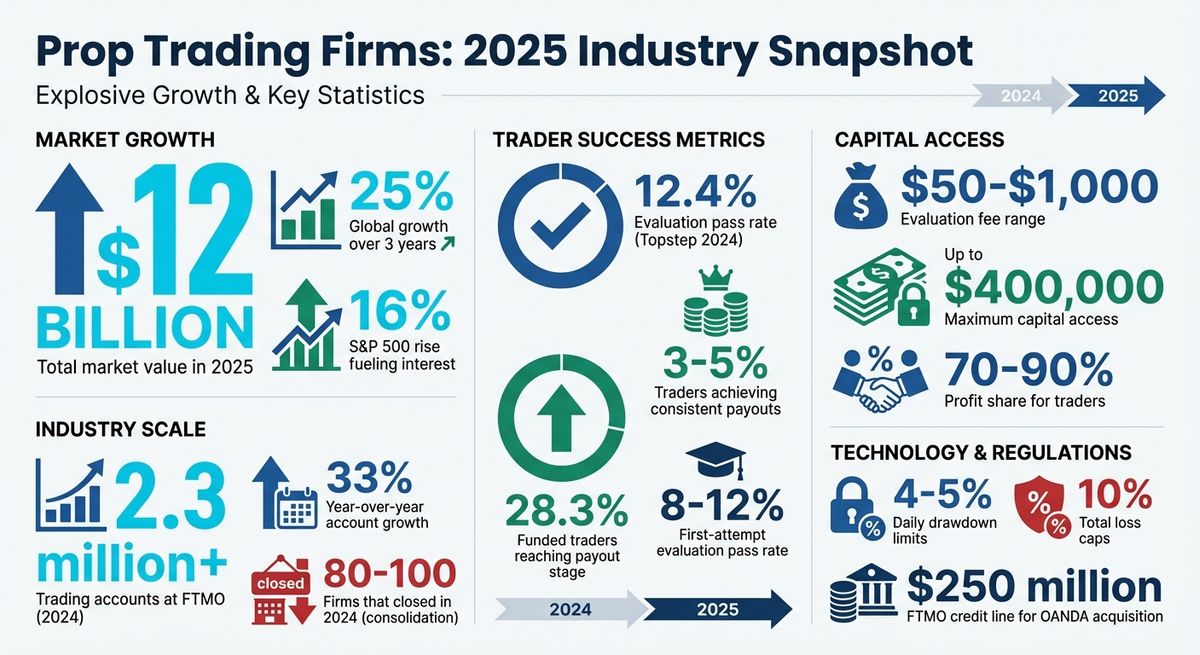
Prop trading firms exploded in 2025, reaching a $12 billion market value. These firms allow traders to access significant capital in exchange for profit-sharing, making trading more accessible without risking personal savings. Key trends driving this growth include younger traders entering the market, advanced trading technologies, and improved funding options.
Key Highlights:
- Market Growth: Prop trading grew 25% globally in 3 years, fueled by a 16% rise in the S&P 500 and increased interest from Gen Z and millennials.
- Funding Models: Flexible options like instant funding prop firms and performance-based scaling make it easier for traders to access up to $400,000 in capital.
- Technology: AI-driven risk management, advanced platforms (e.g., cTrader), and real-time analytics enhance the trading experience.
- Regulations: New compliance standards in 2025 legitimized the industry, distinguishing simulated trading from live environments. Understanding these distinctions requires traders to carefully review prop firm terms before committing.
Prop firms are reshaping trading by offering opportunities for disciplined traders to grow with minimal upfront risk. The future points toward more transparency, institutional partnerships, and global expansion.
Top 5 Futures Prop Firms of 2025 – Instant Funding, No Consistency & Fast Payouts
What's Driving the Prop Firm Boom
The prop trading industry saw a major surge in 2025, fueled by three key factors: growing interest from traders, advancements in technology, and more flexible funding options.
Increased Trader Demand
Younger generations, particularly Gen Z and millennials, have been drawn to trading as a way to achieve financial independence. With evaluation fees ranging from $50 to $1,000, traders could access up to $400,000 in capital, making the process far less intimidating and more accessible.
Social media platforms like TikTok and Instagram played a big role in this trend, amplifying success stories and showcasing the appeal of flexible, trader-driven lifestyles. The "pass challenge" model added a gamified element, turning evaluations into a motivating, level-up experience that made trading seem attainable for many.
For example, at Topstep, 12.4% of participants passed their evaluations in 2024, and of those who became funded traders, 28.3% reached the payout stage. This growing interest in trading helped pave the way for technological advancements that reshaped how prop firms operate.
Technology Improvements in Prop Trading
Technology has transformed prop trading by enhancing both risk management and trader tools. AI systems now monitor trading accounts in real-time, enforcing strict limits like 4–5% daily drawdowns and 10% total loss caps. These measures protect firm capital while providing clear, objective rules for traders to follow.
Behavioral analytics tools have also stepped up, detecting account sharing and unauthorized automated trading strategies. Meanwhile, AI-driven platforms like Bridgewise and Acuity offer market analysis directly to traders, making professional-grade insights accessible without the need for costly subscriptions.
Platform integration has been another game-changer. As MetaQuotes tightened restrictions on prop firms, traders turned to advanced alternatives like cTrader, DXTrade, and TradeLocker. These platforms prioritize transparency, offering features like zero price manipulation guarantees and detailed trade receipts that boost trust. A landmark moment came in 2025 when the Czech prop firm FTMO acquired regulated broker OANDA, securing a $250 million credit line from Czech banks led by UniCredit to fund the deal. This move highlighted the industry's evolution and maturity. With technology strengthening risk controls, firms also reimagined their funding and evaluation processes.
Changes in Funding Models and Simulated Trading
Prop firms have embraced more flexible funding options to cater to a broader range of traders. For instance, firms like PROP365 removed time limits for hitting profit targets, recognizing that traders develop skills at different paces.
Two main funding paths emerged:
- Traditional challenges: These involve lower entry fees ($50–$500) but require traders to pass multi-phase evaluations.
- Instant funding: With higher upfront costs (over $1,000), this option provides immediate access to trading capital.
Profit-sharing models have also become more appealing, with traders now keeping 70–90% of their earnings - an attractive alternative to standard jobs or retail trading.
Another exciting development is performance-based scaling, where traders who consistently manage risk can see their accounts grow by 25% every three months. This system offers a clear, merit-based pathway from small accounts to six-figure capital allocations, replacing traditional career uncertainties with measurable progress.
Simulated trading environments have become a cornerstone of the evaluation process. By testing their skills in demo accounts, traders can prove their abilities without risking firm capital. This approach not only protects firms but also emphasizes trader skill over financial risk, making the process fairer and more accessible for aspiring traders.
Current Trends in Prop Trading
The prop trading world in 2025 looks very different from just a few years ago. With rapid changes in the industry, three key trends are shaping how firms operate and expand: multi-asset trading, geographic growth, and industry consolidation that’s filtering out less competitive players.
Growth in Multi-Asset Trading
Prop firms have moved far beyond their forex roots. Today, traders can access a wide range of markets, including futures, stocks, commodities, and cryptocurrencies, all through evaluation platforms. This shift reflects growing demand for both market variety and volatility. The numbers back this up: firms like FTMO reported over 2.3 million trading accounts in 2024, marking a 33% increase from the previous year.
In the U.S., futures trading is ideal for prop firms and is currently booming, while cryptocurrencies continue to appeal to younger traders, expanding the reach of prop trading platforms. London-based IG Group exemplified this trend in 2025 by partnering with a third-party platform to offer crypto trading to retail users. They also acquired regulated crypto exchanges in Australia and Singapore to strengthen their digital asset offerings. Some firms have even introduced 24/5 stock trading, giving traders nearly round-the-clock access to equities. This diversification of assets is also fueling geographic expansion as firms seek to reach new trader communities.
Expansion into New Markets
Geographic growth has become a priority, with firms targeting new trader populations and regions with favorable regulatory climates. After facing regulatory challenges in 2024, major players like FTMO, The5ers, and FundedNext made their way back into the U.S. market in 2025 by collaborating with regulated entities. The U.S. remains an attractive market due to its size and strong demand for retail trading services.
Meanwhile, Dubai and the UAE have emerged as key hubs for prop trading firms. Their streamlined regulatory frameworks make them ideal for licensing and operations, providing access to both Middle Eastern and Asian markets. For example, in 2025, FundedNext launched a brokerage under Comoros registration while simultaneously seeking licenses in Mauritius and Dubai. India has also become a hotspot, with firms offering funding programs tailored to local traders, enabling them to engage with global markets without risking personal capital.
Strategic partnerships and acquisitions are further driving firms like FTMO to strengthen their foothold in these new markets.
Industry Maturation and Consolidation
As the industry grows, it's also maturing. The chaotic, "wild west" days of prop trading are fading, with an estimated 80–100 firms shutting down in 2024 due to fierce competition and stricter regulations. The firms that remain are focusing on smarter, more sustainable operations, prioritizing risk management and long-term trader retention instead of just collecting evaluation fees.
"Prop trading is becoming increasingly popular, and the sector is expected to change with... increased institutional participation. Traditional financial institutions may well contemplate entering into alliances with prop firms, lending the industry yet another legitimacy push." Gerald Segal, Writer, FX News Group
To keep up, firms are adopting AI-driven risk management systems that monitor overall exposure and prevent trading loopholes. Traders, in turn, are gravitating toward firms with a track record of transparency, reliable payouts, and clear growth plans. In response to the 2024 MetaQuotes restrictions, many firms have diversified their tech stacks, incorporating platforms like cTrader, DXTrade, and TradeLocker.
These changes signal an industry that’s not only expanding but also moving toward greater stability and professionalism, offering a more structured environment for both firms and traders alike.
Ready to trade funded capital?
Choose your path — Instant Accounts, One-Step or Two-Step Challenges — from just $23, with up to $300,000 in funded capital.
Choose your challengeOpportunities for Aspiring Traders in 2025
The surge in proprietary trading has opened doors for aspiring traders who want access to substantial capital without risking their own savings. However, enthusiasm alone won’t cut it. Only about 3–5% of traders manage to secure consistent payouts, and they do so through meticulous preparation, disciplined strategies, and effective use of resources. The challenges traders face highlight the importance of a solid education and a disciplined approach, as outlined below.
Educational Resources and Training Programs
Top proprietary trading firms are stepping up their game by offering structured courses, personalized feedback, and active community support through platforms like Discord and Slack. These initiatives address a critical issue: nearly 94% of traders fail to complete their initial challenge phases. By engaging with these communities, attending webinars, and participating in mentorship programs, traders can refine their strategies before risking real money on evaluations.
Unsuccessful traders often spend between $600 and $800 on repeated attempts, making community-driven learning an excellent way to save both money and frustration. Additionally, many firms now offer tools like automated journaling and behavioral analytics to help traders recognize and correct mental traps such as "revenge trading" or "size creep" - mistakes that can quickly derail an account. Building this educational foundation is essential before tackling simulated challenges that lead to real rewards.
Simulated Challenges and Real Rewards
Simulated challenges provide a safe environment for traders to prove their skills. With entry fees ranging from $50 to $500, traders gain access to virtual capital that can range from $5,000 to several hundred thousand dollars. The risk is limited to the entry fee, while the potential rewards include profit splits of 70% to 90% once traders are funded.
Between 2024 and 2025, Apex Trader Funding saw a sixfold increase in payouts to traders, driven by word-of-mouth and the elimination of high personal capital requirements. However, passing an evaluation on the first try is just the first step. As market analyst Kathy Lien points out:
"The tactics required to pass an evaluation are not the same as those required to sustain payouts".
In 2025, firms have shifted their focus, rewarding traders who prioritize consistency and lower-risk strategies over aggressive, evaluation-driven tactics.
How to Stand Out in a Competitive Market
Even with the right education and practice, traders must differentiate themselves through disciplined routines and consistent performance. Successful traders stick to strict risk management rules, such as daily drawdown limits of 4–5% and total loss limits around 10%. They risk only 0.5% to 1% per trade and maintain detailed journals to track performance and avoid repeating mistakes.
Interestingly, firms tend to favor "boring" but consistent behavior over high-risk, flashy trades. Winning traders develop and test repeatable strategies, ensuring they have at least three months of documented results in demo or simulated environments before attempting a paid challenge. They also master their chosen trading platform - whether MetaTrader, cTrader, or DXTrade - to minimize technical errors.
With only 8–12% of traders passing evaluations on their first attempt, thorough preparation is essential. As the Seacrest Markets Research Team notes:
"The traders who achieve success at prop firms demonstrate both skill and persistent boring behavior".
For those willing to put in the time and effort, 2025 offers unparalleled opportunities to access capital and connect with supportive communities - resources that were far less accessible just a few years ago.
How For Traders Supports the Prop Firm Industry
For Traders is stepping up to meet the changing demands of 2025’s traders. By offering flexible plans, advanced technology, and fostering a strong sense of community, the platform has carved out a significant role in the thriving prop trading industry.
### Simulated Trading Challenges with Flexible Plans
For Traders provides virtual accounts ranging from $6,000 to $100,000, with entry fees between $46 and $413. These plans come with unlimited time limits, aligning with the 2025 trend toward payout-focused, lower-risk trading strategies. Each plan is designed with a 9% profit target and a 5% maximum drawdown, offering bi-weekly payouts for consistent performance. A 15% profit share ensures balanced account growth, benefiting both traders and the platform.
AI-Driven Risk Management and Advanced Platforms
Beyond flexible plans, For Traders equips users with cutting-edge tools for risk management and trade execution. Following the 2024 MetaQuotes ban, the platform introduced advanced trading solutions like DXTrade, TradeLocker, and cTrader, ensuring reliable access for U.S. and restricted-region traders. Among these, cTrader stands out with its institutional-grade features, including Depth of Market displays and professional charting tools, empowering traders to make well-informed decisions.
The platform also integrates AI-powered risk management tools that analyze trading patterns and assess consistency. These tools help traders spot potential mistakes before they spiral out of control, a crucial feature given that 98% of funded traders leave their prop firms within six months.
Building Community and Opportunities
For Traders doesn’t just rely on technology - it prioritizes community as a way to keep traders engaged and motivated. Its active Discord community brings traders together to discuss markets like Forex, Gold, Indices, Stocks, and Crypto, while also sharing trade strategies in real-time. This sense of connection helps combat the isolation and burnout that often lead to failure, as 94% of traders fail to complete their initial challenges.
The platform goes beyond online interaction, organizing in-person events and tournaments where traders can test strategies in a no-risk setting. These initiatives turn prop trading into more than a one-time challenge - they create a long-term partnership, helping traders stay engaged even after setbacks. By focusing on retention and support, For Traders transforms the trading experience into a sustainable journey.
The Future of Prop Firms Beyond 2025
The prop trading industry is undergoing a transformation, driven by advancements in technology, stricter regulations, and deeper connections with institutional finance. With a global market value of around $12 billion, the focus is shifting from short-term challenges to building sustainable partnerships that prioritize long-term growth for traders. Here's a closer look at the trends shaping the future and how traders can prepare for what's ahead.
Key Takeaways
The future of prop trading is being shaped by innovations and changes in regulation that are redefining the industry.
- AI-powered risk management is no longer a novelty - it's now a cornerstone of trading platforms. Real-time monitoring and predictive analytics are helping traders steer clear of common mistakes.
- Stronger ties with institutions are creating new opportunities. Prop firms are increasingly becoming talent pipelines for hedge funds and asset managers, bridging the gap between retail traders and professional finance.
- Evolving regulations are weeding out less reputable firms. Stricter oversight is fostering a more transparent and trustworthy industry.
Recent developments highlight these changes. For example, FTMO's acquisition of OANDA in 2025 signaled a push toward greater legitimacy and deeper institutional integration.
Additionally, prop firms are expanding their offerings beyond Forex to include futures, stocks, and commodities. Tools like voice-activated trading and AI-driven market analysis - such as Bridgewise's white-label chat tool launched in 2025 - are becoming standard, enhancing the trading experience. To attract top talent, firms are offering profit-sharing split structures as high as 90%.
Next Steps for Traders
To succeed in this evolving landscape, traders need to adjust their approach and embrace a long-term perspective.
The key to thriving in 2026 and beyond lies in consistency. Firms are placing greater value on disciplined strategy execution rather than high-risk, aggressive trading. Education and mentorship are becoming essential; comprehensive training programs can help traders develop the psychological resilience and risk management skills needed to handle larger capital.
AI tools can be a game-changer for traders. These tools allow for effective backtesting and strategy refinement, giving traders an edge in an increasingly competitive environment. When selecting a prop firm, it's important to look for transparent rules, clear fee structures, and a strong track record of payouts. Starting small - typically with evaluation phases costing between $50 and $100 - provides a safe space to hone strategies before scaling up.
Ultimately, treating prop trading as a professional journey rather than a shortcut to quick funding is the mindset that leads to long-term success.
FAQs
How is AI revolutionizing risk management in proprietary trading?
AI is reshaping risk management in proprietary trading by making decision-making faster, more precise, and forward-looking. With advanced machine learning models, traders can analyze market data in real time, predict volatility, and adjust their positions accordingly. These AI-driven tools also keep an eye on equity curves and automatically tweak risk limits when certain thresholds are reached, ensuring tighter control over potential exposure.
On top of that, AI-powered stress-testing tools can run thousands of market scenarios in mere seconds, revealing risks that traditional methods might miss. These systems also improve behavioral monitoring by flagging instances where traders stray from their historically successful strategies. This gives firms the chance to step in early and protect their capital. Combined, these technologies are helping proprietary trading firms manage risk more efficiently and stay ahead of the curve.
Why are prop firms' funding models so appealing to new traders?
Prop firms have created an appealing gateway for new traders by offering access to real trading capital without demanding a hefty upfront investment. Instead of risking their own savings, traders usually pay a relatively small fee to participate in an evaluation or challenge. If they succeed, they’re rewarded with a fully funded account and the opportunity to keep a significant portion of their profits - often 70% to 80% - while the firm shoulders the risk of potential losses.
What sets these funding models apart is their use of gamified challenges that mimic real market conditions. These challenges provide immediate feedback and offer a clear, merit-based route to securing funding. By removing high financial barriers, prop firms make professional trading more accessible, especially for Gen Z and millennials, enabling them to build their trading careers based on skill rather than the size of their bank accounts.
Why are younger generations drawn to prop trading?
Younger generations, especially Millennials and Gen Z, are gravitating toward proprietary trading because it caters to their desire for flexibility, creativity, and minimal upfront investment. Prop trading firms often offer simulated challenges where aspiring traders can demonstrate their skills and earn access to funded accounts - without needing to risk much of their own money.
This approach resonates with a generation accustomed to gamified systems and instant feedback. It provides the chance to trade using the firm’s capital while keeping personal financial exposure low. Plus, the ability to work remotely, create their own schedules, and sidestep the rigidity of traditional corporate jobs makes prop trading a perfect match for those seeking more independence and unconventional career options.
Ready to trade funded capital?
Choose your path — Instant Accounts, One-Step or Two-Step Challenges — from just $23, with up to $300,000 in funded capital.
Choose your challengeTrade up to $300,000
Choose challenge