Should You Quit Your Job for a Funded Trading Career?
Weigh the risks and rewards of quitting your job for a funded trading career—profit splits, high failure rates, costs, and a step-by-step transition plan.

Thinking about leaving your job to pursue a funded trading career? Here’s the bottom line:
- Funded trading programs allow you to manage large accounts ($10K–$2M) without risking your savings. You earn 70–90% of profits, while firms cover losses beyond the evaluation fees and costs.
- The risks are high. Over 90% fail the initial evaluation, and 80% of funded traders lose their accounts within months. Trading is unpredictable, with no steady paycheck or benefits.
- Preparation is non-negotiable. You need at least two years of profitable trading experience, a financial cushion for living expenses, and strong emotional discipline to handle the pressures of performance-based income.
Before quitting your job, ensure your trading income consistently exceeds your expenses for six months. Start small, scale gradually, and maintain financial stability until you’re ready to fully transition. This career path offers flexibility and income potential, but success requires discipline, skill, and careful planning.
The Problem: Traditional Jobs vs. Funded Trading
Problems with 9-5 Jobs
The traditional 9-to-5 grind has left many workers feeling stuck. In the U.S., nearly 59 million people - about 36% of working-age adults - are either independent workers or juggling side hustles. For Millennials and Gen Z, that number jumps to nearly 50%.
One of the biggest frustrations? Fixed salaries. No matter how hard you work, your earnings rarely increase. Add to that the endless meetings and tasks that seem to do nothing for your career growth. And if you’re dreaming of saving enough to trade independently, the outlook isn’t great - most experts estimate you’d need at least $200,000 to get started.
"Chalk it up to disillusionment with the career advice doled out for decades and low full-time wages, but it's clear that younger generations want more control of their income." Real Trading Staff
Then there’s the rigid structure: fixed hours, a set location, and little room to make your own choices. For those who value freedom and flexibility, this setup can feel stifling.
It’s no wonder so many are turning to funded trading as an alternative.
Why Funded Trading Attracts People
Funded trading flips the script. Instead of being tied to a fixed salary, you earn based on your performance. Profit splits often let you keep 70% to 90% of your earnings. No boss, no office drama, and no long commutes - just the freedom to trade from anywhere with an internet connection.
Here’s the kicker: you don’t need to risk your own savings. Funded trading firms provide the capital and take on the losses, while you only pay a small evaluation fee. This removes the massive financial barrier that stops most people from entering the trading world.
For those tired of corporate limitations, funded trading offers a fresh start. It’s a results-driven path where your performance is what matters - not office politics or the size of your bank account. And the best part? You don’t need to save up $200,000 to begin.
The REAL Steps to Quit Your 9-5 & Trade Full-Time
Pros and Cons of Quitting for a Funded Trading Career
Benefits of a Funded Trading Career
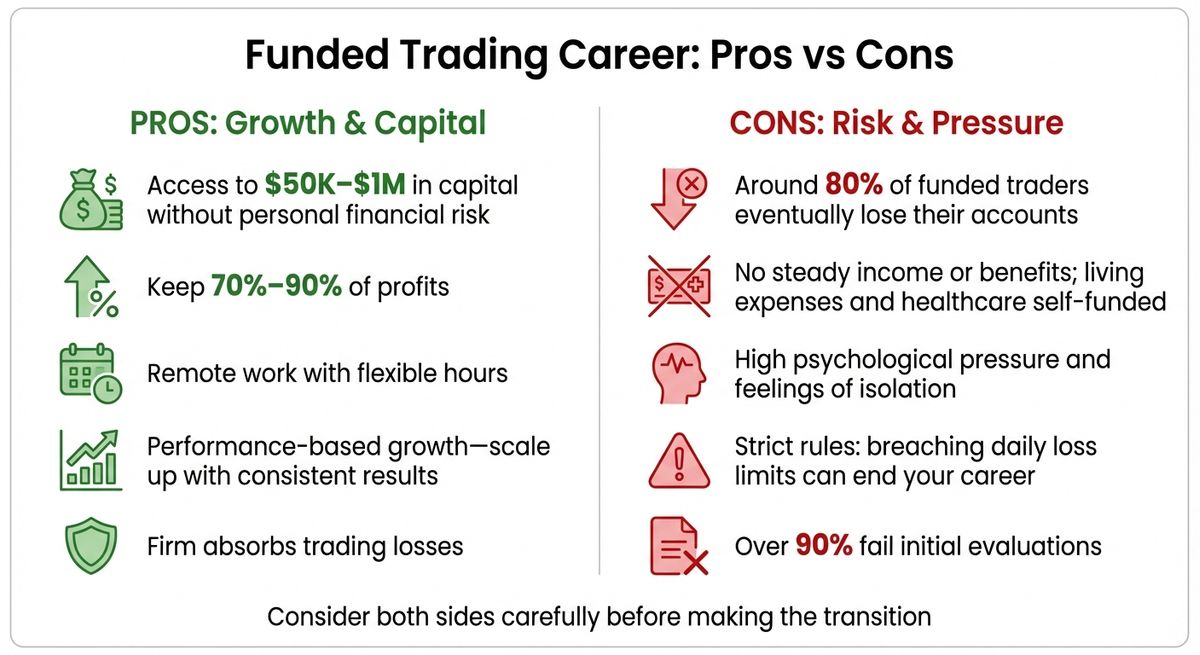
A funded trading career offers a unique opportunity to access significant capital - ranging from $50,000 to $1,000,000 - without putting your own money on the line. One of the biggest perks? The firm takes on the risk of trading losses, which means your personal savings stay untouched. Plus, you get to keep a substantial share of the profits you generate, typically between 70% and 90%. If you perform consistently, you can scale up quickly to manage even larger accounts.
The lifestyle flexibility is another big draw. You can trade from anywhere with an internet connection, whether that's your home office or a beachside café. You set your own hours, skipping the daily grind of commutes and endless meetings. At the end of the day, your success is determined by your performance, not office politics or external factors.
However, this career path isn't without its challenges.
Drawbacks of Quitting Your Job for Trading
The road to becoming a successful funded trader is steep and unforgiving. More than 90% of candidates fail the initial evaluations, and around 80% of those who do get funded eventually lose their accounts. Income is highly unpredictable, with no guaranteed paycheck, benefits, or financial safety net. For instance, if you're used to employer-sponsored healthcare, switching to private coverage could set you back anywhere from $500 to $1,500 per month.
Trading also demands long hours of focus and can feel isolating. You might spend 8–10 hours a day glued to your screen, and the psychological toll can be immense. On top of that, strict rules are in place - like daily loss limits of 4–5% and maximum drawdowns of 8–10% - and breaking them can lead to immediate disqualification. Interestingly, many traders don't fail because they lack technical skills; instead, they struggle with issues like overtrading during a challenge or trying to scale up too quickly.
"Unfortunately, the best time to quit your job to trade is when you don't need to. If you're desperate for trading success, you're setting yourself up for failure." - Investopedia
Comparison Table: Pros and Cons
Here's a quick look at the major upsides and downsides of pursuing a funded trading career:
Financial Considerations Before Making the Switch
How Earnings Work in Funded Trading
In funded trading, your income depends entirely on your performance. Traders typically keep between 70% and 90% of their profits, with some top-tier performers earning up to 100% of their gains. Monthly earnings can vary dramatically. If you're just starting out, you might earn between $500 and $2,000 per month. However, experienced traders managing larger accounts can bring in anywhere from $10,000 to $50,000 or more each month.
For example, let’s say you’re trading with a $100,000 account and achieve a 5% monthly return. With an 80% profit split, you’d take home around $2,000 per month - or $24,000 annually - before taxes. While this might resemble a mid-level salary, it’s worth noting that it doesn’t include perks like employer-sponsored healthcare, retirement plans, or paid time off.
The real opportunity lies in scaling. If you consistently show profitability over three to four months, many firms will allow you to trade larger amounts - sometimes as much as $2 million or more. This can significantly increase your earning potential, but it takes time and a proven track record to get there.
Before you start seeing profits, though, you’ll need to account for some upfront costs and read the firm's terms carefully.
Costs to Consider: Evaluation Fees and Other Expenses
To become a funded trader, you’ll need to pass an evaluation challenge. Fees for these challenges typically range from around $100 for a $10,000 account to $500 or more for a $100,000 account. Some firms charge a one-time fee, while others use a monthly subscription model. If you don’t pass the challenge on your first try, these costs can add up quickly.
On top of evaluation fees, you’ll also need to budget for platform subscriptions, data feeds, and potential reset fees. If you violate any rules during your evaluation, you may have to pay a reset fee, which usually falls between $49 and $100. Additionally, if you’re trading full-time in the U.S., you’ll need to consider healthcare costs, which can range from $500 to $1,500 per month.
Breakeven Analysis: Calculating Affordability and ROI
To determine if funded trading is financially viable for you, calculate whether your trading income can cover your expenses. Your monthly earnings need to exceed your total monthly costs, which include living expenses, taxes, and trading fees. Here’s a simple formula to estimate your return:
Account Size × Monthly Profit % × Profit Split %
For example, with a $50,000 account earning a 5% monthly return and an 80% profit split, you’d make about $2,000 per month. If your monthly expenses total $3,500 - including living costs, healthcare, and trading-related fees - you’d fall short. In this case, you’d need either a larger account or multiple funded accounts to break even.
Some firms sweeten the deal by refunding your evaluation fee with your first payout, which can improve your overall return on investment. Still, it’s wise to approach this career shift cautiously. A good rule of thumb is to save 6 to 12 months’ worth of living expenses before going full-time. Additionally, aim for at least two years of consistent, profitable part-time trading experience before making the leap.
To manage risk, start with modest profit targets of 1% to 3% per month. Professional traders also recommend risking no more than 1% of your capital per trade, which helps you endure inevitable losing streaks.
Ready to trade funded capital?
Choose your path — Instant Accounts, One-Step or Two-Step Challenges — from just $23, with up to $300,000 in funded capital.
Choose your challengeSkill Requirements and Preparation for a Funded Trading Career
Skills You Need for Funded Trading Success
To thrive in a funded trading career, you’ll need a solid foundation of essential skills. First and foremost, master risk management by adhering strictly to daily loss limits, maximum drawdowns, and precise position sizing - typically between 0.25% and 0.5% per trade. These rules are non-negotiable; breaking them could cost you your funded account. Equally important is discipline, which ensures you stick to these guidelines without exception.
Another critical skill is emotional control. Trading with larger capital can amplify emotional reactions, often referred to as "tilt." For example, one trader overcame significant losses by stepping away for two months and incorporating daily mindfulness practices. This allowed her to limit losses to just 1% and eventually pass her evaluation. Alongside emotional control, analytical thinking is key. By developing a rule-based strategy through backtesting and historical analysis, you can remove emotional bias and focus on consistent, high-probability setups rather than chasing risky “hero trades.”
The reality is that only 5%–15% of traders pass a proprietary firm evaluation, and fewer than 10% succeed on their first try. Even among those who earn a funded account, about 80% fail to maintain it due to a lack of discipline or a sustainable strategy. These statistics highlight the importance of honing these skills - they form the bedrock of success in live trading environments.
How Simulated Trading Challenges Help You Prepare
Simulated trading challenges are an excellent way to refine these critical skills. These challenges replicate live trading conditions, including strict limits, to help you focus on preserving capital rather than chasing aggressive profits. Multi-phase evaluations ensure that your performance is consistent over time, proving that your success isn’t just a fluke but the result of disciplined and responsible trading.
For Traders offers simulated trading challenges with virtual capital accounts ranging from $6,000 to $100,000. Using advanced platforms like DXTrade, TradeLocker, or cTrader, you’ll trade on demo accounts equipped with AI-driven risk management tools. Features such as "The Tilt" automatically lock accounts when emotional trading is detected, helping you develop the mental discipline required for live trading.
When transitioning to a funded account, consider following a 7-Day Adaptation Plan. Spend the first two days observing the market without trading. On days three and four, engage in micro-trading with just 0.1% risk per trade, and gradually increase to 0.25% risk by days five through seven. Another useful approach is the 3-2-1 Strategy: limit yourself to three trading days per week, two trades per day, and aim for a 1% weekly profit target. This helps prevent overtrading and keeps your strategy focused. Finally, maintain a detailed trading journal. Document every trade, including your reasoning, emotional state, and results. This habit will help you spot and correct patterns of failure before they lead to significant losses.
Solution: A Step-by-Step Transition Plan
Start Small: Test with Entry-Level Plans
Success in trading starts with discipline and preparation. Before diving into larger challenges, it's wise to test your skills on a smaller scale. For example, For Traders offers a $6K Virtual Capital plan for $46, which is a great way to simulate real trading in a low-risk environment. This plan includes a 9% profit target, a 5% maximum drawdown, and access to a 12+ video trading course - ideal for building confidence without risking actual money.
Before committing to any evaluation, take a step back and practice demo trading for 30 days, aiming for three consecutive profitable weeks. This phase isn't just a warm-up; it's where you refine your strategy and master key concepts like pips, lots, leverage, and risk management. Treat this as a learning opportunity, not a shortcut to quick gains. Once you've established consistency, you'll be in a strong position to move forward.
Scale Gradually: Move to Higher Capital Accounts
As you progress, maintaining strong risk management is crucial. After proving your consistency with an entry-level account, focus on one account for the first three months. Only consider scaling up or adding a second account after demonstrating three months of steady profits with a total gain of over 10%. It's worth noting that 80% of funded accounts fail within six months, often due to poor discipline.
When you're ready to scale, use the Optimal Payout Strategy: withdraw 80% of your profits every two weeks while leaving 20% in the account as a buffer against potential losses. Use these withdrawn profits to fund challenges with larger capital accounts, such as upgrading from the $6K plan to $15K ($91) or $25K ($163) virtual capital accounts. This approach not only diversifies your risk but also creates multiple streams of income.
By scaling gradually and sticking to a disciplined strategy, you can lay the groundwork for a sustainable trading career.
Keep Your Job Until Trading Income Covers Your Expenses
Financial stability should always be a priority. Continue working your day job until your trading income consistently covers your monthly expenses for at least six months. Modern funded trading programs make this feasible by allowing you to trade remotely and on your own schedule. Structure your day to include dedicated market review periods and trade only during optimal conditions that align with your work hours.
To determine when you're ready to transition, calculate your breakeven point. Account for all expenses, including evaluation fees (ranging from $500 to $1,500 for larger accounts), potential subscription fees ($100-$300 monthly for some programs), and your living costs. Only when your bi-weekly payouts from funded accounts - factoring in profit splits between 50% and 80% - consistently exceed these expenses should you consider going full-time. Additionally, building a safety net of 6-12 months' worth of living expenses can provide the financial security you need during this transition.
Conclusion: Weighing the Risks and Rewards of a Funded Trading Career
Stepping into the world of funded trading is a decision that carries both promise and peril, and it’s not one to take lightly. The stats are sobering: between 80% and 90% of funded traders fail their challenges or lose their accounts shortly after being funded. Add to that the overall success rate for day traders, which hovers between just 1% and 15%, and it’s clear that this path is far from easy. The hurdles include intense psychological pressure, strict trading rules, and the uncertainty of irregular income. On top of that, leaving a traditional job means giving up employer-sponsored benefits like healthcare, retirement plans, and paid time off.
To navigate this transition wisely, financial preparation is key. Experts recommend having 6 to 12 months of living expenses set aside in cash, separate from your trading capital. Another smart move is following the "Two-Year Rule." This means delaying a full-time leap into trading until you’ve documented at least two years of consistent profitability while trading part-time. These steps can provide a cushion and reduce the financial risks involved.
For those who succeed, the rewards can be compelling. Funded trading offers access to significant capital - sometimes $100,000 or more - without risking your personal savings, aside from evaluation fees. Profit splits, often ranging from 70% to 90%, can make this a scalable income opportunity for disciplined traders, especially those managing multiple accounts. However, this isn’t a shortcut to financial freedom; it requires unwavering discipline, emotional resilience, and a business-like approach to trading.
The bottom line? Your decision should reflect your financial stability, skill level, and appetite for risk. If you’re drawn to trading as an escape from a frustrating job but lack the preparation to handle its challenges, it’s worth reconsidering. Start small, focus on consistency, and only make the leap when your trading income reliably covers your expenses. A steady, methodical approach will not only protect you from unnecessary risks but also set the foundation for long-term success in this demanding yet potentially rewarding career.
FAQs
What skills are essential for success in a funded trading career?
To succeed in a funded trading career, you need a mix of critical skills that help you navigate risks, maintain discipline, and respond effectively to market changes.
Risk management is at the core of trading success. Prop firms expect traders to safeguard their capital by limiting risk on each trade and using tools like stop-loss orders to keep potential losses in check.
Equally important is discipline - this means sticking to your trading plan, following position-sizing rules, and steering clear of impulsive decisions that could derail your strategy.
Another essential skill is emotional control. The best traders stay composed under pressure, keeping fear and greed in check while staying focused, regardless of whether they’re experiencing wins or losses. Establishing a structured routine - like regularly analyzing the market, journaling your trades, and reviewing past performance - can help you stay grounded and focused.
Lastly, analytical skills play a huge role. Spotting high-probability setups and executing strategies that meet the firm’s expectations require sharp analysis. The ability to keep learning and adjusting to evolving market conditions is what sets consistent performers apart in the long run.
How can I financially prepare to transition into a full-time funded trading career?
Financial preparation for a full-time funded trading career starts with creating a strong financial foundation. One of the first steps is building an emergency fund that can cover 3–6 months of essential living expenses, such as rent, utilities, groceries, and insurance. This safety net ensures you can manage any initial hurdles without dipping into your trading capital. On top of that, factor in the evaluation fees needed to qualify for a funded account - these typically range from $100 to $300. Additionally, establish a dedicated trading bankroll solely for your trading activities.
When planning your potential earnings, keep in mind that funded accounts usually involve profit-sharing arrangements, where traders retain 70–90% of the profits. For instance, if you’re trading a $100,000 account and achieve a 3% return, your monthly earnings could range from $2,100 to $2,700 after the profit split. Ensure your emergency fund and any supplemental income can sustain your expenses while you work on achieving consistent trading performance.
Adopting disciplined financial habits is also crucial. Limit your risk per trade to 0.25–0.5% of your account balance to protect your capital. Avoid unnecessary debt, and postpone significant purchases until you’ve built a dependable track record. Treat your trading income like a business: allocate funds for taxes, reinvest in your trading capital, and stick to a personal budget. These practices will help you transition into a funded trading career with confidence and stability.
What are the risks of leaving a traditional job to start a funded trading career?
Leaving a steady job to pursue a funded trading career is no small decision - it’s a leap that comes with its own set of challenges. One of the biggest hurdles is financial uncertainty. Unlike a regular paycheck, trading income can swing dramatically, with no assurance of consistent earnings. This makes strong money-management skills absolutely essential, especially during tough periods marked by losses or market volatility.
Another challenge lies in the strict rules and fees tied to funded trading programs. Evaluation fees often range between $500 and $1,500, and breaking rules - like exceeding daily loss limits or position-size restrictions - can result in losing your account. This not only means losing access to trading opportunities but also forfeiting the money you’ve already paid into the program. The added pressure of hitting performance targets while protecting the firm’s capital can cloud your judgment and lead to poor trading decisions.
And then there’s the emotional toll. Depending solely on trading for income brings its own kind of stress. The combination of financial unpredictability, rigid program requirements, and the mental strain of high-stakes decision-making can make this career path incredibly demanding. Success in this field requires not just skill but also careful planning, self-discipline, and a strong mindset.
Ready to trade funded capital?
Choose your path — Instant Accounts, One-Step or Two-Step Challenges — from just $23, with up to $300,000 in funded capital.
Choose your challengeTrade up to $300,000
Choose challenge