Psychology of Consistency: Lessons for Prop Traders
How top prop traders maintain discipline during market chaos: a chaos-day protocol, size step-downs around FOMC and NFP, and post-loss cool-down rules.
By Lenka Rož Schánová · Operations & Risk, For Traders
Top prop traders maintain discipline during market chaos by pre-deciding their behaviour before volatility arrives: they run a pre-market chaos check, cut position size by 50% or more into FOMC, NFP and CPI windows, place stops off ATR rather than round numbers, cap the session at 3-5 trades, and stop trading at a hard -2R circuit breaker well inside the prop firm's daily loss limit.
Key takeaways
- Discipline in chaos is not willpower — it is a set of pre-written rules that trigger automatically when volatility, losses or fatigue cross defined thresholds.
- The daily loss limit and maximum drawdown in a prop evaluation work best when treated as psychological circuit breakers, with your personal stop set tighter than the firm's.
- Loss aversion means a loss hurts roughly twice as much as an equivalent gain feels good (Kahneman & Tversky), which is why revenge trading follows stop-outs so predictably.
- Barber & Odean (1999) found the most active traders earned 11.4% annually against a 18.5% market return — overtrading, not bad analysis, is the usual account killer.
- Decision fatigue disguises itself as confidence or urgency; the earliest warning sign is reduced selectivity, taking setups you would have skipped at 8am.
- Crypto's 24/7 market removes the natural session close, so profitable crypto prop traders impose artificial trading hours and a hard weekly off-switch.
Watch: related video
What do top prop traders actually do differently on chaotic days?
Here's the concrete answer: how top prop traders maintain discipline during market chaos comes down to a written protocol, executed before the candle prints — not a mood, not a gut call made mid-spike. The trader who passes an evaluation and the one who blows it on the same NFP release are usually looking at the same chart. The difference is that one of them decided what to do about the chaos on Sunday night, and the other decided it at 8:29am with a live position on.
The chaos-day protocol: trigger, action, rule protected
A chaos day trading plan works because it maps each known volatility trigger to a pre-defined action, and that action exists to protect a specific prop firm rule. Nothing improvised, nothing "let's see how it looks."
| Volatility trigger | Pre-defined action | Prop rule protected |
|---|---|---|
| FOMC rate decision / press conference | Halve position size 30 min before, flat 5 min prior | Daily loss limit |
| NFP release | Stand aside for first 15 minutes post-print | Max drawdown |
| CPI release | Widen stop to 1.5x ATR or skip the setup entirely | Daily loss limit |
| XAUUSD spread widening | Halve size, no market orders — limit only | Max drawdown |
| US100 (NSDQ) cash open | No new entries in first 10 minutes | Consistency rule |
| Unexpected headline (geopolitical, central bank surprise) | Close the platform, reassess in 30 minutes | Daily loss limit + max drawdown |
Why pre-commitment beats in-the-moment judgement
Trading discipline during high volatility isn't a personality trait some traders have and others don't — it's an artifact of timing. Decide your position size while you're calm on Sunday, and you'll halve it into NFP without a second thought. Decide it 90 seconds after the print, and your amygdala is running the trade, not your edge. This is the core of prop firm trader mindset that actually survives evaluations: the rule gets written when the market is quiet, so it can be followed when the market isn't.
The three decisions to make before the session opens
- What's on the calendar today? Check FOMC, NFP, CPI release times against your session hours before your first click.
- What's my size and stop for each window? Pre-commit the halved size and the ATR-based stop distance — not the round-number stop that gets hit first.
- What's my hard stop for the day? Set a circuit breaker (commonly -2R) well inside the daily loss limit, so one bad sequence during FOMC NFP volatility windows doesn't become a breach.
Every line in that table has mechanics behind it — sizing math, ATR calculations, why the consistency rule punishes an oversized lucky trade as hard as it punishes a loss. That's the rest of this guide.
Definitions: decision fatigue, revenge trading and the consistency rule
Three terms separate traders who survive a prop trading challenge from traders who blow it on day 12. Know them cold, because your evaluation is testing your relationship to all three whether you realize it or not.
What is decision fatigue in trading?
Decision fatigue is the measurable decline in decision quality after a long run of choices — not physical tiredness, but a depletion of the mental resource you spend every time you decide whether to take, skip, or manage a trade.
On a desk it rarely looks like nodding off. It looks like your 11th setup of the day getting the same green light as your 1st, even though it's a B-minus at best. Decision fatigue trading shows up as reduced selectivity — you stop filtering, you start taking, and your win rate quietly erodes without you feeling "tired" at all. That's why a hard cap of 3-5 trades per session isn't a discipline gimmick, it's a fatigue management tool.
What is revenge trading?
Revenge trading is re-entering the market immediately after a stop-out with the explicit goal of recovering the loss, rather than executing your edge.
The tell is timing, not logic. A legitimate re-entry waits for your setup to reform; a revenge trade fires within minutes of the stop, often at a worse price, often oversized because "I need it back." If you want to know how to stop revenge trading, the fix isn't willpower in the moment — it's a pre-committed rule made before the loss happens, like a mandatory 15-minute walk-away after any stop-out, enforced the same way you'd enforce a stop-loss.
What is a consistency rule in a prop firm evaluation?
A consistency rule is an evaluation condition capping how much of your total profit can come from a single day, or how far your position size may vary trade to trade — forcing uniform risk instead of one lucky swing.
A common structure requires no single day to account for more than 20-30% of total gains. That means a prop trading challenge psychology test isn't just "did you hit the target" — it's "did you get there like a professional, or did one oversized YOLO trade carry the account." The consistency rule punishes an oversized winner exactly as hard as an oversized loser, because both are evidence of size drift, not edge. Traders who pass evaluations size the same on trade 40 as they did on trade 1 — that's the behavior the rule is actually measuring.
Why discipline breaks: what volatility does to the trading brain
Discipline breaks under volatility because your brain literally switches operating systems — the slow, plan-holding prefrontal cortex gets outrun by the fast, threat-detecting limbic system, and the trader who wrote a clean plan at 8am is not running the same hardware at 14:31 during a CPI spike. This isn't a willpower problem. It's neuroscience, and understanding the mechanism is the first step to building rules that survive it.
Prefrontal cortex vs limbic system under pressure
Your prefrontal cortex is the part of your brain that holds your trading plan, calculates R:R, and remembers your daily loss limit. It's also slow and metabolically expensive. The limbic system — specifically the amygdala — is fast, reactive, and built for one job: get you away from danger, right now. When price rips through your level on a fast tape, the amygdala fires before the prefrontal cortex has finished reading the chart. That's why you close the winner too early or add to the loser "just this once" — the decision was made before the reasoning part of your brain was even consulted.
Cortisol, tunnel vision and the shrinking time horizon
Cortisol released under acute stress does something specific and measurable: it shortens your time horizon. A trader planning a swing position on the weekly chart starts, under stress, managing the last five minutes of price action instead of the week's setup. Tunnel vision narrows your field of view to the immediate tick — you stop seeing the ATR-based stop you set at 8am and start seeing only "how much am I down right now." Survey data on this is blunt: 73% of retail traders report feeling stressed during volatile market conditions, and 35.3% admit their decisions are directly influenced by that emotional state rather than their plan. That's not a fringe minority — that's more than a third of the market trading on cortisol, not on process.
Loss aversion and the overconfidence trap in the data
Kahneman and Tversky's loss aversion research found that the pain of a loss registers roughly twice as intensely as the pleasure of an equivalent gain — which is exactly why traders hold losers too long (hoping to avoid realizing the pain) and cut winners too early (locking in the pleasure before it can slip away). This loss aversion trading behaviour is the psychological root of most rule violations you'll catch yourself in during a chaotic session. Layer overconfidence on top and it gets worse: the Barber and Odean overconfidence study (1999) tracked over 60,000 households and found the most active traders — the ones convinced their read on fast markets gave them an edge — returned 11.4% annually against 18.5% for the market itself. Activity and confidence under volatility didn't produce outperformance. It produced underperformance, funded by the exact impulses cortisol and loss aversion trading behaviour create.
Put the pieces together and you get a predictable emotional cycle: euphoria after a win, anxiety as price turns, denial as it turns further ("it'll come back"), panic as it breaches the stop mentally before it breaches it on the chart. Rules don't get abandoned randomly — they get abandoned specifically at the anxiety-to-denial hinge, the moment the prefrontal cortex's stop-loss logic loses the argument to the limbic system's refusal to accept the loss.
The chaos-day playbook: pre-market check to session cut-off
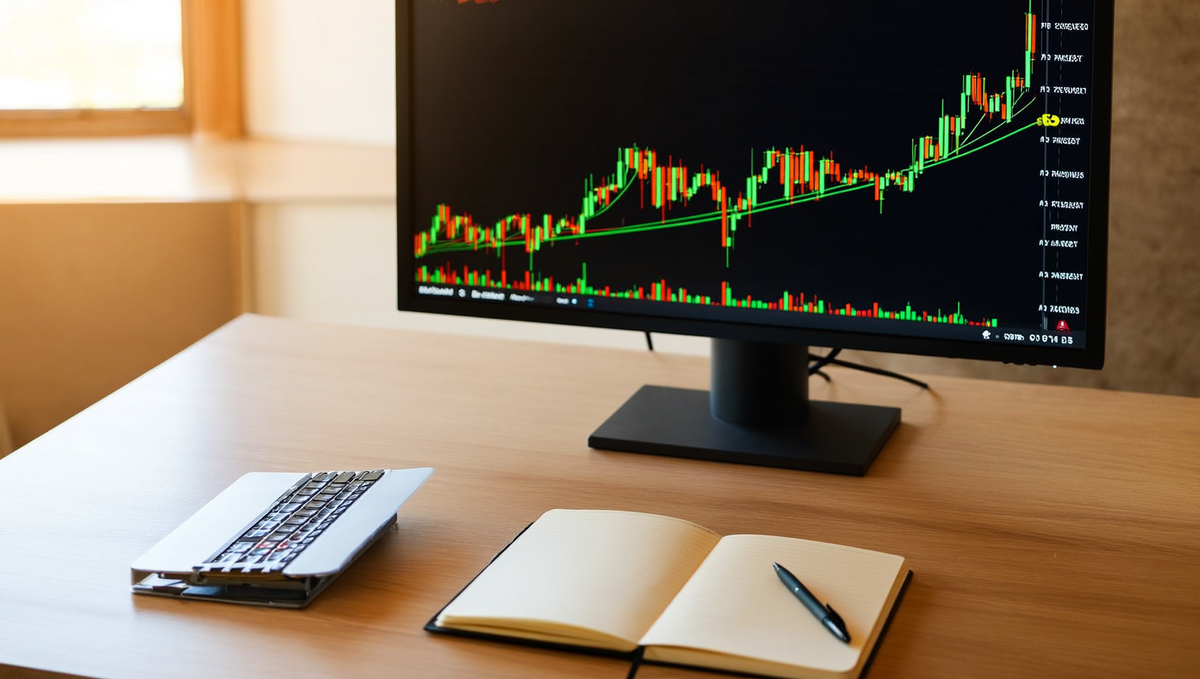
Run the checklist before you look at a single chart candle. Score the day, get your size tier, then and only then decide whether you're trading at all. This is the prop trader daily routine that separates the funded from the blown — a mechanical sequence executed the same way on a calm Tuesday and on NFP Friday.
The pre-market chaos check: what belongs on the checklist
Four inputs, five minutes, before market open:
- Economic calendar scan — tier-one releases (FOMC, NFP, CPI) inside your session window, flagged by time.
- Current ATR vs 20-day average — pull the 14-period ATR on your primary instrument and compare it to its 20-day mean. This single ratio drives your size tier.
- Overnight gap — measure the gap from prior close, especially on indices after an overnight headline.
- Spread condition on XAUUSD — gold's spread widens fast around news; if it's running 3x normal at 8:29am before a 8:30am release, that's your answer on whether to be in the market at all.
This is the pre-market checklist trading desks run daily and retail traders skip — and it's the difference between reacting to chaos and pricing it in ahead of time.
Position-size step-downs around FOMC, NFP and CPI
Position sizing high volatility days isn't discretionary — it's a table you follow.
| Condition | Size tier | Rule |
|---|---|---|
| ATR at or below 20-day average | Full size | Normal risk per trade, stops off ATR-based stop placement, not round numbers |
| ATR ≥ 1.5x average, or tier-one release inside session | Half size | Cut risk per trade by 50%, widen stop to reflect the ATR expansion |
| 15 minutes either side of FOMC / NFP release | Flat | No open positions, no new entries — slippage and spread make R:R meaningless in this window |
This is how to stay calm during FOMC news trading: you're not managing emotion in the moment, you're flat before the moment arrives.
The post-loss cool-down protocol after a stop-out
Two consecutive stop-outs trigger a mandatory 20-30 minute walk away from the screen. No exceptions, no "just one more setup." When you're back, re-run the full pre-market checklist before any new entry — market conditions may have shifted, and so has your state. Hard stop for the day: -2R. Not the prop firm's daily loss limit, well inside it. You want distance between your personal circuit breaker and the account-killing one.
Daily caps: 3-5 trades, 2-3 instruments, 45-50 minute focus blocks
Separate analysis from execution — plan in one block, execute in another. Cap yourself at 3-5 trades and 2-3 instruments maximum; more than that and you're not trading a plan, you're gambling on volume. Work in 45-50 minute focus blocks with real breaks between them — attention degrades past that window and emotional control trading rules only hold up when the brain running them isn't fatigued. Protect 7-9 hours of sleep non-negotiably; sleep debt is the fastest route back to the anxiety-to-denial hinge.
How do prop traders manage stress during and after a losing session?
Prop traders manage stress by running pre-decided physical protocols, not by trying to "feel better" in the moment — you stand up, cut screens for 90 seconds, restate your plan out loud, and you flatten and log every session the same way whether it was your best day or your worst. Psychology of consistency in trading isn't a mindset you summon on demand; it's a routine you built when you were calm, executed when you're not.
Desk-level resets you can run in 90 seconds
When a trade goes against you hard — stopped out on a spike, slipped fill on XAUUSD during a data release, a two-loss run in your first 20 minutes — the loop that gets traders in trouble is staring at the chart, watching price, and negotiating with yourself about re-entry. Break the loop physically. Stand up. Turn screens off or walk away from the desk entirely. Take four or five extended exhales — longer out-breath than in-breath, which is what actually downshifts the nervous system, not the inhale. Then say your plan out loud: "One trade per instrument, stop off ATR, max 3-5 trades today, I am at -1R." Hearing your own rules in your own voice re-engages the analyst brain instead of the wounded one. This is the core of trading stress management routine work — it's mechanical, not motivational.
Session cut-offs and the end-of-day shutdown routine
How do prop traders manage stress after the losses stack up? They shut the session down the same way every time. Flatten every position. Log the session — entries, exits, R multiple, whether each trade matched the plan or not. Close the platform. Then walk away. The rule that matters most: the full review doesn't happen until at least an hour after the last trade closes. Review it immediately and you're writing it as the loser — defensive, self-justifying, hunting for reasons it wasn't your fault. Wait an hour, eat something, get outside, and you review it as the analyst — the version of you that can actually see the plan deviation and fix it tomorrow.
Separating your identity from your equity curve
The traders who blow up funded accounts are almost never the ones who had a bad day. They're the ones who couldn't have a bad day without it meaning something about them. If your self-worth is tied to today's P&L, a normal -1R session reads as a threat, and the instinct is to escalate size to "fix" it before the day ends — which is exactly the anxiety-to-denial hinge that turns one loss into a blown daily loss limit. The antidote is measuring yourself on process metrics instead of outcome: rule-adherence rate, average R per trade, number of plan deviations per week. A trader who followed the plan on five losing trades had a good day. A trader who broke the plan on one winner had a bad one — the P&L just hasn't told them yet. We'll build out exactly how to track those process metrics in the next section.
Ready to trade funded capital?
Choose your path — Instant Accounts, One-Step or Two-Step Challenges — from just $23, with up to $300,000 in funded capital.
Choose your challengeProp rule mechanics as external willpower
The rulebook isn't there to trip you up — it's the willpower you don't have to supply yourself on the day your judgment is worst. A daily loss limit, a maximum drawdown prop firm ceiling, and a consistency rule prop firm requirement aren't obstacles between you and a funded account. They're a pre-built discipline system that makes the decisions for you when you're least equipped to make them well.
The daily loss limit as a psychological circuit breaker
The single worst decision a stressed trader makes isn't a bad entry — it's the decision to keep going after the third loss of the day. A daily loss limit removes that decision entirely by making it external and non-negotiable. But don't wait for the firm's number to stop you. Set your own circuit breaker at -2R — two full risk units, using your standard R-multiple risk unit per trade — and stop trading when you hit it, regardless of what the firm's actual daily loss limit allows. If your firm's limit sits at -5% and your personal -2R breaker equates to roughly -1.5%, you structurally never touch the firm's ceiling. The firm's rule becomes a backstop you never need, because you built your own stricter one first.
Maximum drawdown: the rule that punishes escalation
Maximum drawdown — especially trailing variants that ratchet down as your equity peaks rise — exists specifically to punish the size-escalation instinct that follows a loss. Revenge-sizing to "win it back" is exactly the behavior that a trailing drawdown mathematically penalizes hardest: a bigger position after a loss doesn't just risk a bigger loss, it compresses your remaining room to maneuver against the trailing floor. Traders who understand this stop treating drawdown limits as a countdown clock and start treating them as proof that flat, repeatable sizing is the only mathematically survivable path. For the mechanics of how trailing versus static drawdown is calculated across challenge types, see our drawdown rules guide.
How consistency rules force uniform position sizing
A consistency rule caps how much of your total profit can come from a single day or single trade — which sounds like a restriction until you realize it solves the biggest-loser-day problem for you. If no single day can carry the account, then no single day can sink it either. The only viable approach under a consistency rule is uniform risk per trade: same R-multiple, session after session, regardless of conviction level. That's not a compliance workaround — it's the exact behavior good risk management demands anyway.
| Rule | What it stops | Psychological function |
|---|---|---|
| Daily loss limit | "One more trade" spiral | External stop-loss on your own judgment |
| Max drawdown (trailing) | Size escalation after losses | Punishes revenge-sizing mathematically |
| Consistency rule | One outsized day carrying the account | Forces uniform R per trade |
Read the rulebook of any Two-Step or Three-Step Challenge with this lens and the restrictions stop looking arbitrary — they're the exact constraints a disciplined trader would impose on themselves anyway, just enforced from outside instead of from will.
Where discipline breaks most: XAUUSD and US100
Two spots on the platform account for the majority of blown challenges: gold around news, and US100 in the first half hour of the cash open. Across For Traders evaluations, XAUUSD is the single most-traded instrument on the platform, and it's also the fastest route to a daily loss limit breach. US indices are the second-largest cluster, and the opening range of the US100 (NSDQ) session produces the highest concentration of rule violations we see — oversized entries, moved stops, revenge trades, all within thirty minutes of the bell.
Gold: spread widening, ATR expansion and the stop that gets hunted
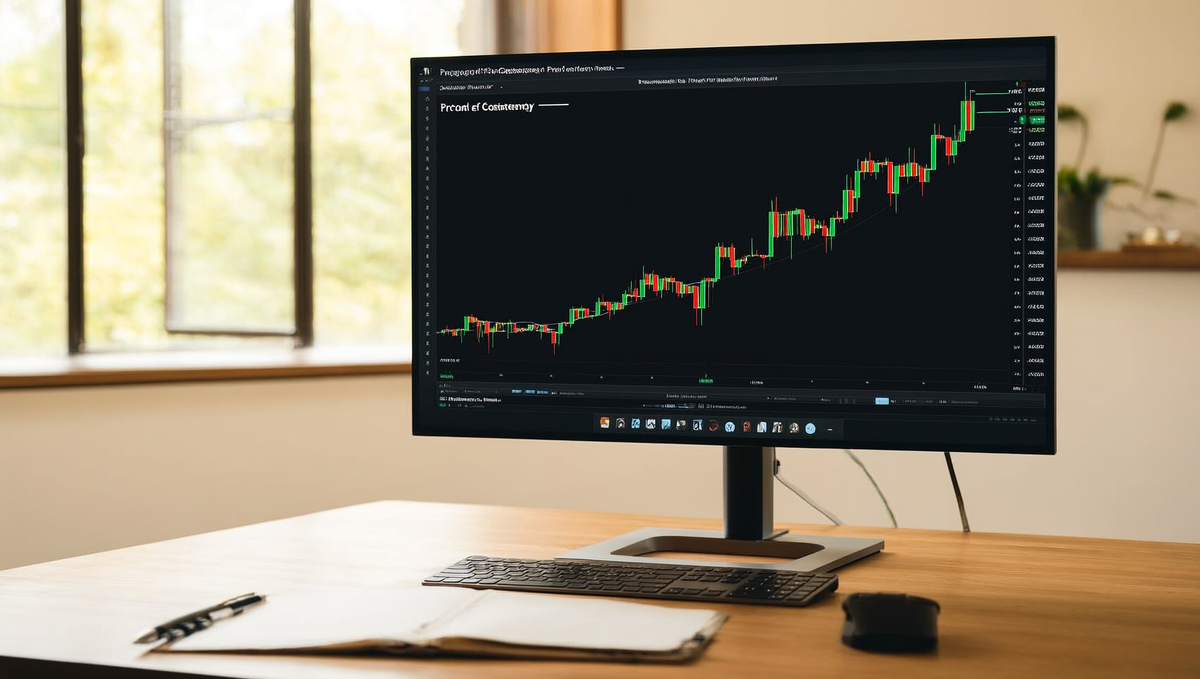
XAUUSD volatility doesn't scale up smoothly — it steps up. Around tier-one releases (CPI, NFP, FOMC), spreads on gold can widen two to three times their normal resting width in seconds, and ATR on the 5-minute chart can double inside a single candle. A stop parked at a round number — 3,350, 3,400 — sits exactly where resting liquidity clusters, and it gets filled a tick before the "real" move continues in your direction. That's not bad luck. That's the stop being visible to anyone reading the order book, and gold's depth thins out precisely when volatility spikes, so it takes less size to move price through a round level.
Gold trading discipline means treating the round number as the thing you avoid, not the thing you anchor to. If structure says your stop belongs near a level, push it 1.5x ATR beyond that structure instead — the extra distance costs you a slightly worse R:R on paper, but it keeps you out of the hunt zone and in the trade when price does what you expected it to.
US100 and the first 30 minutes of the cash open
The opening range on US100 NSDQ index open volatility is where overnight positioning, gap fills and algo-driven order flow collide. ATR in that first 30 minutes routinely runs 3-4x the intraday average, and direction flips more than once before the range settles. Traders who enter on the first breakout are effectively betting on noise, and the data on rule violations bears that out — most challenge failures tied to US100 trace back to a position opened before 9:30am ET had a chance to establish itself.
Instrument-specific rules that survive contact with volatility
- ATR stop placement gold: stop goes 1.5x ATR beyond structure, never on the round number — even if that means a wider stop than you'd like.
- No gold entries in the two minutes surrounding a tier-one release. Not a tighter stop, not smaller size — no entry. The spread alone will eat the edge.
- No US100 entries until the opening range has resolved. Let the first 30 minutes print, then trade the range break or the fade — not the guess.
- Size in risk units, not lots. A wider ATR-based stop automatically shrinks your position size if you're sizing by fixed risk — the rule protects itself once it's built into your position formula.
These aren't restrictions you fight against mid-trade. They're decisions made in advance, which is the entire point — trading discipline during high volatility is just pre-market rules refusing to negotiate once the candles start moving fast.
Trading psychology for crypto prop traders in a 24/7 market
Crypto never closes, so your discipline has to close the market for you. FX and index traders get a built-in reset — the 5pm close, the Sunday gap, the session bell that forces a walk away from the screen. Trading psychology for crypto prop traders has no such mechanism, which means fatigue that would get interrupted in any other asset class just keeps compounding, trade after trade, day after day.
No close, no reset: why crypto fatigue compounds
Decision fatigue trading isn't a metaphor — it's a measurable decline in judgment quality the longer you stay engaged without a break. In FX, that decline gets capped by the close. In crypto, a trader who's been watching XRP chop sideways for six hours straight is still making entries at hour seven, hour eight, with the same conviction they had at hour one — except the conviction is now running on fumes. The drawdown that a session bell would have contained instead keeps bleeding into the next candle, and the next, because there's never a hard stop forcing a reassessment. This is the single biggest psychological gap between crypto and every other asset class we see across evaluations, and almost nobody addresses it directly because there's no natural moment that demands it.
Weekend gaps, funding-rate FOMO and the always-on feed
Three pressures stack on top of standard 24/7 crypto market fatigue. First, weekend liquidity gaps — thinner books mean a normal-sized order moves price further than it would on a Tuesday afternoon, and stops that were fine on weekday volume get clipped by weekend noise. Second, crypto funding rate FOMO: when perpetual funding swings hard positive or negative, it broadcasts exactly which side of the trade is "paying," and that visible pressure pulls traders into chasing the crowded side rather than their own plan. Third, the phone. A feed that alerts on every 1% move doesn't just cost you sleep — it keeps your nervous system in a low-grade alert state that erodes the same judgment you need for your next entry.
Imposing artificial trading hours and a weekly off-switch
The fix is to build the reset the market won't give you.
- Define your trading window around your best-performing hours from your own trade log — not the hours the market happens to be open, since for crypto that's all of them.
- Treat everything outside that window as closed. No checking price, no "just looking" at charts — the market being open doesn't mean you have to be.
- Set one weekly no-trade day, fixed in advance, non-negotiable regardless of how the week's gone.
- Disable price alerts outside your window. If it can ping your phone, it can pull you into a trade you didn't plan for.
A Crypto Challenge is a genuinely useful place to test these hours before they matter with a funded account — it's structured, simulated capital, and gives you a live rep at proving your artificial close actually holds up under real screen-time temptation.
What separates traders who pass an evaluation from those who don't
Most traders who sit a prop trading challenge don't pass it — that's just the reality of evaluation-based funding, and it's true across the industry, not something unique to any one firm. The minority who do pass share a specific behaviour: they stop measuring themselves by P&L and start measuring themselves by rule adherence rate. That single shift in what you track changes what you optimise for, and it's the closest thing to a leading indicator of who survives phase two.
Process metrics that predict outcomes better than P&L
P&L on any single day is mostly noise — it's the trade you couldn't control mixed with the trade you executed perfectly. Process metrics strip the noise out. The traders who consistently pass track four things, weekly, regardless of whether the week was green or red:
- Rule adherence rate — the percentage of trades taken that matched every condition on the plan, not just the entry trigger.
- Average R multiple — average return per trade in units of risk, which tells you if your R:R discipline is intact even when win rate dips.
- Number of plan deviations — moved stops, oversized entries, revenge re-entries. Count them, don't excuse them.
- Largest single-day contribution — what percentage of the week's result came from one outlier day. A healthy curve doesn't lean on a single lucky leg.
Here's the reframe that actually matters: a losing day where you followed every rule is a successful day. A winning day where you doubled size after two losses is a failure, even though the equity curve says otherwise. That's the psychology of consistency in trading in one sentence — you're grading the decision, not the outcome.
Emotion tagging in a trading journal
A trading journal for discipline doesn't need paragraphs. It needs one word, twice per trade — your emotional state at entry and your emotional state at exit. Bored, confident, anxious, rushed, calm. Logged in seconds, reviewed in bulk. The value shows up after ten or fifteen trades, when a pattern emerges: maybe every deviation traces back to trades tagged "impatient" at entry, and every one of those happened in the first 30 minutes after a stop-out.
| Field | Logged at | Example entry |
|---|---|---|
| Setup + plan match (Y/N) | Entry | Y — pullback to 20 EMA, ATR stop |
| Emotion tag | Entry | Rushed |
| R multiple result | Exit | -1.0R |
| Emotion tag | Exit | Relieved |
| Deviation flag | Exit | None |
The weekly review that changes next week's behaviour
A journal that isn't reviewed is just a diary. The weekly review is five questions, asked every Friday or Sunday, no exceptions:
- What was my rule adherence rate this week, as a percentage?
- What emotion tag shows up most often on deviation trades?
- What time of day or news window do deviations cluster around?
- What was my average R multiple, and did it match my plan's target R:R?
- What's the one rule I'll enforce harder next week?
These prop trading challenge psychology tips only work if the output changes something concrete — a smaller size window around CPI, a hard rule against re-entry after a stop-out. The question you ask yourself at entry stays the same every single time: does this align with my plan? Never "will this trade win?" You can't control the second question. You can control the first one, every time, and that's what a funded account actually rewards.
Ready to trade funded capital?
Choose your path — Instant Accounts, One-Step or Two-Step Challenges — from just $23, with up to $300,000 in funded capital.
Choose your challengeFrequently Asked Questions
How top prop traders maintain discipline during market chaos+
Top prop traders maintain discipline by cutting position size and widening their decision window before volatility spikes, not during them. They pre-define reaction plans for NFP, FOMC, and gold gap moves so no live decision is improvised. Most run a hard daily loss limit as a circuit breaker that closes the platform, not a suggestion they can override. The edge isn't predicting chaos — it's having fewer decisions to make once it arrives, because the rules were set on a calm day.
How do prop traders manage stress during a losing session+
Prop traders manage stress by stepping away from the screen once a pre-set loss threshold hits, rather than trying to trade their way back to even. Physical distance — closing the platform, walking, breathing drills — interrupts the cortisol spike that drives revenge trades. Many log the loss immediately in a journal while it's fresh, separating the emotion from the analysis. The goal isn't feeling calm in the moment; it's having a mechanical exit from the session so stress can't compound into a second bad trade.
What is decision fatigue in trading and its early signs+
Decision fatigue is the decline in judgment quality that builds after repeated high-stakes choices in a session, and it's a leading cause of late-session blowups. Early signs include moving stops without a new reason, sizing up after a loss to "get it back," skipping your checklist because it feels tedious, and taking setups outside your normal criteria just because price is moving. It typically appears after 3-4 hours of active screen time or several consecutive trades. The fix is a hard stop on trades-per-day, not willpower.
How does a daily loss limit work as a psychological tool+
A daily loss limit functions as a psychological circuit breaker by removing the choice to keep trading once damage is done, taking the decision out of an already-compromised mind. Its real value isn't the capital it saves on any single day — it's that it prevents the emotional spiral where one loss becomes three. In a Two-Step Challenge or Funded Account, hitting the limit forces a reset before the next session instead of a doubling-down attempt. Traders who treat it as a hard stop, not a target, pass evaluations more consistently.
How should you size trades around NFP or FOMC volatility+
Cut position size by half or more, or stand aside entirely, in the minutes surrounding NFP, FOMC, and major gold volatility spikes, since spreads widen and slippage risk rises sharply. Many prop traders set a rule to avoid new entries 15-30 minutes before and after scheduled news, only re-engaging once the initial spike settles into a range. Consistency rules in evaluations also penalize outsized single-day gains, so an oversized news trade can actually work against passing even if it wins.
What does a prop firm trader mindset look like+
A prop firm trader mindset treats simulated capital with the same process discipline as personal capital, focusing on hitting a consistent process rather than chasing a single big win. It centers on protecting the daily loss limit and max drawdown as non-negotiables, since a funded account is earned through repeatable behavior, not one lucky trade. Retail traders often size up for a home run; funded traders size for survival across dozens of sessions, because the evaluation and the payout both reward consistency over peak performance.
How do you stop revenge trading after a stop-out+
Stop revenge trading by building a mandatory cooldown into your rules — no new trade for a set period, or for the rest of the day, after a stop-out. The urge to immediately re-enter comes from wanting to fix the emotion, not the trade setup, and that's rarely a good reason to click buy or sell. Journaling the stop-out before doing anything else forces a pause and shifts focus from the loss to the lesson. Traders who automate this cooldown into a hard rule remove it as a live decision entirely.
How is crypto prop trading psychology different from forex+
Crypto prop trading psychology differs mainly because the market never closes, removing the natural reset that a forex session close provides. Without a bell to end the day, traders need self-imposed session boundaries — a fixed number of trading hours or a hard stop after hitting the daily loss limit — since the market will always offer another candle to chase. A Crypto Challenge also sees sharper overnight volatility swings, so pre-defined position sizing matters more than in less continuous markets, where fatigue and FOMO have fewer built-in breaks.
Written by
Lenka Rož Schánová
Operations & Risk, For Traders
Lenka focuses on the operational and risk side of running a prop trading firm — the rules behind evaluations, why drawdown limits exist, and the patterns that distinguish traders who pass from those who don't. She writes for traders who want to understand the framework they're trading inside, not just the markets they're trading.
Follow on LinkedInReady to trade funded capital?
Choose your path — Instant Accounts, One-Step or Two-Step Challenges — from just $49, with up to $300,000 in funded capital.
Choose your challengeTrade up to $300,000
Choose challenge