Gold Futures Trading Hours: The Complete GC & MGC Schedule
Gold futures trading hours: COMEX gold (GC and MGC) trades on CME Globex Sunday 6:00 p.m. ET to Friday 5:00 p.m. ET, with a daily 5–6 p.m. ET break.
By Marcel Hambálek · Senior Trader, For Traders
Gold futures (COMEX GC and Micro Gold MGC) trade on CME Globex from Sunday 6:00 p.m. ET to Friday 5:00 p.m. ET, with a 60-minute maintenance break each weekday from 5:00 to 6:00 p.m. ET. That is a 23-hour session, five days a week. Daily settlement is set at 1:30 p.m. ET — hours before the session actually closes.
Key takeaways
- COMEX gold now trades electronically on CME Globex: Sunday 6:00 p.m. ET open, Friday 5:00 p.m. ET close, 23 hours a day, five days a week.
- A 60-minute maintenance break runs 5:00–6:00 p.m. ET every weekday — in UTC that is 21:00–22:00 during US daylight time and 22:00–23:00 during US standard time.
- MGC (Micro Gold) trades the exact same hours as GC; only contract size, tick value ($1 vs $10) and depth of book differ.
- The 1:30 p.m. ET daily settlement price is not the close — trading continues until 5:00 p.m. ET.
- For Traders platform data across 7.6M+ trades shows the volume and range peak at 12:00–15:00 UTC, a secondary Asian peak at 00:00–02:00 UTC, and a dead zone at 17:00–21:00 UTC.
- CME holidays bring 1:00 p.m. ET early closes (Independence Day, Thanksgiving eve/day, Christmas Eve) — verify the 2026 CME holiday calendar before sizing around them.
Watch: related video
Gold futures trading hours at a glance (GC and MGC)
Gold futures (GC) and Micro Gold (MGC) trade Sunday 6:00 p.m. ET through Friday 5:00 p.m. ET on CME Globex, with a daily 60-minute maintenance break from 5:00 to 6:00 p.m. ET. That's a 23×5 session — 23 hours a day, five days a week, the same clock whether you're trading a full-size GC contract or the 1/10th-size MGC. No separate schedule for the micro. If you know GC trading hours, you already know MGC trading hours.
What time does COMEX open?
Literal answer: COMEX opens at 6:00 p.m. ET on Sunday and reopens at that same 6:00 p.m. ET mark every weeknight after the maintenance break, running through until 5:00 p.m. ET Friday. That's the gold futures open time you set your alarm for if you're trading the Sunday gap, and it's the same clock for every COMEX-listed gold contract — GC, MGC, and the options that sit on top of them.
Is COMEX the same thing as CME Globex gold?
Functionally, yes — and this trips people up more than anything else on this topic. COMEX is the exchange license that lists gold futures; CME Globex is the electronic platform that actually executes the trades. The open-outcry trading pit era ended years ago. When you see "comex opening hours" quoted anywhere today, what's actually being described is the CME Globex electronic session for COMEX-listed products. There's no separate floor session running on a different clock — one screen, one order book, one schedule.
Gold futures hours in ET, UTC, CET and London time
Converting time zones mid-trade is how missed entries happen. Here's the full session mapped across the four zones traders ask about most, so you're not doing math at 2 a.m.
| Event | Eastern Time (ET) | UTC | CET (Prague/Frankfurt) | London |
|---|---|---|---|---|
| Weekly open | Sun 6:00 p.m. | Sun 22:00 / 23:00* | Sun 23:00 / midnight* | Sun 11:00 p.m. |
| Daily maintenance break starts | 5:00 p.m. | 21:00 / 22:00* | 22:00 / 23:00* | 10:00 p.m. |
| Daily maintenance break ends | 6:00 p.m. | 22:00 / 23:00* | 23:00 / midnight* | 11:00 p.m. |
| Daily settlement | 1:30 p.m. | 17:30 / 18:30* | 18:30 / 19:30* | 6:30 p.m. |
| Gold futures closing time (weekly) | Fri 5:00 p.m. | Fri 21:00 / 22:00* | Fri 22:00 / 23:00* | Fri 10:00 p.m. |
*UTC and CET offsets shift with US/EU daylight saving transitions, which don't always change on the same weekend — always double-check the week of a DST switch.
Daylight saving: why your gold futures hours move twice a year
CME never touches the schedule for gold futures — the open, the break and the close stay fixed at 6:00 p.m., 5:00 p.m./6:00 p.m., and 5:00 p.m. Eastern Time, all year. What actually moves is the clock underneath it. If you're quoting the session in UTC, CET or London time, your gold futures market hours shift by a full hour twice a year, and the two shifts don't land on the same weekend.
US EDT vs US EST: the same session, two different UTC clocks
Chicago and New York run on Eastern Time, and Eastern Time itself flips between EDT (UTC-4) in summer and EST (UTC-5) in winter. The COMEX gold trading hours 2026 schedule — Sunday 6:00 p.m. to Friday 5:00 p.m. ET, five-day week, 60-minute daily break — is anchored to that local clock, not to UTC. So when a US-based trader tells you "the break is at 5 p.m.," that's true in January and true in July. The UTC time of that same break, however, is 22:00 in EST months and 21:00 in EDT months. Nothing about liquidity or the break itself changed — only the label you'd put on it if you're not in New York.
2026 clock-change dates that shift your gold session
- US DST starts: Sunday, March 8, 2026 (clocks move to EDT, UTC-4)
- US DST ends: Sunday, November 1, 2026 (clocks move back to EST, UTC-5)
- EU/UK DST starts (CET→CEST, GMT→BST): Sunday, March 29, 2026
- EU/UK DST ends (CEST→CET, BST→GMT): Sunday, October 25, 2026
Why European traders get caught out for three weeks
The US and Europe don't flip their clocks on the same weekend, and the spring gap is the one that bites. The US moves to EDT on March 8, 2026 — three full weeks before Europe moves to CEST/BST on March 29, 2026. During that window, everyone in London, Frankfurt or Prague quoting the session in local time is off by an hour without realizing it, because the assumption "US session = same UTC offset it was last week" quietly breaks. That's exactly when traders misread the maintenance break and end up placing orders — or checking margin — inside a window they thought was closed.
| Session event (ET, fixed) | UTC — EST months | UTC — EDT months | CET/CEST (approx.) | London GMT/BST (approx.) |
|---|---|---|---|---|
| Weekly open — Sun 6:00 p.m. | 23:00 | 22:00 | 00:00 / 23:00 | 23:00 / 22:00 |
| Daily break start — 5:00 p.m. | 22:00 | 21:00 | 23:00 / 22:00 | 22:00 / 21:00 |
| Daily break end — 6:00 p.m. | 23:00 | 22:00 | 00:00 / 23:00 | 23:00 / 22:00 |
| Daily settlement — 1:30 p.m. | 18:30 | 17:30 | 19:30 / 18:30 | 18:30 / 17:30 |
| Weekly close — Fri 5:00 p.m. | 22:00 | 21:00 | 23:00 / 22:00 | 22:00 / 21:00 |
The practical takeaway: don't bookmark gold futures trading hours in UTC, CET or London time at all. Bookmark them in ET. It's the one clock in this table that never moves, and it's the one CME actually builds the schedule around.
The 60-minute daily maintenance break — and what happens to your orders
Every weekday, GC and MGC go dark for exactly one hour: 5:00–6:00 p.m. ET. That's the CME Gold futures daily maintenance break — not a holiday, not thin liquidity, an actual halt where the exchange stops matching orders. It happens Monday through Thursday and again after the Friday reopen doesn't apply — Friday's break is the one that turns into the weekend close instead of a reopen. Everywhere else, Sunday through Thursday, the market comes back at 6:00 p.m. ET like clockwork.
Exactly when the break runs, in every zone
The 5:00 p.m. ET start doesn't move — CME builds the whole session around that fixed point in New York. What moves is everyone else's clock, because of daylight saving offsets on both sides of the Atlantic.
| Period | ET | UTC | CET |
|---|---|---|---|
| US daylight time (roughly Mar–Nov) | 5:00–6:00 p.m. | 21:00–22:00 | 23:00–00:00 |
| US standard time (roughly Nov–Mar) | 5:00–6:00 p.m. | 22:00–23:00 | 23:00–00:00 |
Notice the CET column barely shifts even though UTC does — that's the DST mismatch between the US and Europe stacking up in the shoulder weeks each spring and fall. If you're trading gold futures from Prague or Madrid, don't trust "11 p.m." as a fixed anchor twice a year — check the ET time instead.
Day orders, GTC orders and native stops through the halt
This is the part most schedules skip entirely, and it's the part that actually costs money. Day orders are cancelled at the end of the session — anything you placed as a day order simply doesn't exist anymore once the break hits, and it does not carry into the next session automatically. If you wanted that limit order live tomorrow, you have to re-enter it.
GTC (good-till-cancelled) orders survive the halt. They sit on CME's book through the 60-minute maintenance window and are still working when the market reopens at 6:00 p.m. ET.
Here's the trap: native stop orders resting on your account — whether day or GTC in designation — are not "protecting" your position during the halt itself. A stop is a trigger order. It can only fire once trading resumes and a price prints through your level. For that one hour, your stop is armed but inert.
Open positions, margin and gap exposure across the break
Open positions stay open. Margin requirements still apply exactly as before — the break doesn't pause your exposure, it just pauses the ability to manage it. That's the real risk: if news breaks during the halt — a surprise geopolitical headline, a leaked data point — gold can reopen well away from where it closed at 5:00 p.m. Your stop only executes at the next available price once trading resumes, which means slippage on reopen is a real possibility, not a theoretical one. A $30 stop can fill $45 away if the reopen gaps.
If you're not comfortable holding through a daily halt, that's a legitimate reason to flatten before 5:00 p.m. rather than assume your stop has you covered. For the mechanics of setting stops that actually hold up around session breaks, see our MT5 stop-loss placement guide.
1:30 p.m. ET settlement vs the 5:00 p.m. ET close: not the same thing
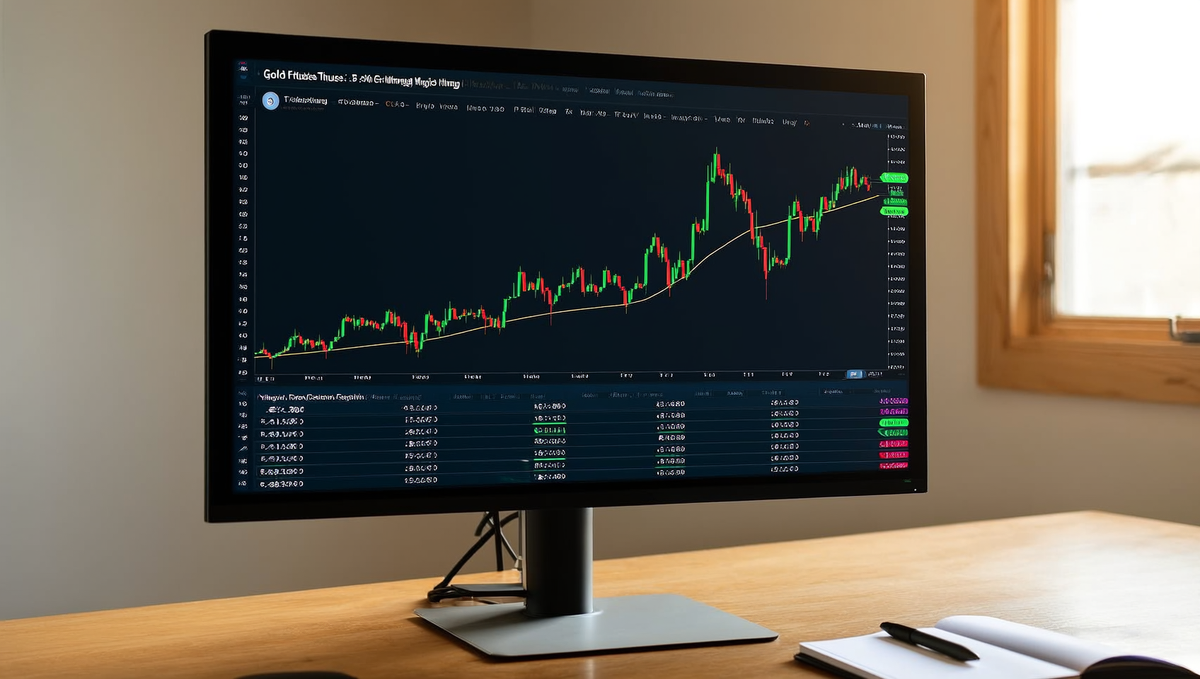
Daily settlement on gold futures happens at 1:30 p.m. ET — the closing bell doesn't ring until 5:00 p.m. ET, and the market keeps trading in between. Mixing these two up is probably the single most common mistake newer futures traders make with the GC and MGC schedule, and it can leave you confused about why your account balance moved when "nothing happened" on the chart.
What the 1:30 p.m. ET daily settlement price actually is
The gold futures settlement time is set by CME Group at 1:30 p.m. ET, and it's not just a snapshot of whatever price happens to print at that second. Settlement is calculated from trading activity in a defined closing window around that time, producing an official reference price the exchange uses to mark every open position. That number becomes the basis for margin calculations, daily statements, and — if you're holding into expiry — final contract valuation. It's an exchange mechanism, not a market close. Trading on GC and MGC continues normally straight through the afternoon session and into the evening, all the way to the 5:00 p.m. ET break.
Why your P&L and margin change hours before the close
Because settlement is the official mark, your daily profit and loss — the number your broker or prop firm reports — gets fixed off the 1:30 p.m. ET price, not off wherever gold happens to be trading at 5:00 p.m. or at 6:00 p.m. when the new session opens. This matters for anyone tracking a daily loss limit inside a funded account: your realized daily number is effectively locked in at settlement, even if the market runs another $8 or $10 in your favor afterward. Margin requirements get recalculated off the same mark. If gold has moved sharply into the settlement window, don't be surprised if your available margin looks different at 2:00 p.m. than it did at noon, even with your position unchanged.
How settlement affects front-month liquidity and the roll
Volume tends to bunch into the minutes around 1:30 p.m. ET — institutional flow, index-linked rebalancing, and anyone squaring up ahead of the mark all show up in that window, which is exactly why the tape often thins noticeably right after settlement prints. You'll see spreads widen and fills get less clean in the early afternoon lull that follows.
This effect compounds during contract roll and expiry. As the front-month contract approaches its last trading day, front-month liquidity doesn't just fade evenly — it migrates. Volume and open interest shift into the next contract month in the days around settlement, sometimes abruptly, as funds and larger players roll their positions rather than stand for delivery. If you're trading the expiring month into that window, expect wider bid-ask spreads and less depth than you're used to; if you're not deliberately trading the roll, it's usually cleaner to be in the new front month before that liquidity shift is well underway.
MGC vs GC vs 1OZ: identical hours, very different risk per tick
MGC trading hours are exactly the same as GC — Sunday 6:00 p.m. ET through Friday 5:00 p.m. ET on CME Globex, with the identical 5:00–6:00 p.m. ET maintenance break every weekday. The clock doesn't change between contracts. What changes is how much each tick costs you, and that's the number that actually matters when you're managing a fixed daily loss limit.
MGC trading hours — the same Globex session as GC
There's no separate schedule to memorize for Micro Gold. MGC opens and closes on the same Globex session as full-size GC (Gold Futures), rolls through the same daily break, and sits under the same CME Group holiday calendar. If you've already got GC's hours mapped to your trading plan, MGC costs you nothing extra to learn — the only homework is on sizing, not timing.
Contract size, tick size and tick value compared
This is where the three products diverge sharply. GC represents 100 troy ounces of gold, MGC represents 10 troy ounces, and 1 OZ Gold Futures (1OZ) represent exactly what the name says — one troy ounce. That tenfold-and-further step down in notional size is deliberate, aimed at traders who want gold exposure without gold-sized swings in their account.
| Contract | Contract size | Tick size | Tick value |
|---|---|---|---|
| GC (Gold Futures) | 100 troy oz | $0.10/oz | $10.00 |
| MGC (Micro Gold Futures) | 10 troy oz | $0.10/oz | $1.00 |
| 1OZ (1 Oz Gold Futures) | 1 troy oz | $0.10/oz | $0.10 |
Same minimum price increment across all three — $0.10 per ounce — but tick value scales directly with contract size. One GC tick equals ten MGC ticks, and one MGC tick equals ten 1OZ ticks. Liquidity also stacks in that order: GC still carries the deepest order book and the tightest spreads session over session, MGC has built substantial depth of its own as futures prop trading has grown, and 1OZ trades thinner — fine for precision scaling, less ideal if you need to get large size filled fast around a number like NFP.
Which contract fits a prop evaluation drawdown
Run the math against your daily loss limit before you pick a contract, not after a bad fill. If your evaluation account caps daily loss at $500, a handful of adverse GC ticks against a full-size position can burn through that limit in minutes — a 15-tick move against one GC contract is $150, against three contracts it's $450, and you're one more tick from a breach. The same 15-tick move on MGC costs $15 per contract, giving you room to size into a position, get it wrong, and still have daily loss limit left to trade the reversal.
That's the practical answer to mgc vs gc for anyone evaluating on a capped account: GC suits traders with larger accounts or those trading small, deliberate size; MGC lets you express the same view with drawdown that fits a small evaluation; 1OZ is worth knowing about if you're fine-tuning position size to the dollar. Match the contract to the loss limit, not the other way around.
Ready to trade funded capital?
Choose your path — Instant Accounts, One-Step or Two-Step Challenges — from just $23, with up to $300,000 in funded capital.
Choose your challengeWhich gold hours actually pay: 7.6 million trades of volatility data
The best time to trade gold futures is 12:00–15:00 UTC, the London/New York overlap — that's where volume and realised range both peak across our platform data. We pulled hourly volume and ATR distribution from 7.6 million-plus trades executed on For Traders since mid-2024, and XAUUSD isn't just popular here — it's the single most-traded instrument on the entire platform. When your bread-and-butter asset generates that much sample size, the hourly pattern isn't a theory. It's a map.
The 12:00–15:00 UTC peak: London/New York overlap
This three-hour window is where London desks are still active and New York has just opened. Gold volatility by hour peaks hard here — our data shows average realised range in this block running roughly 1.8–2.2x the 24-hour mean, with volume climbing in step. This is also where the deepest order books show up, meaning fills are cleaner and slippage on stops is lowest relative to the range being traded. If you only trade one window a day, this is it.
The 00:00–02:00 UTC secondary peak: Asia and Shanghai
A smaller but real bump shows up as Tokyo opens and the Shanghai Gold Exchange begins pricing physical demand. It won't match the London/New York overlap in raw range, but volume ticks up meaningfully — enough that spreads stay tight and the move is tradeable, not just noise. Traders running Asia-session strategies on gold futures trading hours should treat this as the legitimate second window, not a consolation prize.
The 17:00–21:00 UTC dead zone — and why traders lose there
Post-New York, pre-Tokyo: this is where average range collapses but spread doesn't shrink proportionally. Our ATR hourly volatility distribution shows this block sitting at roughly 40–55% of the daily average range, while realized spread-to-range ratio is actually worse than during the peak — you're paying overlap-level cost for lull-level movement. Traders who size stops for the 12:00–15:00 window and then hold positions into this dead zone are the ones who get chopped by noise that isn't backed by real participation. It's a quiet killer in evaluations, not a dramatic one.
FOMC, CPI and NFP release times vs the liquidity window
The scheduling isn't an accident worth ignoring. NFP and CPI both land at 8:30 a.m. ET (13:30 UTC), and the FOMC statement drops at 2:00 p.m. ET (19:00 UTC) with the press conference at 2:30 p.m. ET — check release dates directly via the Federal Reserve calendar. NFP and CPI sit squarely inside the London/New York overlap, where liquidity can absorb the volatility spike. FOMC lands right at the edge of the dead zone, which is exactly why post-FOMC price action can look erratic relative to the size of the news — the deepest liquidity has already started thinning by the time the presser wraps.
| UTC Window | Session | Relative Volume | Relative Range (ATR) |
|---|---|---|---|
| 00:00–02:00 | Asia / Shanghai | Moderate | ~70–85% of daily avg |
| 12:00–15:00 | London/New York overlap | Highest | ~180–220% of daily avg |
| 17:00–21:00 | Post-NY lull | Lowest | ~40–55% of daily avg |
2026 CME holiday schedule: early closes vs full closures
Gold futures don't run the same 23-hour clock every week of the year — around eight sessions in 2026 either close early at 1:00 p.m. ET or shut down entirely, and trading a full position size into one of these thinned tapes is how a normal-looking limit order turns into a bad fill. The gold futures holiday schedule 2026 splits into two categories: early closes and full closures, and they behave differently.
1:00 p.m. ET early-close days in 2026
On an early-close day, COMEX gold trading hours 2026 compress to a single morning session — Globex opens as normal overnight but trading halts at 1:00 p.m. ET instead of running through the 5:00 p.m. close. These sit around Independence Day observance, Thanksgiving week, Christmas Eve, and the New Year's Eve pattern the exchange repeats annually.
| Date (2026) | Occasion | GC/MGC Close Time (ET) |
|---|---|---|
| Fri, Jul 3 | Independence Day observance | 1:00 p.m. |
| Wed, Nov 25 | Day before Thanksgiving | 1:00 p.m. |
| Fri, Nov 27 | Day after Thanksgiving | 1:00 p.m. |
| Thu, Dec 24 | Christmas Eve | 1:00 p.m. |
| Thu, Dec 31 | New Year's Eve | 1:00 p.m. |
Full closures and the Good Friday exception
Full closures are different — no session at all, not even overnight Globex. New Year's Day (Thu, Jan 1), Martin Luther King Jr. Day (Mon, Jan 19), Presidents Day (Mon, Feb 16), and Christmas Day (Fri, Dec 25) all fall into this bucket for gold futures. Thanksgiving Day itself (Thu, Nov 26) is a full closure too, sandwiched between two early-close days — that's the giveaway that Thanksgiving week behaves like nothing else on the calendar, with three consecutive abnormal sessions in a row.
Good Friday (Fri, Apr 3, 2026) is the odd one out. Equity markets close outright, but CME keeps a modified metals session running — treat it like an early-close day rather than assuming it's dark, and confirm the exact cutoff on the official CME Group holiday calendar before you plan around it, since the exchange has adjusted Good Friday hours in past cycles.
How to size the day before a holiday session
A holiday-thinned tape isn't just shorter — it's structurally worse liquidity. The same clip that fills clean on a Tuesday morning can slip several ticks wider on Christmas Eve, because market makers pull size ahead of the desk going dark. Treat the session before a full closure like a mini-Friday-before-NFP:
- Cut position size on the entry into an early-close or pre-holiday session — don't assume normal spread and depth.
- Close or reduce swing positions before a full closure day rather than holding through a dead tape with no ability to react.
- Widen your mental model of slippage on stops — a stop that would fill within a tick on a normal Tuesday can air-fill several ticks worse when volume is 40-50% of average.
This table is date-stamped for 2026 and reflects the standard CME holiday calendar pattern, but the exchange does adjust specific dates and modified-session rules from year to year — always cross-check the live calendar on cmegroup.com before you size a position going into a holiday week.
Gold futures hours vs XAUUSD spot hours on a prop platform
Short answer: the two schedules rhyme but don't match. Both GC/MGC futures and XAUUSD spot gold run a near-24-hour week from Sunday evening to Friday evening with a short daily pause, but the exact break time, quoting convention, and cost structure are different enough to change how you plan entries around news and rollover.
Where the two schedules diverge (and where they don't)
CME gold futures break daily from 5:00 to 6:00 p.m. ET for maintenance. XAUUSD on most prop platforms — including a gold challenge account trading spot — typically pauses for a shorter rollover window, often five minutes around the same 5:00 p.m. ET mark, because spot gold pricing is derived from a rolling interbank/futures-linked feed rather than a single exchange session. Both instruments open Sunday evening (5:00-6:00 p.m. ET is common for spot) and close Friday evening. The practical overlap is huge — if you're trading the London or New York session, you won't notice a difference day to day. Where it matters is weekend gap risk and the exact minute liquidity thins out before a break; futures traders can see this documented explicitly on the CME Globex calendar, while spot traders are relying on their platform's stated hours.
Spread, tick value and rollover differences that matter
The cost structure is where GC/MGC and XAUUSD genuinely separate. Futures quote in dollars per troy ounce with a fixed tick ($10 per 0.10 tick on GC, $1 on MGC), commission-based, and spreads compress in liquid CME hours (8:20 a.m.-1:30 p.m. ET) then widen in the Globex overnight. XAUUSD spot is typically spread-only or spread-plus-small-commission, quoted to the pip/point, with spread behavior tied to broker liquidity rather than a single exchange order book. Around the 1:30 p.m. ET CME settlement, futures often see a volume and volatility spike as day-session participants square positions into the print — spot XAUUSD doesn't settle at a fixed daily time, so that particular pattern is a futures-only phenomenon you need to watch for if you're holding a GC/MGC position through midday.
| Factor | GC/MGC Futures | XAUUSD Spot |
|---|---|---|
| Weekly session | Sun 6pm ET – Fri 5pm ET | Sun evening – Fri evening (platform-specific open) |
| Daily pause | 5:00–6:00 p.m. ET (1 hr) | ~5-min rollover window near 5pm ET |
| Settlement/reset | 1:30 p.m. ET daily settlement | No fixed daily settlement |
| Quoting | $/oz, fixed tick value | Pip/point, broker-quoted |
| Cost structure | Commission + variable spread | Spread (often built-in) |
Choosing GC/MGC or XAUUSD for an evaluation
If you already think in pips and want continuous exposure without contract rollovers, XAUUSD spot on a gold challenge is the more familiar path. If you want to trade the actual CME contract — with defined tick value, transparent settlement, and eventual real futures execution — futures prop trading through GC or MGC is the better training ground, since MGC's smaller tick size lets you size risk tightly during an evaluation. Either way, matching your instrument to your strategy's session and volatility profile matters more than which one is "better" in the abstract.
Reading the session: Sunday reopen, weekend gap and your drawdown rules
The Sunday reopen at 6:00 p.m. ET is when gold futures market open for the week — but it's a discovery window, not an entry signal. Book depth is a fraction of Tuesday's, and any headline that broke over the weekend gets repriced into the first few candles, not gradually. Treat the first hour as information gathering, not opportunity.
Framework for the first hour of the Sunday reopen
Mark three levels before you do anything else: Friday's 1:30 p.m. ET settlement price, the actual Friday 5:00 p.m. close, and wherever GC or MGC prints in the opening minutes Sunday night. The gap between settlement and reopen tells you how much weekend risk repriced instantly. If gold gapped 8-10 points on a surprise geopolitical headline, that move already happened — chasing it at 6:05 p.m. with thin liquidity means paying a spread that's nothing like what you'll see once London desks are online. Let the first hour build a range. Don't trade it.
Mapping the Asian range into the London/NY overlap
Once the Sunday-night noise settles, the session takes shape in stages. Asian hours (roughly 7:00 p.m.-3:00 a.m. ET) typically compress into a tighter range as gold consolidates ahead of European flow. Mark that Asian high and low — it's your reference box. London open (3:00 a.m. ET) often tests one side of that box, and the real expansion tends to land in the 12:00-15:00 UTC window, when London and New York overlap and US data (CPI, NFP, FOMC) hits. That's where daily ATR gets spent. A repeatable routine looks like this:
- Mark Friday settlement and the Sunday reopen print.
- Box the Asian high/low as your reference range.
- Watch for a London test of that box, not a blind breakout entry.
- Let the 12:00-15:00 UTC window confirm direction before sizing up.
How the Friday close and 5 p.m. ET break interact with daily loss limits and trailing max DD
This is where prop evaluation risk rules and the CME calendar stop being separate conversations. Your daily loss limit resets on the platform's day boundary — which is usually tied to broker/platform time, not to the 1:30 p.m. ET settlement print. That mismatch matters: a position that's fine relative to settlement can still blow through your daily limit if it moves hard in the hours after settlement but before your platform's day rolls over.
Weekend gap risk is the sharper edge. A trailing max drawdown doesn't care that you were asleep — if gold gaps through your stop level on Sunday reopen, that loss prints against your account exactly like a Tuesday-afternoon move, except you had zero ability to intervene. The practical rule: flatten or meaningfully reduce size into the gold futures friday close, respect the 5:00-6:00 p.m. ET maintenance break as your own cue to step back, and if you're holding anything over the weekend, size it as if a full ATR-range gap is your entry risk — because in gold, it sometimes is.
Ready to trade funded capital?
Choose your path — Instant Accounts, One-Step or Two-Step Challenges — from just $23, with up to $300,000 in funded capital.
Choose your challengeTrading gold futures hours vs spot gold hours: the trade-offs
Pros
- Centralised CME order book — one visible depth of market, no per-venue quoting differences
- Fixed, published session times and a dated holiday calendar you can plan a whole quarter around
- MGC and 1OZ let you scale tick risk down to fit a small evaluation drawdown
- Official 1:30 p.m. ET settlement gives every trader the same reference level
Cons / risks
- The 5:00–6:00 p.m. ET halt leaves positions unprotected for a full hour, every weekday
- Holiday early closes and roll periods thin the book and widen fills without warning
- Contract expiry and roll add admin that spot XAUUSD traders never deal with
- Tick value on full-size GC ($10) is unforgiving on a small account — one bad overlap can end an evaluation
Frequently Asked Questions
What time does COMEX gold futures open and close?+
COMEX gold futures (GC) trade on the CME Globex electronic platform nearly 24 hours a day, opening Sunday at 6:00 p.m. ET and running through Friday at 5:00 p.m. ET, with a daily 60-minute maintenance break from 5:00 p.m. to 6:00 p.m. ET. COMEX is the exchange that lists the contract; CME Globex is the electronic system you actually trade on — there's no separate open-outcry session left for retail traders to worry about. In UTC that's a Sunday open around 22:00 and daily break at 21:00-22:00, shifting by an hour when US daylight saving changes.
When does the gold futures market open on Sunday?+
Gold futures reopen for the week on Sunday at 6:00 p.m. ET, which is 11:00 p.m. UK time and 23:00 CET (or 22:00 in winter, depending on daylight-saving alignment between the US and Europe). Friday's close is 5:00 p.m. ET. The Sunday reopen typically shows thin liquidity and wider spreads for the first 30-60 minutes as the market prices in any weekend headline risk, so the initial print often gaps from Friday's settlement before finding real two-way flow once London desks come online.
What are the official CME gold futures trading hours in 2026?+
CME's official GC hours for 2026 remain Sunday 6:00 p.m. ET through Friday 5:00 p.m. ET, with trading halted daily between 5:00 p.m. and 6:00 p.m. ET for system maintenance. These hours apply across the standard GC contract and the smaller Micro Gold (MGC) contract identically. Holiday schedules and early closes (around Thanksgiving, Christmas, and Good Friday) shift the Friday close earlier — always check CME's published holiday calendar rather than assuming a normal week, since settlement timing changes on those days too.
Why does gold futures halt for an hour each day?+
The daily 60-minute pause from 5:00 p.m. to 6:00 p.m. ET is CME's scheduled maintenance window, used to reset margin calculations, run system diagnostics, and process the day's settlement cleanly before the next session opens. It's not a holiday or a liquidity event — it's infrastructure. In UTC/CET terms the window shifts by an hour whenever the US flips daylight saving but Europe hasn't yet (or vice versa), so for a few weeks each spring and fall the break lands at a different local time than traders expect.
Are MGC trading hours the same as GC gold futures?+
Yes in terms of the clock — Micro Gold (MGC) and standard Gold (GC) trade the identical Sunday-to-Friday schedule with the same daily maintenance break, since both run on the same CME Globex session. What differs is contract size and dollar risk: GC represents 100 troy ounces per contract while MGC represents 10 ounces, meaning MGC's tick value is roughly one-tenth of GC's. Liquidity is deeper in GC overall, but MGC has grown fast and offers finer position sizing for smaller accounts without changing when you can trade.
What happens to open orders during the gold futures break?+
Working limit orders, stops, and open positions from the day session simply carry over the 5:00-6:00 p.m. ET halt untouched — nothing gets cancelled or force-closed. The exchange isn't processing new fills during that hour, so your stop-loss won't trigger on a break-time headline, but it also means you can't react or adjust until the market reopens at 6:00 p.m. If you're holding into the break around a scheduled news event, that's the one hour your protective orders are effectively frozen in place.
What's the difference between gold futures settlement and the daily close?+
The 1:30 p.m. ET settlement is when CME calculates the official daily settlement price used for margin calls and mark-to-market accounting, while the 5:00 p.m. ET session break is simply the end of that trading day's continuous session. Trading continues for another 3.5 hours after settlement before the daily halt — plenty of volume still moves in that window, especially around US data releases. Confusing the two matters if you're timing performance snapshots on a prop challenge, since account equity typically references the settlement price, not the 5:00 p.m. mark.
Which hours have the most gold futures volume?+
The heaviest GC volume and range consistently land during the London-New York overlap, roughly 8:00 a.m. to 11:00 a.m. ET, when European and US desks are both active and scheduled data (CPI, NFP, FOMC) typically drops. The thinnest, choppiest stretch is usually the early Asian session right after the Sunday reopen and again in the late US afternoon before the daily break. If you're building a trading plan around gold futures trading hours, treating the overlap as your primary window and the overnight Asia hours as reduced-size or no-trade time is the standard approach.
Do gold futures close for US holidays in 2026?+
Gold futures follow CME's official holiday calendar, which includes full closures on days like Christmas and Thanksgiving plus early closes (typically 1:00 p.m. ET) around Independence Day, the day after Thanksgiving, and Christmas Eve when it falls on a trading day. The exact 2026 dates shift year to year based on the calendar, so check CME's published schedule before assuming a normal Friday 5:00 p.m. close during holiday weeks. Early closes also move the daily settlement time, which affects margin and reward calculations for that session.
How do gold futures hours compare to spot XAUUSD hours?+
Gold futures (GC) and spot XAUUSD run on nearly identical weekly windows — Sunday evening open through Friday evening close — but XAUUSD on most trading platforms doesn't have the same fixed daily maintenance break that GC does, since spot pricing is typically streamed continuously from liquidity providers. On a prop platform where you can trade either XAUUSD or gold futures, the practical difference comes down to contract specs and execution venue rather than the clock: futures settle to an exchange price, spot gold reflects an aggregated interbank feed.
Written by
Marcel Hambálek
Senior Trader, For Traders
Marcel trades Futures and Forex day-trading setups on funded accounts and writes about the executional details most traders skip — order types, slippage, session timing, platform quirks on MT5 and NinjaTrader. Pragmatic, mechanics-first, no fluff.
Follow on LinkedInReady to trade funded capital?
Choose your path — Instant Accounts, One-Step or Two-Step Challenges — from just $49, with up to $300,000 in funded capital.
Choose your challengeTrade up to $300,000
Choose challenge