Funded Accounts vs Demo Trading: What’s Better for Beginners?
A demo funded account isn't a contradiction — prop funded accounts trade simulated capital. Here's how demo, funded and small live accounts really differ.
By Marcel Hambálek · Senior Trader, For Traders
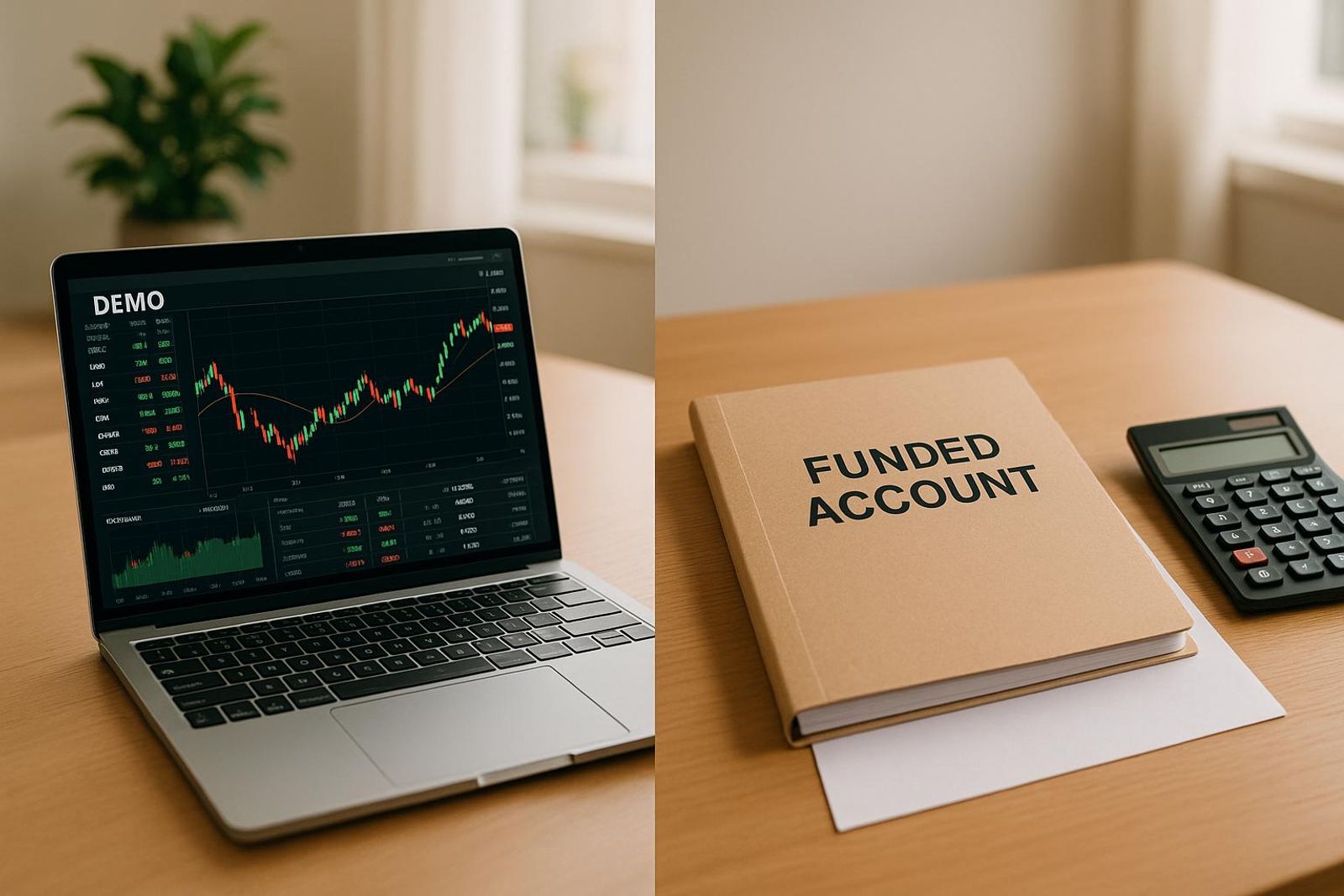
A funded account at a prop trading firm is traded on simulated capital, so mechanically it is a demo environment — the difference is that enforced rules, a maximum drawdown and a real payout mechanism are attached to it. Your own demo account has none of those consequences.
Key takeaways
- "Demo funded account" is not a contradiction: prop challenges and funded accounts at For Traders run on simulated capital, which is the industry norm.
- The real gap between your demo and a funded account isn't the money on screen — it's the daily loss limit, maximum drawdown and payout mechanism bolted onto it.
- A personal demo account never pays anything; a funded account pays performance rewards calculated from simulated trading results.
- Before you leave demo, you want hard numbers: 100+ closed trades, 3 months minimum, positive expectancy and a peak-to-trough drawdown that fits inside the challenge limits.
- There are three realistic beginner paths — stay on demo, deposit a small live retail account, or buy an evaluation — and each teaches something different.
- Most demo setups misrepresent XAUUSD spreads, US100 gaps and futures tick value, which is why execution feels alien the first week the rules bite.
Watch: related video
Is a funded account a demo account? The straight answer
Yes, mechanically — a funded account runs on simulated capital, so the trading environment is demo-like. But the rules, the fail conditions, and the performance rewards attached to it are real and enforced. That's what actually separates a demo funded account from the demo you opened on your own last week.
This isn't a loophole or marketing spin unique to any one prop trading firm — it's how the entire industry works. A firm evaluating you isn't routing your orders to a liquidity provider; it's watching how you manage risk on a simulated balance and paying you when that skill produces results. Simulated capital is virtual balance used to measure trading performance without real money changing hands in the market.
What "simulated capital" means in practice
Your account balance, your P&L, your equity curve — all of it moves on a simulated ledger tied to live price feeds. Prices are real, fills approximate real market conditions, but no actual order hits an exchange or a broker's book. This is standard across CME-style futures challenges, forex, gold, and index challenges alike — the instrument doesn't change the mechanic underneath it.
Why the phrase "funded demo account" exists
You'll see traders search "funded demo account" because the two ideas feel contradictory — funded implies real money, demo implies none. Both are true at once. The account is demo in mechanism, funded in consequence: pass the evaluation and the firm attaches a payout structure and hard risk limits to what was, until that point, just a practice account with no teeth.
What is genuinely different from your own demo
Three things change, and only three:
- Enforced risk parameters — a daily loss limit and max drawdown you can't override, unlike your own demo where you can reset or ignore a blown account with zero friction.
- A hard fail condition — breach the rule, the account closes. No do-overs, no "just this once."
- A payout mechanism — hit your target and trade to plan, and the firm pays out performance rewards tied to your simulated gains. That's the part your personal demo will never offer.
Correct the common claim you'll see repeated online: "funded means real money in your hands from day one." It doesn't. The capital you trade stays simulated the entire time. What's real is the reward attached to disciplined performance — at For Traders and across the industry, that's the actual product being sold: proof you can follow rules under pressure, monetized.
What is demo trading — and how it differs from paper trading
Demo trading is placing orders in a simulated market environment using fake balance, so you can practice execution and strategy without risking real capital. That's the whole concept in one line. Everything else — paper trading, simulated funded capital, prop challenges — is a variation on that same core idea with different rules bolted on.
Demo trading, defined in one line
If you strip away the marketing language: demo trading means clicking buy or sell on live or delayed price feeds, with a balance that only exists in a database. No broker executes anything against real liquidity. That's true whether you're on MetaTrader 5, cTrader, or a browser-based platform — the mechanics of order entry feel identical to live trading, which is exactly the point.
Paper trading vs demo account vs simulated funded capital
Beginners use these three terms interchangeably, and it costs them clarity they need later.
- Paper trading — the oldest form. Historically a literal paper log of hypothetical trades; today it usually means platform-logged simulated trades, often without a real execution engine behind them. TradingView's paper trading feature is the modern version most new traders touch first — you mark entries on a chart and the platform tracks P&L, but there's no order book, no queue, no real fill logic.
- Demo account — broker-hosted, running on the same infrastructure (or close to it) as live accounts, usually on live or slightly delayed prices. A Trading 212 demo account is the classic example: same interface, same charts, fake balance. This is a step closer to reality than paper trading because you're routing orders through actual platform architecture.
- Simulated funded capital — a demo-style environment wrapped in prop firm rules: a maximum drawdown, a daily loss limit, profit targets, and a reward structure tied to passing an evaluation. Mechanically it's still demo. The difference is consequence — break a rule and the account closes, pass and you get paid.
What your platform actually simulates (and what it fakes)
Demo trading is genuinely useful for learning platform mechanics — where your stop-loss field is, how a trailing stop behaves, how to read RSI, MACD and Bollinger Bands without fat-fingering a setting under pressure. It's also the only honest way to build a journaling habit and run a strategy across enough trades — 50, 100, more — to see actual expectancy instead of a lucky streak masquerading as edge.
But be honest about what it fakes. Demo fills are usually instant, at exactly your requested price — no slippage, no partial fills, no queue behind you at a level. Spreads on many demo feeds are static or artificially tight, especially around news events like NFP or FOMC, when real spreads on gold or indices can blow out several times wider. None of that shows up on a standard MetaTrader 5 or cTrader demo. It's a reason demo P&L and live P&L rarely match — and something every trader eventually has to unlearn.
Demo vs funded vs small live account: the three-column comparison
Here's the direct answer: a personal demo account risks nothing and teaches you the least, a funded account risks nothing financially but enforces real rules that teach discipline, and a small live retail account risks real cash but often less pressure than you'd expect. Put them side by side and the picture gets clearer fast.
| Factor | Personal Demo Account | Funded Account (Simulated Capital) | Small Live Retail Account |
|---|---|---|---|
| Capital type | Simulated, self-funded | Simulated, firm-allocated | Real money, your own |
| Upfront cost | Free | One-time challenge fee | Deposit (e.g. $200-$500) |
| What you can actually lose | Nothing | The challenge fee only | Your full deposit |
| Realistic size on XAUUSD/US100 | Unlimited, unrealistic | Sized to account rules and risk % | Micro lots — capital-constrained |
| Rules enforced | None | Daily loss limit, maximum drawdown, sometimes trailing drawdown | Only broker margin rules |
| Consequence of breach | None | Account closed instantly | Margin call / equity drop, but account stays open |
| Emotional load | Low to none | High — mirrors real fear of loss | Moderate, scales with size |
| Payout mechanism | None | Performance rewards on simulated profit split | Withdraw your own P&L |
| What it teaches | Mechanics of the platform | Risk discipline under real rules | Real psychological weight of live money, at small scale |
A daily loss limit caps how much your account can drop in a single trading day before you're locked out; a maximum drawdown caps how far your account can fall from its starting balance (or a trailing high) before the account is breached and closed. These aren't suggestions — on a funded account they're enforced automatically, no discretion involved.
This is where the funded account vs live account comparison gets counterintuitive. A $200 live deposit can survive a bad week — you take the drawdown, you're down on paper, but the account stays open and you can trade your way back. A funded account on simulated capital, by contrast, ends the moment you touch the maximum drawdown or trailing drawdown line. There's no recovering from inside a breached account. That single mechanical fact — instant termination versus a bruised but living account — is why traders consistently report more pressure managing a $50,000 funded account than a $200 live one.
The funded account demo structure also enforces rules nobody enforces on you personally. Your own demo account lets you revenge trade, oversize, and hold through FOMC with zero consequence — there's no daily loss limit stopping you, no trailing drawdown watching your equity curve. A funded account puts a rule-keeper between you and your worst impulses, which is exactly the gap that separates funded accounts vs demo trading in practical terms: one has guardrails, one doesn't.
None of the three teaches you everything. Demo teaches mechanics, live teaches the raw weight of real money at small size, and a funded account teaches you to trade as if the money is real because the rules behave as if it is — even though, mechanically, it's still simulated capital underneath.
Does a demo account pay real money? How performance rewards work
No — a demo account pays nothing, ever. There's no counterparty on the other side of your trades, no reward structure attached to your equity curve, and no agreement that turns simulated pips into real currency in your bank account.
Why a broker demo pays nothing, ever
A standard broker demo exists to show you the platform and let you test a strategy without risk. That's the entire purpose. There's no evaluation behind it, no profit target to hit, no rulebook, and critically — no business model that pays you for winning. You could put up a 40% return on a broker demo and the answer to "does a demo account pay real money" stays the same: no. The account isn't connected to any payout mechanism because it was never designed to be. It's a sandbox, not a pathway.
How payouts are calculated on a funded account
A funded account works differently, even though the capital underneath is still simulated. Here's the sequence: you pass an evaluation by hitting a defined profit target while respecting the risk rules (max drawdown, daily loss limit), you receive a Funded Account, and from that point your simulated trading results generate performance rewards — payouts calculated as a share of the simulated profit your account produces, released on a defined schedule rather than whenever you feel like withdrawing.
Performance rewards are the payout you earn from profitable trading on a funded account — calculated from simulated results but paid out as real money, on a fixed cycle, once you meet the account's rules. That's the mechanical difference: the same chart, the same instrument, the same XAUUSD spread — but one path has a payout process behind it and one doesn't.
The evaluation fee and what happens to it
You pay an evaluation fee to enter a Challenge. Be clear-eyed about what you're actually buying: it isn't the market data, it's the rule-enforced environment — the daily loss limit, the max drawdown, the profit target — plus access to the reward pathway on the other side of it. That structure is what a free demo can never offer, because nothing is enforced and nothing pays out.
Common industry practice, including on For Traders' Challenges, is to reimburse the evaluation fee once you pass and reach your first qualifying milestone on the funded stage — check the current terms on the pricing page for the exact conditions attached to your account size. Read through how the funded trading accounts mechanism works end to end, and how the payout process itself is scheduled and processed, before you commit fee money to an attempt.
The three realistic paths for a beginner (and who each one suits)
There isn't a binary choice here — there are three. Stay on demo, fund a small live retail account, or buy a prop evaluation. Each teaches something different, each fails to teach something else, and picking the wrong one for your stage is why so many traders feel stuck for years without a clear "before vs after."
| Path | Upfront cost | What's at risk | What it teaches | What it can't teach |
|---|---|---|---|---|
| Demo trading | $0 | Nothing | Mechanics, strategy testing, sample size | Psychology under real consequence |
| Small live retail account | $100–$500 | Your own capital, in full | The emotional flinch of real fills and real slippage | Meaningful returns, risk discipline at scale |
| Prop evaluation (Two-Step Challenge) | Fee only (refundable on pass, per current terms) | The fee; simulated capital enforces the rest | Trading inside externally enforced risk rules toward a real reward pathway | Raw strategy discovery — you need an edge before you start |
Path 1: stay on demo and build the sample size
If you've closed fewer than 100 trades or don't have a written plan you can hand to another trader and have them execute identically, you're not ready to risk anything — demo or otherwise. This path costs nothing and that's the point: use it to find out if your edge survives contact with 100+ trades before money enters the conversation, live or simulated.
Path 2: fund a small live retail account
This path suits one specific person: the trader who has never held a position with real money attached and needs to feel the flinch. Be honest with yourself about what $100–$500 buys you — it's not returns, it's psychology. The position sizes are too small to matter financially, but the emotional response to a red number that's actually yours is real, and no demo replicates it. If you already know that flinch, skip this path — you're paying tuition you've already taken.
Path 3: buy a prop evaluation and trade to rules
Is a funded account good for beginners? Honestly — not if you can't answer the readiness checklist in the next section. But for a trader with a documented edge who keeps blowing their own informal risk limits, a Two-Step Challenge or Instant Funding does something demo trading structurally cannot: it forces risk management via a hard daily loss limit and max drawdown, rather than asking you to self-enforce rules you haven't proven you can follow. That's the real case for demo trading vs prop firm challenge — the challenge isn't a shortcut around learning, it's a structure that does the risk management you haven't built yet.
Sequencing matters more than most beginners think. Moving from demo to funded account directly — skipping the underfunded live account entirely — is often the better route, because an evaluation's enforced rules catch the mistakes an underfunded $200 account just lets you make quietly, alone, with no one checking your drawdown.
Ready to trade funded capital?
Choose your path — Instant Accounts, One-Step or Two-Step Challenges — from just $23, with up to $300,000 in funded capital.
Choose your challengeAre you ready to leave demo? The numeric checklist
You're ready to move from demo to funded account when you can show, in numbers, not feelings: 100+ closed trades on one strategy, 3+ months across mixed conditions, positive expectancy, drawdown inside your target challenge's limit, tight position sizing, and a complete journal. Miss any one of these and you're not underprepared morally — you're statistically unproven, and the evaluation will find the gap.
The five thresholds, with numbers
- Minimum 100 closed trades on a single, unchanged strategy. Ten winning trades tell you nothing about edge — variance dominates small samples.
- At least 3 months of screen time, not backtested bars. Live or demo, you need to have sat through at least one NFP release and one FOMC week, because that's where spreads widen, stops get run, and undisciplined traders reveal themselves.
- Positive expectancy over that sample — not a lucky streak inside it. Calculate it as: (win rate × average win) − (loss rate × average loss). If that number is above zero across 100+ trades, you have an edge worth funding.
- Peak-to-trough drawdown smaller than your target challenge's maximum drawdown. If you're eyeing a Two-Step Challenge with a 10% max drawdown, your demo equity curve needs to have never dipped more than 7-8% from a high — leaving room for the fact that funded psychology tightens, not loosens, your risk.
- Position size variance inside a narrow band. No doubling lot size after a loss, no cutting size in half out of fear after a win. Risk-of-ruin math assumes consistent sizing — martingale-style recovery bets are exactly what blow accounts inside a single bad week.
How long to demo trade before going funded
Three months is the floor, not the target. It's the minimum time needed to see a trending regime, a chop regime, and at least one high-volatility news week in the same sample. If your only data is a quiet August, you haven't tested anything — you've gotten lucky in calm conditions. Add a written trading plan and a trade-by-trade journal covering entry logic, size, and outcome for every single trade in that window. If you can't produce that journal on demand, you're not ready to sit an evaluation yet.
Why a sub-50% win rate can still pass an evaluation
Win rate is the metric beginners obsess over and the one that predicts the least. A trader hitting 40% winners at 2.5R average winners has positive expectancy of +0.7R per trade. A trader hitting 65% winners at 0.4R average winners nets roughly −0.09R per trade — a losing system dressed up as a "good" strategy. Prop firms don't grade you on how often you're right; they grade you on whether your profit target gets hit before your maximum drawdown does.
Here's the honest framing: most evaluations are failed on risk breaches, not on strategy. Traders don't usually get out-analyzed — they get out-disciplined, doubling size to chase a red day or ignoring a daily loss limit they set themselves. This checklist exists to screen for exactly that failure mode before you pay for an attempt.
The demo-to-consequence gap: why beginners fall apart when rules bite
Demo trading doesn't punish bad habits, so those habits ride along invisibly until a funded account's rules make them expensive. This is the core reason beginners struggle with live trading accounts even after months of clean demo results — nothing on a standard demo account penalizes a moved stop, a doubled lot size, or a skipped stop-loss the way a daily loss limit or max drawdown rule does.
The three failure patterns: moved stops, revenge trades, size creep
Three habits survive demo trading undetected because there's no consequence attached to them:
- Moving a stop "just this once" — on demo, price coming back to save you feels like proof it works. On a funded account, one wide stop against you is the difference between staying under your daily loss limit and getting flagged out of the evaluation.
- Revenge trading / doubling size after a red day — trying to get back to flat by doubling risk is the single fastest way to breach a daily loss limit. It rarely shows up as a "strategy" problem in your journal — it shows up as a discipline problem.
- Quiet size creep after a winning week — confidence from three green days nudges lot size up 20%, then 40%. Nobody sets out to blow an account this way; it happens one small increase at a time.
What actually transfers to a funded account: fixed fractional risk per trade (same % risked regardless of how the last trade went), a hard daily loss cutoff set below the platform's daily loss limit — not at it — one trade idea per session instead of hunting for a second chance, and journaling your entry reason before the fill, not after. That last one alone kills most revenge trades because it forces a pause.
XAUUSD: spread behaviour, ATR-based stops and where demo lies to you
Gold is the platform's most-traded instrument, and it's also where demo assumptions break hardest. XAUUSD spreads widen sharply around the New York open and around data releases — a spread that's 20 cents on a quiet Tuesday afternoon can triple heading into an NFP print. If your demo account runs a fixed spread, you're training on numbers that don't exist during the sessions that matter most.
Stop placement compounds this. Sizing stops off round numbers ($3,650, $3,700) gets you hunted, because everyone else's stop is sitting there too. Sizing off ATR — say 1.5× the 14-period ATR below entry — adapts to whatever volatility regime gold is actually in that week, gap risk and all.
US100 gaps, NFP and FOMC fills
US100 (NSDQ) index CFDs gap over weekends and overnight on futures-driven news, and a demo account with instant fills at your requested price hides that completely. Around FOMC decisions and NFP releases, real fills slip past your intended entry — sometimes several points on US100, sometimes a few pips on majors. If your demo doesn't model slippage and spread, commission, and swap, week one on a funded account will feel like a different market. Go into your demo settings now, turn on realistic spread and slippage, and add commission — it's the cheapest lesson you'll ever take. Pair that with a solid trading psychology routine and a written risk management plan, and the gap between demo and funded stops being a surprise.
Should you demo before trading futures with real money?
Yes — and not on a generic demo, but on the specific CME futures contract you intend to trade. Futures sizing mistakes get punished faster than spot forex mistakes because tick value and margin do the damage in whole dollars per contract, not fractions of a pip. If you've never asked yourself "should I start with a demo account before trading futures," the honest answer is: you should, and you should do it on the exact contract, not a lookalike.
Tick value and why futures punish sloppy sizing fastest
Every futures contract has a fixed tick value baked into it — you don't calculate it from lot size like in forex, it's just what the exchange says it is. That's exactly why it's dangerous for beginners: the market doesn't care that you sized the position like you would on your forex demo.
Take a worked example. On the E-mini S&P 500 (ES), one tick (0.25 points) is worth $12.50. Its little sibling, the Micro E-mini (MES), has the same tick size but the tick is worth $1.25 — one-tenth. Put a 20-tick stop on both:
| Contract | Tick value | 20-tick stop = $ risk |
|---|---|---|
| MES (Micro E-mini S&P) | $1.25 | $25 |
| ES (E-mini S&P) | $12.50 | $250 |
Same chart, same stop distance, a 10x difference in dollar risk. Traders coming from forex demo accounts routinely misjudge this because they're used to thinking in pips and percentages, not fixed tick dollars — and one fat-fingered contract count on ES instead of MES can wipe a daily loss limit in a single fill.
Margin, day-trading margin and overnight requirements
Margin on CME futures isn't the same number all day. Brokers and prop platforms typically offer a reduced day-trading margin — a few hundred dollars per contract — that lets you hold a position during the session, but that margin jumps sharply if you carry the position overnight, because the exchange's overnight requirement reflects full gap risk. A beginner who sizes a position based on the cheap day-trading margin and forgets to flatten before the close can get a margin call or an automatic liquidation they never demoed for. This is a mechanic worth breaking on a demo account first, at zero cost, before it breaks your funded evaluation.
Trailing drawdown on CME products explained
Trailing drawdown is the rule that follows your account's high-water mark down as you gain profit and locks in a floor you can't trade below — and it's the single rule that ends more futures evaluations than any strategy flaw. Unlike a static max drawdown from the initial balance, a trailing rule keeps moving against you even after a winning streak, so a give-back that felt fine in spot forex can breach a futures account outright. Read the exact mechanics on our prop trading terms page before you touch a funded futures challenge.
Futures prop trading is the fastest-growing segment on the platform right now, particularly out of the US — so the demo hours you put into tick value, margin, and trailing drawdown aren't wasted practice. They're rehearsal for where the volume is actually heading.
Where For Traders fits — and what it costs versus a live deposit
For Traders is an educational prop trading platform, not a broker — it offers Instant Funding, the Two-Step Challenge and the Three-Step Challenge across forex, gold and commodities, index CFDs, CME futures and crypto, executed on MetaTrader 5, cTrader and TradingView. Every phase — the evaluation and the funded stage that follows it — runs on simulated capital. Passing traders don't withdraw a deposit; they earn performance rewards tied to how their simulated equity curve performs against the rules.
Evaluation formats: Instant Funding, Two-Step and Three-Step Challenge
Instant Funding skips the evaluation phase entirely — you get simulated funded parameters from day one, at the cost of tighter risk limits. The Two-Step Challenge is the industry-standard structure: pass an initial profit target under a max drawdown, confirm it in a second phase, then trade funded. The Three-Step Challenge spreads the same idea across an extra phase, generally trading looser per-phase targets for a lower single-phase pressure point. None of the three change what you're trading on — simulated capital throughout, on real market data and real spreads.
Account sizes, asset coverage and platforms
Coverage spans forex majors and minors, gold and commodities (XAUUSD sits at the centre of volume on the platform), major index CFDs including US100, CME futures contracts, and crypto — check the Trading Challenge page for the current 2026 account-size tiers and instrument list, since these get revised as the futures and crypto segments grow. Execution runs on MetaTrader 5 and cTrader for CFD instruments, with TradingView charting layered in for traders who want it.
Evaluation fee vs the capital you'd need to deposit live
Here's the comparison most challenge reviews skip. A live retail account needs your own deposited capital sized to the position you want to run — trade a full-size XAUUSD lot or a US100 contract with real margin behind it, and you're funding that margin out of pocket, exposed to every point of it. An evaluation fee buys you access to a much larger simulated capital tier for a fraction of what depositing that size yourself would cost — but you're not buying ownership of that capital. You're buying structure: defined risk parameters, a max drawdown that stops you before a blown account, and a reward pathway if you clear the rules.
| Factor | Challenge (evaluation fee) | Live deposit (self-funded) |
|---|---|---|
| Capital exposed | Simulated — no personal capital at market risk | Your deposit, fully at risk |
| Access to larger size | Larger simulated tiers for a set fee | Scales only with what you deposit |
| Downside if you fail | Lose the evaluation fee, retry | Lose the deposited capital itself |
| Upside if you pass | Performance rewards under the funded agreement | Keep 100% of gains, none of the structure |
| What you own | Nothing — it's a simulated account with rules attached | The account and the capital in it |
Be clear-eyed about the trade-off before you pay for a challenge: this is not real-money trading, For Traders is not a broker, and no evaluation fee buys you a shortcut past the readiness checklist. If your demo hours haven't shown a consistent edge yet, a challenge attempt is just an expensive way to find that out.
Ready to trade funded capital?
Choose your path — Instant Accounts, One-Step or Two-Step Challenges — from just $23, with up to $300,000 in funded capital.
Choose your challengeDemo account vs funded account: pros and cons side by side
Pros
- Demo: zero cost and zero financial downside while you learn platform mechanics and build a trade sample
- Demo: unlimited repetition — you can test a strategy over hundreds of trades without pressure to perform
- Demo: safe place to break things, from position sizing errors to misread order types
- Funded: enforced daily loss limit and maximum drawdown do the risk management most beginners can't self-impose
- Funded: a defined profit target and payout mechanism turn vague practice into a measurable objective
- Funded: access to larger simulated size on XAUUSD, indices and CME futures than a small live deposit would allow
Cons / risks
- Demo: no consequences, so the habits that actually kill accounts — moved stops, revenge trades, size creep — never get tested
- Demo: default settings usually understate spread, slippage and gap risk, especially on gold and around NFP and FOMC
- Demo: open-ended practice with no deadline often delays the decision indefinitely
- Funded: an upfront evaluation fee, which is a real cost whether or not you pass
- Funded: a single rule breach can end the account regardless of how the strategy was performing
- Funded: the capital is simulated, so it isn't yours to withdraw — you earn performance rewards, not the balance
Frequently Asked Questions
Is a funded account a demo account?+
A funded account trades on simulated capital, but it's not the same as a free-form demo — it's a live evaluation environment with real rules attached to real payouts. Once you pass a Challenge, your Funded Account still runs on simulated capital (no real money touches the market), but your discipline, drawdown limits, and daily loss limits are enforced exactly like a live account. The difference from a plain demo is consequence: hit your max DD and the account closes, hit targets and you earn Performance Rewards. That structure is what makes it useful, not just a sandbox.
What does 'funded demo account' actually mean?+
A funded demo account refers to the simulated-capital account you receive after passing a prop firm evaluation, where trading gains translate into real Performance Rewards even though the underlying capital isn't live. It sits between a no-stakes practice demo and a personal live account — you're managing real risk rules (daily loss limit, max drawdown, profit targets) on capital that's simulated. This hybrid is exactly what platforms like For Traders offer: educational risk exposure with a genuine payout mechanism attached to disciplined execution.
What is demo trading and how does it differ from a prop firm evaluation?+
Demo trading means placing trades on simulated capital with no rules, no deadline, and no payout — it's purely for practice. A prop firm evaluation, like For Traders' Two-Step Challenge, also uses simulated capital but adds structure: a profit target, a max daily loss limit, a max drawdown, and often a time limit. That structure is the whole point — it forces you to trade like your capital (and a future Funded Account) is on the line, which plain demo trading never does. Paper trading sits in between: manual trade logging without even a platform fill.
Does a demo account pay real money, and how do funded account payouts work?+
A demo account pays nothing — it exists purely for practice with zero financial consequence either way. A Funded Account is different: trading remains on simulated capital, but simulated profits convert into real Performance Rewards paid out to you, typically on a set cycle (e.g., biweekly) once you meet the profit split and consistency rules. This is the core distinction beginners miss — demo trading has no upside or downside, while a Funded Account has real payout upside despite the capital itself being simulated.
Is a funded account good for beginners, or should you demo first?+
A funded account works for beginners only after they've proven consistency on demo first — jumping straight into a Challenge without base-level skill just burns evaluation fees. Demo trading is where you build muscle memory: sizing positions, respecting stops, reading XAUUSD or NSDQ volatility without the added pressure of a max drawdown rule. Once you can string together weeks of rule-following demo results, an evaluation like For Traders' Two-Step Challenge becomes a reasonable next step, not a gamble on unproven habits.
Funded account vs live account: which exposes you to more realistic pressure?+
A funded account, despite running on simulated capital, exposes you to more realistic decision-making pressure than a small live account because the stakes (Performance Rewards, account survival) feel real and the risk rules are strictly enforced. A tiny personal live account often lets you break your own rules quietly since only you answer for it. Ironically, the enforced daily loss limit and max drawdown on a Funded Account can teach discipline faster than undercapitalized live trading, where slippage and poor fills add noise without teaching structure.
Should I demo trade before trading futures with real money?+
Yes in effect — demo trading futures first lets you learn contract specs, tick value, margin, and overnight session behavior (CME futures run near 24 hours) without financial risk. Futures move fast and use leverage differently than spot forex or CFDs, so beginners who skip demo often misjudge position size and get stopped out on normal volatility. Spend time on demo learning how ticks translate to dollar P&L, then consider a Futures Challenge once your sizing and stop placement are consistent across multiple sessions.
How long should you demo trade before moving on?+
There's no fixed number of days — the benchmark is consistency, not calendar time: most traders need 4-8 weeks of demo trading showing a stable win rate, controlled max drawdown, and repeatable R:R before an evaluation makes sense. Track real metrics: are you sizing the same way regardless of recent wins or losses? Is your drawdown staying under a self-imposed limit across at least 20-30 trades? When those numbers hold steady through both trending and choppy conditions, you're closer to ready than someone guessing by weeks alone.
What are the challenges of trading without demo practice first?+
Skipping demo means your first real mistakes happen with money (or evaluation fees) on the line, which usually leads to oversized positions, moved stops, and revenge trading after the first loss. Beginners who go straight to live or straight to a Challenge without demo reps tend to misjudge how fast XAUUSD or index futures move during news, and they haven't built the muscle memory to respect a daily loss limit under pressure. The 95% Challenge failure rate skews even higher for traders who never demo-tested their strategy first.
What should a beginner's order of operations be: demo, evaluation, funded?+
The logical sequence is demo trading first to build strategy consistency, then a Challenge evaluation to prove you can follow rules under real stakes, then a Funded Account to earn Performance Rewards. Skipping demo means paying evaluation fees to learn basic sizing and stop discipline — an expensive way to practice. Skipping the evaluation isn't an option on most platforms since it's the gate to funding. Treat demo as free tuition, the Challenge as your certification, and the Funded Account as the payoff for both.
Written by
Marcel Hambálek
Senior Trader, For Traders
Marcel trades Futures and Forex day-trading setups on funded accounts and writes about the executional details most traders skip — order types, slippage, session timing, platform quirks on MT5 and NinjaTrader. Pragmatic, mechanics-first, no fluff.
Follow on LinkedInReady to trade funded capital?
Choose your path — Instant Accounts, One-Step or Two-Step Challenges — from just $49, with up to $300,000 in funded capital.
Choose your challengeTrade up to $300,000
Choose challenge