Best Practices for cTrader Copy Trading Providers
Fee per million cTrader explained: the $10 volume fee costed in dollars, all three fee caps compared, and a copier-side risk framework for 2026.
By Marcel Hambálek · Senior Trader, For Traders
On cTrader Copy, the volume fee — commonly called "fee per million" — is capped at $10 per one million units of base currency traded, charged per side. Ten standard lots of EURUSD (1,000,000 units) opened and closed therefore costs the copier $20 in total: $10 on entry, $10 on exit.
Key takeaways
- The volume fee is charged per side and capped at $10 per million units of base currency, so a round turn on 10 lots of EURUSD costs a copier a maximum of $20.
- cTrader Copy has three fee caps: 30% performance, 10% annual management, and $10 per million volume — a provider can combine them, but the ranking algorithm favours performance-only pricing.
- A volume fee beats a performance fee only for high-turnover, low-return strategies; on a low-turnover swing book, a 20% performance fee is usually cheaper for the copier.
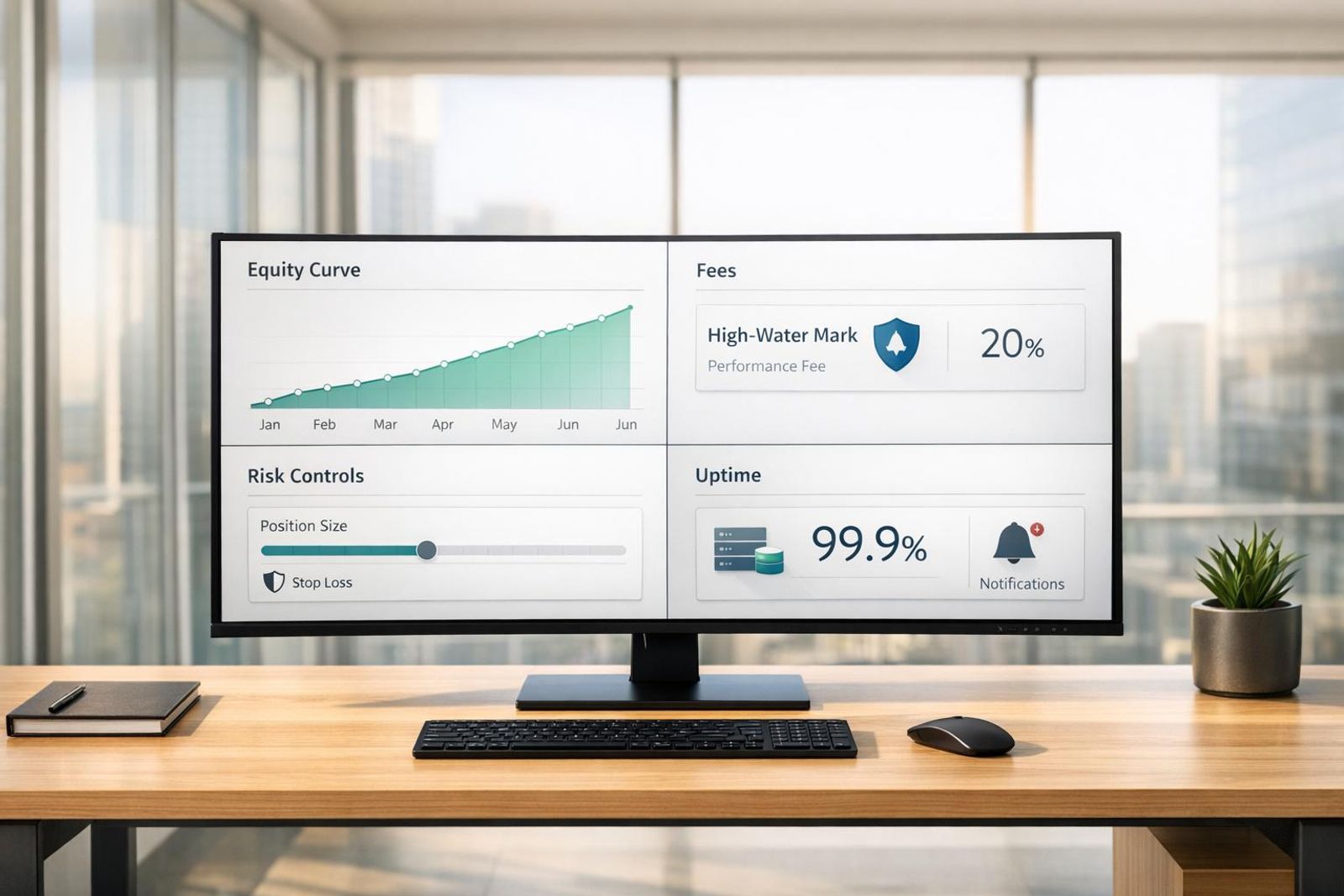
- The High-Water Mark means a copier only pays performance fees on new equity highs, so drawdowns must be recovered before the provider is paid again.
- The provider owns entries, exits and position sizing; the follower owns allocation size, leverage, equity stop and the decision to unlink — that split is where most copiers lose money.
- Equity-to-equity sizing plus the 0.01 minimum lot size is why undersized copier accounts fall out of sync — the fix is a realistic minimum investment, not more leverage.
Watch: related video
What "fee per million" means on cTrader — and what it costs in dollars
The volume fee on cTrader Copy is capped at $10 per 1,000,000 units of base currency traded, charged separately on the open and the close. That's the whole mechanic. No tiers, no hidden multiplier — you just need to convert your lot size into units traded to see what you actually owe.
The per-side calculation, step by step
Here's the chain you're working through every time you want to check a provider's real cost:
- Take your lot size. 1 standard lot = 100,000 units of the base currency.
- Multiply lots by 100,000 to get units traded (this is notional volume, not notional value in USD — the fee is charged on units, not on dollar exposure).
- Divide units traded by 1,000,000, then multiply by $10 to get the fee for that side of the trade.
- Do it again on the close — the fee is charged per side, so a round-turn trade pays it twice.
Under one million units, the fee pro-rates. A 2.5-lot EURUSD trade is 250,000 units, which is a quarter of a million — so you pay $2.50 per side, $5.00 round-turn. There's no minimum ticket size that rounds you up to the full $10; the cTrader volume fee scales linearly.
Worked example: 10 lots of EURUSD, entry and exit
This is the anchor case worth memorizing because it's the cleanest round number: 10 lots of EURUSD is exactly 1,000,000 units.
- Open the position: 1,000,000 units ÷ 1,000,000 × $10 = $10
- Close the position: another 1,000,000 units × $10 = $10
- Total round-turn cost: $20
That $20 is charged whether the trade closed in profit or at a loss — the fee sits on traded volume, not on P&L. This is the detail most comparison pages gloss over: a scalper who churns volume and mostly scratches trades still racks up the full fee per million on every leg, win or lose. It's a cost of participation, not a performance fee.
Monthly cost at low, medium and high turnover
Turnover is where providers separate. A swing trader taking a handful of positions a month looks nothing like a scalper firing off dozens of round-turns a day. Here's what the volume fee actually costs at three realistic monthly turnover bands:
| Monthly turnover (units traded, both sides combined) | Equivalent round-turn lots | Volume fee at $10/million |
|---|---|---|
| 5,000,000 units | ~25 round-turn lots | $50 |
| 25,000,000 units | ~125 round-turn lots | $250 |
| 100,000,000 units | ~500 round-turn lots | $1,000 |
Remember this is the copy fee alone — your broker's commission and spread sit on top and are billed separately from the cTrader volume fee. When you're comparing the lowest fee per million cTrader forex providers, always ask whether the quoted number is the volume fee only or an all-in figure that bundles spread markup. Those two numbers get conflated constantly, and it's usually the copier who eats the difference.
The three cTrader fee models compared on the same $10,000 account
cTrader Copy lets a strategy provider charge exactly one of three capped structures: a performance fee up to 30% of net gains, a management fee up to 10% annually, or a volume fee up to $10 per million units traded per side. None of the three can be stacked freely — the platform limits providers to a single primary model — so the choice materially changes who profits and when.
Run all three against one identical copier: a $10,000 account, 4% net return in the month ($400), and a strategy that varies from light to heavy turnover. The fixed-cost models (performance and management) don't move with turnover; the volume fee moves with nothing else.
| Turnover / month | Performance fee (30% cap) | Management fee (10% annual cap) | Volume fee ($10/million, per side) |
|---|---|---|---|
| Low — 5M units | $120 | $83.33 | $50 |
| Medium — 20M units | $120 | $83.33 | $200 |
| High — 50M units | $120 | $83.33 | $500 |
Performance fee (30% cap) and when it makes sense
A cTrader performance fee only charges the copier when the copier actually made money — no gain, no fee. In the scenario above it costs $120 flat, regardless of how many trades it took to get there. It's the right model for swing and position strategies with moderate trade frequency, where turnover isn't the variable driving the return.
Management fee (10% annual cap) and why copiers resist it
The management fee cap converts to roughly $83.33/month on a $10,000 balance, and it's billed whether the account is up 4% or down 4%. That's the structural problem: copiers pay it in flat months, drawdown months, even dormant months. Most experienced copiers scan for this f
The High-Water Mark: why copiers never pay twice for the same gains
The high-water mark (HWM) is the highest equity level your copied allocation has ever reached — a provider can only charge a performance fee on gains that push your equity above that previous peak. If your allocation is still underwater relative to its all-time high, no performance fee is due, no matter how strong the current month looks on its own.
This is the mechanism that stops you paying twice for the same gain. Without a HWM, a provider could earn a performance fee on a +10% month, watch you give it back in a -8% month, then charge you again when you claw back to +2% net — even though you're barely above where you started three months ago. cTrader performance fee high-water mark logic exists specifically to close that loophole.
How the HWM is set and reset
The HWM is set the moment your allocation first generates a profit above your starting balance, then it only ever ratchets upward. Every time your equity closes a period at a new peak, that becomes the new HWM. It never resets downward on its own — a drawdown doesn't lower it, it just means your equity sits below the mark until you recover past it.
A drawdown-and-recovery example in numbers
Take a $10,000 allocation over three months:
| Month | Return | Equity | HWM | Performance fee due? |
|---|---|---|---|---|
| 1 | +10% | $11,000 | $11,000 | Yes — on the $1,000 gain |
| 2 | -8% | $10,120 | $11,000 | No — equity below HWM |
| 3 | +12% | $11,334 | $11,334 | Yes — but only on $334, not the full 12% |
Notice what happens in month three: the +12% move takes equity from $10,120 to $11,334, a gain of $1,214 in dollar terms. But the provider can only bill a performance fee on the $334 that clears the old $11,000 peak — the rest is just you getting back to where you already were. That's HWM copy trading working as designed: recovery is unpaid work for the provider, same as it is for you. It's the one fee structure on cTrader Copy that genuinely aligns incentives — a provider who blows up your account has to earn back your trust before earning another cent from gains.
What the HWM does not protect you from
Be clear-eyed about the limits when you're working through cTrader copy fees explained in full. The HWM only governs the performance fee. It does nothing to the management fee or the volume fee — both keep accruing every day, every trade, regardless of whether you're above or below your peak. A copier sitting in a 15% drawdown is still paying the flat management fee and still paying $10 per million on every round-turn the provider executes.
And the HWM offers zero protection against unlinking. If you unlink from a provider during a drawdown and re-link later — even to the same provider — your HWM resets to your new starting equity. Any prior peak is wiped from the relationship. That's a mechanical fact of the platform, not a workaround, so think twice before pausing a copy relationship mid-drawdown just to "reset the clock."
Signal providers vs followers: who actually controls the risk
A strategy provider on cTrader Copy trades their own live account and broadcasts every position; a follower — sometimes called a copier or investor — allocates equity behind that account and receives a proportionally sized mirror of each trade. That word "proportional" matters: you're not choosing which trades to take, you're choosing how big your slice of the whole strategy is. Understanding signal providers and followers in copy trading starts with accepting that these are two entirely different jobs with two entirely different control panels.
What the strategy provider owns
The provider owns every trading decision, full stop. Entry price, exit price, stop-loss placement, take-profit level, per-trade lot sizing, which instrument gets traded and when — all of it sits with the provider. As a copier, you cannot nudge a stop, skip a trade you don't like, or resize a single position independently of the rest. If the provider opens 3 lots of GBPUSD with no stop and holds it through NFP, your mirrored allocation does the same, scaled to your equity share. There's no override button.
What the copier can and cannot override
Your control lives one level up, at the account level, not the trade level. You decide:
- How much equity to allocate to the strategy provider in the first place
- Your own account leverage, which scales the effective risk of every mirrored trade
- Your equity stop-out threshold — the floor at which your copied positions get force-closed
- When to unlink, pause, or reallocate away from a provider
That's the entire toolkit. It's a meaningful one — leverage and allocation size do more to shape your drawdown curve than most copiers realize — but it's a blunt instrument compared to the provider's trade-by-trade discretion.
The responsibility split table
| Decision | Who controls it | Who owns the risk outcome |
|---|---|---|
| Entry price and timing | Strategy provider | Copier (via mirrored fill) |
| Stop-loss / take-profit placement | Strategy provider | Copier |
| Per-trade lot size | Strategy provider (proportional to your equity) | Copier |
| Total equity allocated to the strategy | Copier | Copier |
| Account leverage | Copier | Copier |
| Equity stop-out level | Copier | Copier |
| Timing of unlink/relink | Copier | Copier |
Look at that middle column and the right column together. The copier ends up owning the risk outcome on nearly every row — including three where they have zero decision-making input. That's the uncomfortable part of being an investor rather than a strategy provider on cTrader Copy: you own the drawdown, the margin call, and the fee per million charged on every mirrored round-trip, without ever touching the entry, exit, or stop that produced it. Choosing a provider is therefore less about liking their track record and more about deciding whether you're comfortable outsourcing every tactical decision while keeping every consequence.
Risk management for copy trading followers
A follower controls exactly four things: how much you allocate to a given provider, the leverage you run the copied account at, an equity stop-out you set before the first trade lands, and the unlink decision. That's the whole toolkit. You don't control entries, exits, or stop placement — so risk management for copy trading followers has to live entirely in sizing and exit rules, not trade selection.
Sizing the allocation: the 5-10% rule
Cap any single provider at 5-10% of your speculative capital, full stop. Not 5-10% of your net worth, not 5-10% of "money you can afford to lose in general" — a defined speculative bucket you've already accepted could go to zero. A provider with a strong six-month track record can still post a max balance drawdown that wipes out a concentrated allocation in a single bad week; sizing small is the only lever that survives a provider's worst month, because you can't negotiate their stop placement after the fact.
Equity stop-out and max drawdown tolerance
Set your personal equity stop below the provider's published max balance drawdown, but above ordinary noise — otherwise you'll unlink on every routine pullback. If a provider's historical max drawdown sits at 18%, an equity stop at 22-25% gives you room for a normal bad stretch while still capping the tail. Tighter than that and you're paying the fee per million on every mirrored round-trip just to get shaken out before the strategy has a chance to mean-revert. This is copy trading drawdown control in one sentence: define the number in writing, before you fund, not while you're watching red equity in real time.
Correlation across multiple providers
Following five EURUSD London-session scalpers isn't five positions — it's one position, five times leveraged, all exposed to the same spread widening around the same news windows. Diversification requires uncorrelated return streams: different instruments, different sessions, different holding periods. Check overlap before you allocate, not after a single NFP print blows through four accounts at once. Copying more providers who trade the same pair at the same hour is concentration wearing a diversification costume.
Unlink triggers you decide before you allocate
Write your unlink triggers down before the first trade copies — max drawdown breach, a defined number of consecutive losing weeks, or a change in the provider's stated strategy. The copier who unlinks at the bottom of a normal drawdown converts a temporary loss into a permanent one; the equity curve that looked broken at -15% often recovers by +8% the following week, but only for the followers still linked. This is the same discipline a funded evaluation enforces mechanically through its daily loss limit and max DD rule — the difference is nobody's forcing it on a copy trading follower except you.
Ready to trade funded capital?
Choose your path — Instant Accounts, One-Step or Two-Step Challenges — from just $23, with up to $300,000 in funded capital.
Choose your challengeHow to evaluate the best cTrader copy strategy providers
Judge a provider on six things before you link a single lot: equity curve versus balance curve, profit factor, max balance drawdown, months of verifiable track record, fee structure, and whether the provider's own capital sits in the strategy account. Skip any of these and you're copying a story, not a strategy.
Equity curve vs balance curve — read the gap
Balance only updates when a trade closes. Equity updates tick by tick, including every open position's floating P/L. On cTrader Copy's provider stats page, both lines are plotted — and the gap between them is the single most honest chart on the platform. A balance line that climbs in a smooth staircase while the equity line whips violently underneath it means the provider is sitting on floating losses, sometimes for days, waiting for price to come back before closing. That's the classic hidden-martingale or grid tell: the account "never loses" on the balance chart because it never closes a loser, it just adds to it.
Profit factor, max balance drawdown and track record length
Profit factor (gross profit ÷ gross loss) below 1.3 on a forex strategy is thin — one bad month erases the edge. Above 2.0, ask how: often it's a small sample size or a strategy that hasn't hit its tail-risk event yet. Max balance drawdown north of 30% on a strategy claiming "low risk" is a contradiction you should walk away from. And a track record under six months tells you almost nothing — it hasn't lived through a full volatility cycle, an NFP surprise, or a central bank repricing. Twelve months minimum, ideally spanning at least one FOMC-driven shock, is the bar.
| Metric | Weak signal | Defensible |
|---|---|---|
| Profit factor | < 1.3 or > 3.0 (unverified) | 1.4 – 2.2 |
| Max balance drawdown | > 30% | < 15% |
| Track record | < 6 months | 12+ months |
| Equity vs balance gap | Wide, recurring | Tracks closely, brief dips |
Does the provider have their own capital at risk?
cTrader's ranking algorithm explicitly weights provider self-investment — Spotware's stated rationale is that a provider trading alongside their followers, with real money exposed to the same drawdown, has skin in the game and less incentive to swing for a headline monthly return. Check the provider profile for the self-invested percentage before you link. A provider running 0% of their own capital through a strategy asking followers to accept 25% drawdowns isn't managing risk for you — they're managing performance fees.
Red flags: 200% monthly claims, no stops, martingale grids
- Monthly returns claimed above 20-30% consistently — sustainable forex edges don't compound like this without eventually blowing up.
- No visible stop-loss on open positions in the trade history — the "stop" is the equity curve itself.
- Position sizing that doubles after a loss (martingale/grid) — the balance curve looks flawless until the one trade that doesn't recover.
- Sub-3-month track record paired with a profit factor above 3.0 — small sample, big claim.
Setting up as a cTrader strategy provider, step by step
You cannot list a strategy from a standard netting account — cTrader forces this decision before you touch the Copy tab, and getting it wrong means opening a new account and starting your track record from zero. Here's the sequence that actually works, in order.
Hedging account requirement and why netting won't work
cTrader copy trading between accounts runs on trade-level replication: every individual position you open gets mirrored as its own position on each copier's account, including cases where you're long and short the same pair simultaneously as separate legs. A netting account collapses opposing positions into a single net exposure, which breaks that replication logic entirely. That's why cTrader restricts strategy hosting to hedging accounts only — check this in your account settings before you build anything, because switching account types later means opening a fresh account and losing whatever history you'd already accumulated.
Creating the strategy in the Copy tab: visibility, fees, leverage
Once you're on a hedging account, open the Copy tab and select "Create Strategy." From there you're making five decisions:
- Visibility — public strategies appear in the searchable leaderboard; private ones are invite-only via link, useful if you're building a track record before going live to the public.
- Minimum investment — set high enough to keep position sizing meaningful for copiers, low enough not to gatekeep genuine interest.
- Fee model — commonly the volume-based fee per million we've covered, sometimes paired with a performance fee. Both get deducted automatically; you never chase invoices.
- Recommended leverage — this is a signal to copiers about your intended risk profile, not a hard cap on their account. Set it honestly relative to your actual position sizing.
- Manual vs. cBots — declare whether execution is discretionary or automated; this shapes copier expectations around consistency and trade frequency.
Writing a strategy description copiers actually trust
The description is where copiers decide whether your equity curve is repeatable or lucky. Include your trading style (scalping, swing, breakout), whether you trade manually or run cBots, the instruments and sessions you focus on, your typical risk per trade, and a realistic return target — monthly figures in the low single digits read as credible, anything promising double-digit monthly rewards reads as a red flag to anyone who's seen a few of these blow up. Disclose your worst historical drawdown explicitly. Copiers who know upfront that a 12% drawdown is normal for your system stick around when it happens; copiers blindsided by it unfollow mid-drawdown and lock in the loss at the worst possible moment.
Activity rules: the 72-hour trade and 30-day delisting
cTrader enforces activity minimums to keep the leaderboard populated with live strategies, not abandoned ones. You need at least one trade every 72 hours to remain visible in strategy search, and 30 consecutive days without a trade triggers automatic delisting. Combine that with VPS uptime and low-latency execution — a provider who drops offline mid-position doesn't just miss one trade, they leave every linked copier holding an unmanaged position simultaneously. Uptime isn't optional infrastructure here; it's part of the product you're selling.
Equity-to-equity sizing and why copied trades fall out of sync
cTrader Copy sizes every trade on an equity to equity copy trading model: your copied volume is a straight percentage of the provider's position, based on the ratio of your equity to theirs. A $5,000 copier following a $50,000 provider is running at 10% — every lot the provider opens, you open one-tenth of. That's the whole mechanism, and it's also where things quietly break.
How proportional sizing is calculated
The formula is simple: copier lot size = provider lot size × (copier equity ÷ provider equity). At 10% ratio, a provider trading 1.00 lot puts you into 0.10 lots — clean, no rounding issues, strategy replicated almost exactly. Problems start when the provider's position size drops small enough that your slice falls under the platform floor.
The 0.01 lot problem, in numbers
cTrader enforces a 0.01 minimum lot size on copied trades — anything that rounds below it simply doesn't execute. Run the same 10% copier against a provider trading 0.05 lots (a common size for scalpers layering into a level) and your theoretical fill is 0.005 lots. That's below the floor, so the trade is skipped entirely. Not resized, not queued — skipped. Do that across a session where the provider takes eight small clips and your account only gets filled on three of them, and you're no longer running their strategy. You're running a different one, with different exposure and a different equity curve, without ever changing a setting.
| Provider position size | Copier ratio | Theoretical copier size | Executed? |
|---|---|---|---|
| 1.00 lot | 10% | 0.10 lot | Yes |
| 0.50 lot | 10% | 0.05 lot | Yes |
| 0.10 lot | 10% | 0.01 lot | Yes (at the floor) |
| 0.05 lot | 10% | 0.005 lot | No — rounds below minimum |
Setting a minimum investment that prevents desync
The fix isn't on the copier's side — it's a cTrader copy minimum investment the provider sets on their strategy listing. If your smallest typical position is 0.05 lots, you need copier equity high enough that even a 5% ratio still clears 0.01: that's copier equity ≥ (0.01 ÷ 0.05) × provider equity, or 20% of your own account size as the floor for anyone copying you. Publish that minimum. A copier who ignores it and funds below the threshold isn't getting a diluted version of your strategy — they're getting out-of-sync trades that silently miss legs.
This is also why micro-scalping for 1-3 pips rarely survives the trip from provider to copier. Add spread, commission, and the 1-2 second execution delay slippage that's normal across linked accounts, and a strategy with a 3-pip target can be underwater on the copier's side before the fill even confirms. If you're building a copyable strategy, keep stops on the server — attached to the order, not held in your head waiting for a manual close. A provider who manages risk mentally leaves every copier unprotected the moment their own connection drops.
Fee and condition transparency: what to check before you commit capital
Before you allocate a single dollar to a cTrader copy trading provider, you should be able to find every fee, cap, and rule on one page — if you can't, that's your answer. Transparent fee structures aren't a nice-to-have in copy trading; they're the difference between knowing your real cost per million traded and finding out the hard way after a month of live fills.
Combined fee structures are completely legitimate. A provider can charge a performance fee, a management fee, and pass through the cTrader Copy volume fee simultaneously — none of that is a red flag on its own. The problem is when those fees aren't disclosed together. Three fees at 0.5% each look harmless individually, but stacked on high-turnover strategies at $10 per million per side, they can quietly out-cost a single flat 2% fee that looked scarier on paper. You need the combined number, not the prettiest line item.
The disclosure checklist
Run this in under two minutes before you copy anyone:
- Every fee and its cap — performance fee %, management fee %, and the cTrader Copy fee per million, stated together, not scattered across a PDF and a Discord pinned message.
- Settlement period — when performance fees are actually deducted (daily, weekly, monthly) and whether that timing lines up with your own withdrawal plans.
- High-water mark (HWM) status — does the provider get paid again on gains that just recover a prior drawdown, or only on genuinely new equity highs?
- Minimum investment — the floor to copy, and whether it changes the fee tier.
- Recommended leverage — stated explicitly, not inferred from past trade history.
- Max historical drawdown — the worst peak-to-trough figure on record, not a curated "typical month."
- Provider's own stake — is the strategy provider trading their own capital alongside yours, or purely running other people's money?
If any one of these seven items is missing, don't guess — ask, or move on.
Questions that expose an opaque structure
Ask these directly and watch how fast (and how specific) the answer comes back:
- "What's my total fee at 50 round-turn lots a month, combined?"
- "Does the HWM reset on withdrawal, or only on a calendar date?"
- "Can you show me the max drawdown figure, not just the average return?"
- "How much of your own capital is in this strategy right now?"
A provider with genuinely transparent fee structures answers in seconds because the numbers already live on a public page. Vague answers, shifting numbers, or "it depends" on a question with a fixed answer is the tell.
Hold your evaluation provider to the identical standard. Whether you're copying a strategy or running a funded challenge, if the drawdown rules, the reward split, and the payout timing aren't sitting together on one page — before you fund anything — that opacity is the risk, not the strategy itself.
Ready to trade funded capital?
Choose your path — Instant Accounts, One-Step or Two-Step Challenges — from just $23, with up to $300,000 in funded capital.
Choose your challengeVolume fee vs performance fee: which structure serves you better
Pros
- Volume fee is predictable — the copier knows the cost per million units before a single trade is placed
- Volume fee suits high-turnover, thin-margin strategies where a 20-30% cut of volatile returns would be punitive
- Performance fee aligns provider and copier — no new equity high, no fee
- Performance fee with a High-Water Mark stops copiers paying twice for the same recovered gains
- Performance-only pricing ranks higher in cTrader's algorithm and attracts allocation faster
Cons / risks
- Volume fee is charged on losing trades too, so a bad month costs the copier twice
- Volume fee scales with churn, which quietly rewards overtrading
- Performance fee can encourage risk-seeking behaviour after a drawdown, as the provider chases back above the HWM
- Management fees accrue through drawdowns and are the hardest structure for a copier to justify
- Stacking all three fee models is legal within caps but can out-cost a single higher fee at high turnover
Frequently Asked Questions
What is the fee per million on cTrader copy trading?+
It's a volume-based charge signal providers can set, billed per million units of notional traded rather than as a cut of profit. cTrader caps this fee at $10 per million, charged per side (open and close count separately), so a round-trip on 1 million notional costs up to $20 total. On 10 lots of EURUSD (roughly 1.05 million notional at current price), that's around $10.50 per side, or roughly $21 round-trip at the cap. Providers can set it lower — many sit at $2-5/million to stay competitive.
What are cTrader's three fee caps for copy providers?+
cTrader caps signal provider fees at three levers: 30% performance fee on new profits, 10% management fee on allocated equity, and $10 per million on traded volume. Providers can combine or mix these, but each has a hard ceiling the platform enforces — no provider can charge above these caps regardless of strategy. When ranking providers, the combination that tends to perform best for followers is a moderate performance fee (15-20%) with zero or low volume fee, since it aligns provider pay with actual results rather than trade frequency.
When is a volume fee cheaper than a performance fee on cTrader?+
A volume fee gets cheaper than a performance fee when a strategy trades low frequency but produces strong average gains per trade — you're paying for activity, not upside. A high-frequency scalping strategy racking up hundreds of lots monthly will bleed you dry on volume fees even with modest returns, while a swing strategy trading 10-20 lots a month barely touches a volume fee cap. Run the math on your own allocation size and the provider's typical monthly lot volume before assuming one fee type is automatically cheaper.
How does the High-Water Mark model work in copy trading?+
The High-Water Mark (HWM) ensures a performance fee only applies to new profit above your account's previous peak equity, not gains that simply recover an earlier drawdown. If your equity drops from $10,000 to $9,000 and then climbs back to $10,500, the provider only gets paid on the $500 above the old high — not the full recovery. This stops copiers paying twice for the same ground: once implicitly through the drawdown, and again through a fee on profit that merely got you back to even.
What's the difference between a signal provider and a follower?+
A signal provider is the trader whose live positions get mirrored — they control entries, exits, position sizing on their own account, and set the fee structure. A follower allocates capital to copy those trades proportionally, but the follower controls their own risk layer: allocation size, equity stop, and when to unlink. The provider has no direct access to follower funds and can't override a follower's own stop or unlink decision — trade signals flow one way, risk control decisions stay with the follower.
What risk management can a copy trading follower apply?+
A follower controls four main levers regardless of what the provider does: allocation size (how much capital is exposed), an account-level equity stop, a personal max drawdown limit that triggers manual unlinking, and the choice to pause or stop copying at any time. None of these require the provider's cooperation. Because the provider's own trade sizing still scales proportionally to your allocation, sizing down is the single biggest lever — a smaller allocation caps your dollar drawdown even if the provider's percentage drawdown runs deep.
How do you judge the best cTrader copy strategy providers?+
Judge providers on the equity curve (not just balance curve), profit factor, max balance drawdown, and whether the provider trades their own capital alongside followers. A smooth equity curve with modest but consistent profit factor above 1.3-1.5 beats a spiky one with occasional huge wins. Check max drawdown against your own risk tolerance, not just the headline return, and confirm activity — providers must place at least one trade every 72 hours or risk 30-day delisting, so an inactive top performer may already be stale.
How do you set up copy trading between accounts on cTrader?+
You link a hedging-enabled cTrader account as a follower to a public or private signal provider, set your allocation and visibility preferences, and copy trades open from that point forward — existing provider positions aren't retroactively copied. Minimum investment thresholds exist to keep the equity-to-equity ratio close enough that trade sizes scale accurately without rounding errors. Leverage on the follower account should generally match or exceed the provider's to avoid position-size mismatches, and most providers recommend checking margin requirements before linking a live allocation.
Why do copied trades fall out of sync on cTrader?+
Sync breaks mainly when the follower's account equity is too small relative to the provider's, forcing trade sizes to round down to a minimum lot size that no longer matches the provider's proportional risk. A minimum investment threshold — usually set by the provider — prevents this by ensuring the equity-to-equity ratio stays fine-grained enough to scale every trade accurately. Slippage, execution delays, and follower-side margin restrictions can also cause partial fills or missed legs, especially during fast news moves like NFP or FOMC.
Can you copy trade on a prop firm challenge account?+
Most prop firms, including For Traders, restrict copy trading on challenge accounts because evaluations are designed to test individual decision-making on simulated capital, and identical trades across many funded accounts create correlated risk the firm can't manage. Some allow it with disclosure or under specific EA/algo rules — always check the challenge's specific terms before linking any copy service. Running an unauthorized copy setup on a challenge account is one of the more common reasons evaluations get flagged during review.
Written by
Marcel Hambálek
Senior Trader, For Traders
Marcel trades Futures and Forex day-trading setups on funded accounts and writes about the executional details most traders skip — order types, slippage, session timing, platform quirks on MT5 and NinjaTrader. Pragmatic, mechanics-first, no fluff.
Follow on LinkedInReady to trade funded capital?
Choose your path — Instant Accounts, One-Step or Two-Step Challenges — from just $49, with up to $300,000 in funded capital.
Choose your challengeTrade up to $300,000
Choose challenge