The Rise of Crypto Prop Firms: Opportunity or Risk?
Crypto prop firms can fast-track traders to bigger capital but often rely on fees, strict rules and volatile markets—approach them with caution.

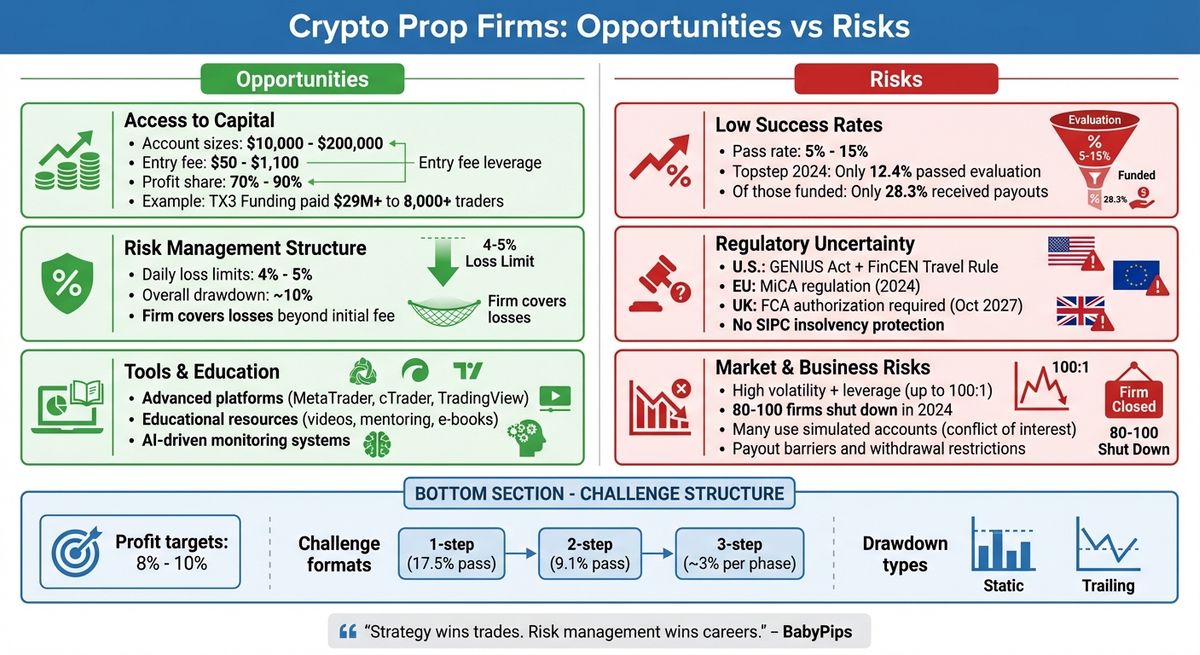
Crypto prop firms are reshaping how traders access capital. Here's the core idea: you pay a fee (usually $50–$1,100) to take a trading challenge. If you hit a profit target (8%–10%) without exceeding strict loss limits, you gain access to a funded account worth $10,000–$200,000 or more. You keep 70%–90% of the profits, while the firm covers losses beyond your fee.
This model appeals to traders with limited funds, offering access to larger capital and tools like advanced trading platforms and risk management systems. However, challenges like low success rates (only 5%–15% pass), regulatory uncertainties, and volatile crypto markets make it high-risk. Some firms rely on fees from failed traders, raising concerns about their stability and fairness.
Key takeaways:
- Opportunity: Trade with more capital and limited personal risk.
- Risks: Strict rules, market volatility, and potential firm instability.
- Success Tip: Research firms, understand their rules, and start small to test reliability.
Crypto prop trading can be a stepping stone for disciplined traders, but it requires caution and preparation.
Opportunities Offered by Crypto Prop Firms
Access to Larger Trading Capital
One of the standout benefits of crypto prop firms is the opportunity to manage substantial trading accounts, ranging from $10,000 to $200,000. By paying a fee between $39 and $1,100 and meeting a profit target of 8%–10% within specific drawdown limits, traders can unlock access to these accounts. This setup is particularly valuable for those with limited starting capital.
Once funded, traders keep a significant share of their profits - usually between 70% and 90% - while the firm absorbs any market losses beyond the initial fee. Some firms even offer scaling plans, increasing account size as traders hit profit milestones. For example, TX3 Funding has reportedly paid out over $29 million to more than 8,000 funded traders worldwide.
This model not only provides access to larger capital but also operates within a framework of structured risk management.
Structured Risk Management and Discipline
Crypto prop firms are built on strict risk management rules, which encourage traders to adopt professional trading habits. Daily loss limits typically range from 4% to 5%, while overall drawdown limits hover around 10%. Breaching these limits often results in account closure, ensuring that traders maintain disciplined and calculated strategies.
As Macro Trader Paul Tudor Jones famously remarked:
"The biggest risk is not adhering to your trading plan. It's the roadmap to your financial goals."
The evaluation phase acts as a proving ground, weeding out traders who struggle with risk management. For instance, Topstep reported that only 12.4% of traders successfully passed their evaluation and secured funding in 2024.
Beyond capital and discipline, crypto prop firms also enhance traders' capabilities through advanced tools and educational resources.
Educational Resources and Technology
In addition to funding and risk management, crypto prop firms equip traders with cutting-edge technology and comprehensive training. They provide access to advanced trading platforms like MetaTrader, cTrader, and TradingView. Many firms go further, offering educational materials such as tutorial videos, virtual classes, e-books, live streams, podcasts, and even personalized mentoring. These resources are designed to sharpen skills and deepen understanding of trading strategies.
Risk management tools are another key offering, including position sizing calculators, ATR indicators, and stop-loss mechanisms. Firms also offer performance dashboards and automated risk management tools, with some incorporating AI-driven monitoring systems to refine trading execution.
Risks and Challenges: Navigating Uncertainty and Volatility
Regulatory Uncertainty
The regulatory environment for crypto prop firms is anything but stable, creating a minefield of challenges for traders. As of January 2026, new U.S. legislation, including the GENIUS Act, has intensified efforts to enforce stricter ethics standards and close loopholes in crypto prop trading practices. Back in early 2025, FinCEN proposed extending the "Travel Rule" to crypto prop firms, requiring them to store and transmit customer data for specific transactions. On the global stage, the EU's Markets in Crypto-Assets Regulation became fully enforceable by late 2024, requiring firms to obtain a Crypto-Asset Service Provider license. Meanwhile, the UK's Financial Conduct Authority will require authorization for crypto-related activities starting in October 2027.
One of the biggest concerns remains the lack of insolvency protection. The SEC has made it clear that non-security crypto assets held by broker-dealers are not safeguarded by the Securities Investor Protection Corporation. This leaves traders with few options if a firm goes under.
"The relatively unregulated nature of crypto can add to the problem by creating further uncertainty and compliance complexities, which would affect stability and make risk management even more difficult."
High Market Volatility and Leverage
Regulatory challenges aside, the volatile nature of crypto markets adds another layer of difficulty. Price swings can wreak havoc on traders navigating strict rules imposed by prop firms. Most firms enforce daily loss limits between 3% and 5%, with maximum drawdown caps ranging from 6% to 10%. Trailing drawdowns, which adjust upward with profits but never decrease, can further restrict available margin during turbulent periods. A sudden spike in volatility can easily trigger account termination, piling on stress for traders.
Leverage is another double-edged sword. While some firms offer leverage as high as 100:1, others stick to more conservative ratios, like 5:1. High leverage magnifies both potential profits and losses, increasing the chances of breaching drawdown limits during volatile times. Liquidity risks, such as slippage or system outages, add to the difficulty, often making it impossible for traders to manage their positions effectively. Unsurprisingly, the pass rate for evaluation programs remains low - typically below 15%, with some estimates suggesting only 5% to 10% of traders succeed.
Business Model and Payout Risks
Beyond external pressures, the business model of many crypto prop firms introduces its own set of risks. A common practice is the "trader churn" model, where fees from unsuccessful traders help fund payouts for the small percentage who succeed. Firms offering steep discounts may rely more on failed evaluations to sustain their operations than on fostering trader success.
"Deep discounts often shift attention away from structural weaknesses. These risks matter more than the percentage shown on the checkout page."
Another issue lies in the nature of "funded" accounts. Many are simulated, with the firm acting as the counterparty. This means the firm profits when traders lose and must pay out of its own treasury when traders win, creating potential conflicts of interest and raising questions about long-term stability.
Payout barriers are also common. Firms may enforce rules like minimum trading days, consistency requirements, or withdrawal caps, delaying or even denying access to funds. Some traders have reported penalties for earning outsized gains, especially if these profits represent a significant portion of the firm's total payouts. Unlike regulated brokers, prop firms often lack third-party oversight of client funds, exposing traders to counterparty risks. If a firm mismanages its capital or faces a wave of withdrawals from successful traders, insolvency becomes a real possibility.
The competitive landscape adds further strain. In 2024 alone, an estimated 80 to 100 prop firms shut down due to fierce competition and stricter regulatory conditions. Allegations of manipulative practices, such as using software to execute trades at unfavorable prices or triggering artificial stop-losses in simulated environments, have also surfaced, further eroding trust in the industry.
Ready to trade funded capital?
Choose your path — Instant Accounts, One-Step or Two-Step Challenges — from just $23, with up to $300,000 in funded capital.
Choose your challengeHow to Evaluate Crypto Prop Firms
Understanding the Rules and Requirements
The first step in evaluating a crypto prop firm is to get a clear grasp of its evaluation challenge structure. Most firms offer challenges in 1-step, 2-step, or 3-step formats, each with its own profit targets and drawdown limits. For instance, a 1-step challenge often requires hitting an 8%–10% profit target while maintaining a 5% trailing drawdown, making it a quicker route to funding. In contrast, 2-step challenges typically split the targets into 8% for Phase 1 and 5% for Phase 2, with an 8% static drawdown. Meanwhile, 3-step formats usually set around a 3% profit target per phase, paired with a 3% static drawdown.
It’s also important to understand how drawdowns are calculated. A static drawdown remains fixed at the starting balance, while a trailing drawdown adjusts upward with your highest equity, which can add complexity during volatile trading periods. These rules emphasize the disciplined risk management that firms expect from traders. Additionally, be mindful of daily loss limits, which typically range from 2%–5% and are calculated based on either the end-of-day high watermark or current equity. Some firms also enforce trading restrictions, such as banning news trading, weekend positions, or high-frequency strategies. Other rules might include limits on "max open risk" (e.g., 1% per trade) or requiring consistency scores before withdrawals.
Finally, confirm that the firm enforces these rules transparently and consistently, as this reflects its operational reliability.
Checking Firm Transparency and Credibility
Once you’ve reviewed the challenge structure, it’s time to assess the firm’s credibility. Start by verifying its legal registration and checking whether its leadership has a solid background in finance rather than unrelated fields like e-commerce. Trustworthy firms are often partnered with regulated brokers under authorities like ASIC or the FCA, which ensures fair pricing, reliable trade execution, and a clear process for resolving disputes.
Another key factor is where the firm holds its capital. Reputable firms use segregated sub-accounts on well-known exchanges like Coinbase International, Bybit, or Deribit. Avoid firms that request crypto deposits into personal wallets. Physical offices in established financial hubs - such as Switzerland, Spain, or the UAE - are another sign of legitimacy.
Take a closer look at the firm’s business model as well. Sustainable firms typically generate income from profit splits with funded traders, rather than relying heavily on evaluation fees. Be cautious of firms offering steep discounts, as they might operate more like "fee farms."
To gauge the firm’s reputation, check community forums, Trustpilot ratings, and independent reviews. For example, Crypto Fund Trader has earned a 4.5 out of 5 rating on Trustpilot from 1,125 reviews, with many users highlighting fast payouts - often within 48 hours. However, some users have flagged issues like denied payouts due to IP or device matching violations.
Using Simulated Trading Challenges
Another way to evaluate a crypto prop firm is by participating in simulated trading challenges. These challenges provide a low-risk way to test your trading skills, as they typically require a small evaluation fee - ranging from $50 to $500 - instead of risking significant capital.
Before entering, ensure your trading strategy aligns with the firm’s low drawdown rules. Industry data shows that only about 12.4% of traders pass these evaluations, and of those who do, just 28.3% go on to receive a payout. Success rates also vary by format: 1-step challenges have a higher success rate of 17.5%, while 2-step formats drop to around 9.1%.
Simulated challenges also allow you to test the firm’s technology and execution quality. High-quality firms replicate live market conditions, including real-time spreads and order book depth. Be sure to read the fine print carefully for any hidden rules, such as unclear slippage policies or restrictions during news events, which could lead to disqualification. To start, consider opting for the smallest available evaluation or a "mini" challenge to test the payout process before committing to larger account sizes.
The Best Crypto Prop Firm in 2025? | Breakout vs Brightfunded vs Crypto Fund Trader
Conclusion: Balancing Opportunity and Risk
Crypto prop firms offer traders access to significant trading accounts for a relatively modest fee (usually between $50 and $500). This arrangement allows traders to keep a substantial portion of their profits, typically around 70%–90%.
That said, these opportunities come with notable risks. Passing evaluation challenges is no easy feat, as the requirements are stringent and success rates remain low. On top of that, regulatory uncertainties persist, with frameworks like MiCA in the EU and FinCEN rules in the U.S. continuing to evolve. The inherent volatility of the crypto market, combined with leverage, can magnify both potential gains and losses. This makes having a solid risk management strategy absolutely critical for achieving long-term success. For anyone considering this path, thorough research and preparation are non-negotiable.
"Strategy wins trades. Risk management wins careers." BabyPips
Before committing, it's essential to verify that the firm is legally registered, uses segregated accounts on reputable exchanges, and has a proven history of payouts. Starting with a smaller challenge can also help you test the platform and its rules without risking too much upfront. Keep in mind that many traders don't pass on their first try, so persistence and careful planning are key.
"Approach the process with the mindset of an entrepreneur seeking seed capital rather than a gambler chasing free money." Crypto-Reporter
Simulated challenges are designed to test your ability to adhere to strict risk limits, maintain execution quality, and stay disciplined. If you can operate within these defined parameters - such as daily loss caps and maximum drawdowns - crypto prop trading could be a viable step toward building a professional trading career.
FAQs
What risks should traders be aware of when working with crypto prop firms?
Trading with crypto prop firms presents interesting opportunities, but it also comes with its fair share of challenges. One of the biggest hurdles is market volatility. Cryptocurrency prices can shift dramatically within seconds, and without solid risk management strategies, these rapid changes can lead to substantial losses. In extreme cases, firms might even shut down trader accounts if their capital takes a significant hit.
Another concern is the regulatory environment surrounding cryptocurrencies in the United States. The rules are still evolving, creating a lot of uncertainty. If a firm operates without proper licensing, traders could face unexpected complications. On top of that, some firms might be subject to restrictions on leverage or other compliance requirements, which can limit trading flexibility.
To navigate these risks, it's crucial for traders to do their homework. Researching a firm's credibility, fully understanding the partnership terms, and sticking to disciplined risk management practices can make a world of difference.
What can traders do to improve their chances of passing a crypto prop firm evaluation?
To boost your chances of successfully passing a crypto prop firm evaluation, think of it as a test of risk management rather than just a showcase of your trading skills. Start by carefully reviewing the firm's rules, such as profit targets, daily loss limits, overall drawdown restrictions, and position size caps. Plan your trades with these rules in mind, and keep your risk per trade minimal - ideally between 1% and 2% of your allocated capital. Always set stop-loss orders to shield yourself from significant losses.
It's also crucial to respect the daily loss limit. If you face two losing trades in a row or hit the daily cap, step away from trading for the day. This prevents emotional decision-making and helps you stay on track to meet the profit target. Keeping a detailed trading journal is another valuable tool - it allows you to track your decisions, spot patterns, and identify areas where you can improve. Lastly, practice in a demo account or a small funded account under conditions similar to the evaluation. This will help you build confidence and fine-tune your strategy before taking the live test.
How can traders assess the reliability of a crypto prop firm?
When considering a crypto prop firm, it's crucial to prioritize transparency and risk management. The most trustworthy firms lay out their operating model in detail. This includes how much capital they provide - often anywhere from $5,000 to $1,000,000 - their evaluation process, and the profit-sharing structure, which typically allows traders to keep 70% to 90% of their earnings. It's also helpful to know whether the firm functions as an in-house trading desk or uses challenge-based funding programs, as this can reveal whether their goals align with yours.
Risk management is another key area to evaluate. Reliable firms enforce strict rules, such as drawdown limits, daily loss caps, and mandatory risk controls, to protect both their funds and yours. Longevity in the market, positive reviews from other traders, and clear terms of service are strong indicators of a firm's reliability. Paying attention to these aspects can help you spot firms that are worth your trust and steer clear of those with hidden pitfalls.
Ready to trade funded capital?
Choose your path — Instant Accounts, One-Step or Two-Step Challenges — from just $23, with up to $300,000 in funded capital.
Choose your challengeTrade up to $300,000
Choose challenge