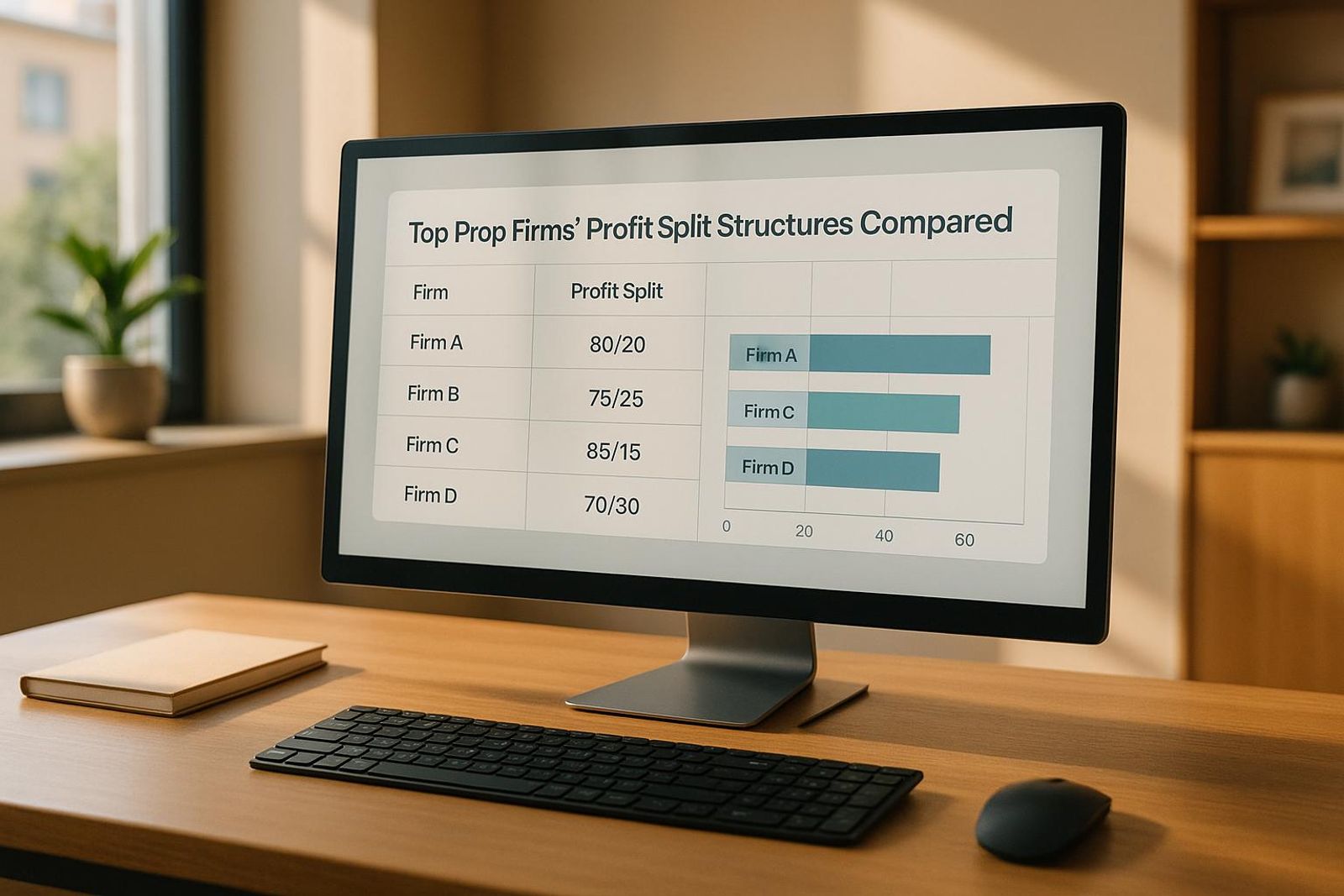
Top Prop Firms’ Profit Split Structures Compared
Prop firm profit split comparison for 2026: split %, payout speed, withdrawal fees and a worked $10,000 example across For Traders, FTMO, The5ers and Topstep.
By Marcel Hambálek · Senior Trader, For Traders
A prop firm profit split is the percentage of simulated trading profit a funded trader keeps as a performance reward, with the firm retaining the rest — most sit between 80% and 90%, and some go to 100% via paid add-ons or scaling tiers. The headline percentage is only half the story: payout frequency, time to first payout, withdrawal fees and consistency rules decide what actually lands in your account.
Key takeaways
- Most 2026 prop firms advertise an 80–90% profit split, and the top tier is usually unlocked by scaling, add-ons or a track record of payouts rather than granted on day one.
- Payout frequency (bi-weekly, monthly, on-demand) and payout processing speed (24h–72h after KYC) are two different things — compare both before you pay a challenge fee.
- A 100% profit split add-on is real in the sense that the terms exist, but it is priced into a higher challenge fee, so it only pays for itself above a specific profit threshold you can calculate.
- On $10,000 of simulated profit, the gap between an 80% and a 90% split is $1,000 — often smaller than what consistency rules, first-payout caps and reset fees cost you over a year.
- Futures prop payouts (Topstep, Apex Trader Funding, Take Profit Trader) run on different mechanics to forex/CFD firms: monthly subscriptions, first-payout caps and stricter consistency thresholds.
- Last verified August 2026 — split percentages, fees and payout cycles change frequently, so always confirm the current terms on the firm's own payout page before buying.
Watch: related video
How prop firm profit splits actually work
A prop firm profit split is the fixed percentage of simulated trading profit you keep as a performance reward once you're trading a funded account; the firm keeps the remainder. Performance rewards are paid on results generated on simulated capital, not real deposits — that distinction shapes every rule that follows.
Nothing about a challenge or a funded account touches live brokerage capital. You trade a simulated balance, and if you hit targets while respecting the risk rules, the firm treats your simulated profit as the basis for a real cash payout — the performance reward. The split percentage determines your cut; the firm's share isn't pocketed as pure margin, it funds the trading infrastructure, market data feeds, risk monitoring systems, and — critically — the payouts of the traders who actually pass, since most challenge attempts don't. That's the honest mechanic behind every profit share model for prop traders: the majority who bust fund the platform that pays the minority who don't.
Profit split vs performance rewards: the correct terminology
"Profit split" describes the ratio (say, 80/20 or 90/10). "Performance reward" describes the actual payment you receive under that ratio. You'll see firms — including For Traders — use both terms interchangeably in marketing, but only one describes money that moves: the performance reward, calculated against simulated profit on a funded account, not against real trading capital.
Who takes the other side of the split — and why
The firm's share isn't arbitrary. It covers the cost of the data feeds and execution infrastructure needed to simulate live market conditions accurately, the risk desk that monitors thousands of accounts for rule breaches, and — the part rarely advertised — cross-subsidizing payouts. Evaluation failure rates across the industry run high; the firm's cut from accounts that never reach a payout is what keeps the reward pool solvent for the accounts that do.
The four variables that matter more than the headline percentage
Two firms both advertising a 90% profit split percentage can produce very different real-world outcomes. What separates them:
- Split percentage — the baseline number everyone advertises first.
- Payout frequency — weekly, bi-weekly, or monthly cycles change how fast simulated profit becomes usable cash.
- Time to first payout — minimum days on a funded account before you can request your first performance reward.
- Cost drag — processing fees, consistency rules, and profit caps that quietly shave value off the headline split.
The rest of this comparison walks through each variable firm by firm. Last verified: August 2026 — split terms, payout schedules and fee structures change without notice, so always confirm current terms directly with the firm before committing to a challenge.
Prop firm profit split comparison table (August 2026)
Short answer: 80% is the floor you should accept from any credible firm in 2026, 90% is the common ceiling most funded traders actually hit, and 100% exists — but always behind a condition (an add-on fee, a scaling milestone, or a capped account size). Below is the master comparison across six firms with active challenges, using the columns that actually decide what lands in your bank account.
| Firm | Profit Split | Top-Tier Condition | Payout Frequency | Time to First Payout | Withdrawal Fee | Scaling Cap | Consistency Rule |
|---|---|---|---|---|---|---|---|
| For Traders | Up to 90% | Reached progressively as account equity scales, no separate paid add-on required | Bi-weekly, on-demand after first cycle | ~14 days | None on standard payout methods | Scales with verified performance, no hard equity lid | Soft — flagged, not auto-rejected |
| FTMO | 80% standard, 90% via upgrade | Requires the profit split add-on purchased at checkout | Every 14 days | ~14 days | Bank/wire fees may apply | Scaling plan up to $2M | Enforced 25%-of-profit-per-day rule on some accounts |
| The5ers | Up to 100% | 100% only on select "instant" and specific funded tiers, not the default split | Monthly to bi-weekly depending on program | ~2–4 weeks | Varies by method | Scaling to $4M+ on flagship programs | Consistency rule on some challenge types |
| Topstep | 100% up to $10,000 total, then 90% | Cap resets once cumulative payouts exceed the threshold | On-demand after eligibility | ~2 weeks minimum trading days | None disclosed on standard payouts | No public scaling beyond account tier | None formally enforced |
| Apex Trader Funding | 90%, 100% on first payout only | One-time 100% "welcome" payout, reverts to 90% after | Bi-weekly minimum | ~8 trading days minimum | None on most tiers | Multiple account stacking, not true equity scaling | None formally enforced |
| Take Profit Trader | 100% up to $10,000, then 90% | Same cumulative-cap structure as Topstep | Bi-weekly | ~2 weeks minimum trading days | None disclosed on standard payouts | No hard scaling cap published | None formally enforced |
How to read the columns
Profit split is the headline, but the "top-tier condition" column is where most traders lose value without noticing — a 100% split that only applies to your first $10,000 in payouts is a very different offer from a 100% split on every cycle. Time to first payout matters more than payout frequency once you're funded, because it's the gap that tests your patience during your first live drawdown. Withdrawal fee and consistency rule are the quiet cost-drag variables from the previous section — a firm can advertise 90% and still hand you less net cash than an 80% firm with zero fees and no consistency penalty.
What 'top tier condition' really means
Every firm on this list gates its best number behind something. For FTMO it's a paid upgrade at checkout. For Topstep and Take Profit Trader it's a cumulative dollar cap that quietly reverts you to a lower split once you've been paid enough. For Apex it's a one-time bonus on your very first payout, never repeated. For Traders scales the split with verified performance rather than a separate purchase — worth checking against your own trading pace before you commit to a challenge.
Three scan-lines
- Fastest to first payout: Apex Trader Funding's 8-trading-day minimum edges out the 14-day standard most other firms use.
- Most flexible frequency: For Traders' on-demand bi-weekly cycle gives you control most rivals lock behind a fixed calendar date.
- Lowest total fee drag: For Traders and Topstep both show no disclosed withdrawal fee on standard methods — check your specific payout method before assuming that holds for wires or regional transfers.
What $10,000 in simulated profit actually pays you
$10,000 in simulated profit pays $8,000 at an 80% profit split and $9,000 at a 90% profit split — before thresholds, caps, and withdrawal fees take their cut. That gap looks small on a pitch deck. Run it through an actual payout cycle and the fees, minimums, and processing rules move the real number more than most traders expect.
The arithmetic at 80%, 90% and 100%
Start with the clean math, no deductions:
- 80% profit split prop firm: $10,000 profit → $8,000 to you, $2,000 retained by the firm.
- 90% split: $10,000 profit → $9,000 to you, $1,000 retained.
- 100% profit split prop firm: $10,000 profit → $10,000 to you, usually only after paying a monthly add-on fee or hitting a scaling milestone — read the fine print on what that add-on costs before treating 100% as free money.
Where thresholds and caps shave the headline number
The split percentage is applied to eligible profit, not to whatever number sits in your dashboard. Four deductions show up in order, and each one bites before the split even happens:
- Minimum payout threshold — many firms won't process a request below $50–$100; if you're just under, that profit rolls to the next cycle.
- First-payout cap — some evaluations cap your first withdrawal (commonly a fixed dollar amount or percentage of the profit target), regardless of split tier.
- Withdrawal or processing fee — flat fee or percentage, charged by the firm or the payment processor.
- Currency conversion — if your funded account is denominated in USD and your bank isn't, expect a spread on top of the transfer fee.
| Step | Effect on $10,000 profit (80% split) | Running total |
|---|---|---|
| Gross split (80%) | −$2,000 retained | $8,000 |
| First-payout cap (example: capped at $5,000) | −$3,000 deferred to next cycle | $5,000 paid now |
| Withdrawal fee (example: $25 flat) | −$25 | $4,975 |
| Currency conversion (example: 1.5% spread) | −~$75 | ~$4,900 landed |
A futures firm often treats the arithmetic differently again: the first $10,000 of profit may sit inside a "safety net" or reduced-split bracket that only unlocks the full trader split once you've cleared it, with everything after paid at the standard rate. That structure matters for anyone comparing best forex profit split for prop traders numbers side by side with futures programs — the two aren't apples to apples on the first payout.
Annualising it: split gap vs fee drag
Over four payouts a year on repeated $10,000 profit periods, the 80% vs 90% gap compounds to $4,000 — real money. But two failed evaluation resets plus one paid scaling add-on can easily cost more than that $4,000 gap. Split percentage is a headline number; total fee drag and reset frequency decide who actually nets more by December.
For Traders: profit split and payout terms
As published on fortraders.com (verified August 2026), For Traders runs three evaluation routes — Instant Funding, One-Step Challenge and Two-Step Challenge — with performance reward splits starting at 80% and scaling toward 90%+ as you progress through funded milestones. The exact split and payout cadence depend on which route you buy, not a single flat number across the platform.
Challenge routes: Instant Funding, One-Step and Two-Step
Instant Funding skips the evaluation phase entirely — you get a funded account from day one, with tighter risk parameters to compensate for the lack of a demonstrated track record. One-Step Challenge is a single evaluation phase with a profit target and daily/max loss limits; clear it once and you move to a funded account. Two-Step Challenge splits the evaluation into two phases with generally more breathing room on drawdown, which is why it remains the most popular route for traders who want a longer runway before real risk parameters kick in.
| Route | Evaluation phases | Starting split | Best for |
|---|---|---|---|
| Instant Funding | None | ~80% | Traders confident in live-style risk from day one |
| One-Step Challenge | 1 | ~80–90% | Traders wanting a faster path to funded status |
| Two-Step Challenge | 2 | ~80–90% | Traders who want more margin for error during evaluation |
Performance rewards and payout cycle
Payout requests follow a defined cycle rather than on-demand withdrawal — check the current cycle length on fortraders.com before you commit, since it's the detail that decides how fast your first performance reward actually lands. KYC verification is required before any payout is processed, standard across the funded prop space, so get your documents sorted during the evaluation, not after you've passed.
Scaling, rules and what to check before you buy
For Traders offers a scaling plan that increases your funded account size as you post consistent performance rewards over successive cycles — the split percentage typically climbs alongside the account size, rewarding traders who don't blow up between milestones. XAUUSD is the most-traded instrument on the platform by volume, with US indices (US100/NSDQ) the second-biggest cluster, alongside CME futures and crypto — so if gold and index trading are your bread and butter, the instrument mix already matches your style. Before buying any route, check daily loss limits, consistency rules and whether the plan you're eyeing supports the instruments you actually trade.
Verdict: who it suits
For Traders is a strong fit if you trade XAUUSD or US indices and want a route — Instant Funding, One-Step or Two-Step — that matches your risk appetite, with a scaling plan that rewards consistency over time. If you need on-demand daily withdrawals rather than a cycle-based payout, or you trade a pure futures-only stack and want a specialist built around CME contracts exclusively, a narrower firm might suit you better. Weigh the split against the payout cycle and rules, not the headline percentage alone.
Ready to trade funded capital?
Choose your path — Instant Accounts, One-Step or Two-Step Challenges — from just $23, with up to $300,000 in funded capital.
Choose your challengeFTMO: 80% to 90% and the 14-day payout cycle
FTMO runs an 80% profit split from day one on its Funded Accounts, stepping up to 90% once you've banked a payout track record — and payouts run on a fixed 14-day cycle rather than on-demand. That structure, verified August 2026, is the trade-off you're buying into: a well-known name and predictable rhythm, not instant withdrawals.
Two-step evaluation and the route to the higher split
Getting funded means clearing FTMO's two-step evaluation: Phase 1 asks for a 10% profit target against a 10% max drawdown and 5% daily loss limit, Phase 2 drops the target to 5% under the same drawdown rules. Both phases carry a minimum trading days requirement, so you can't blitz through in a single lucky session even if you hit the number early. Once you're funded and generate your first payout at the standard 80% split, FTMO bumps you to 90% from your second payout onward — you don't negotiate it, you earn it by proving you can repeat the process without blowing the max drawdown.
Payout mechanics and processing time
The 14-day cycle means you request a payout every two weeks from your funded account's activation date — not the day you feel like cashing out. Realistically, once you've passed both phases and cleared KYC (identity verification typically takes a few business days if your documents are clean), you're looking at your first payout landing within that first 14-day window, then every 14 days after as long as you keep trading. There's no daily or weekly withdrawal option — this is a firm cycle, and missing your window just rolls you into the next one. FTMO also runs a scaling plan that increases your account size roughly every four months if you stay profitable, though the account cap is fixed, so at some point growth has to come from opening additional accounts rather than one balance compounding forever.
Verdict: who it suits
FTMO's prop firm payout speed is a known quantity — reliable, but rigid. If you're a swing trader holding positions over days or weeks, a 14-day cycle fits naturally with how you already operate; you're not checking your balance daily anyway. If you're the trader who wants to lock in a good run the week it happens — a strong NFP week, a clean gold breakout, a lucky earnings gap on indices — the fixed cycle will frustrate you every time. FTMO rewards patience and consistency over flexibility, and the 80% to 90% progression is genuinely earned, not a marketing number. Judge it against your own withdrawal habits before you judge it against the split.
The5ers: scaling-first profit share
The5ers starts most funded traders at an 80% profit share and pushes toward 100% through its scaling plan — but the headline number on day one isn't the point. The5ers' whole model is built around growing your account balance over time, not maximizing what you can pull out of a single hot month. If you're comparing profit share models for prop traders on a spreadsheet, The5ers looks unremarkable at first glance. Live with it for two quarters and the math tells a different story.
Programme structure and starting split
Funded traders typically begin at an 80% split on simulated profits, with the remaining 20% retained by the firm as part of standard prop firm payout structures. There's no dramatic entry percentage to hook you — The5ers isn't selling a 90%-from-day-one headline. What it sells instead is a path: hit your targets inside the risk rules, and both your account size and your split move up together.
How the scaling plan changes your effective split
This is where The5ers separates itself. The scaling plan increases your funded balance after qualifying profit milestones — commonly doubling account size over a series of successful evaluation periods — while simultaneously lifting your split, up to 100% on the profits generated above your initial balance in some tiers.
Model it out. A trader who stays consistent for six to twelve months, clearing scaling checkpoints every 1-2 months without blowing the daily loss limit, ends up trading a materially larger simulated account at a materially better split than where they started. The same trader who cashes out aggressively after one strong month — pulling maximum reward instead of compounding size — never reaches the tiers where the real split advantage kicks in. They're stuck comparing their 80% against someone else's day-one 90% and concluding The5ers is worse. It isn't worse; it's just not built for that comparison.
Payout frequency and trading day requirements
The5ers runs payouts on a scheduled cycle rather than on-demand, and most programmes carry a minimum active trading day requirement before your first reward request is eligible — standard practice across the industry, not a The5ers quirk. Combined with the scaling plan, this reinforces the same message: this firm rewards traders who show up consistently over months, not traders looking for a single clean withdrawal after a lucky week.
Verdict: who it suits
The5ers suits the patient swing trader — someone holding positions across sessions, comfortable letting an account compound rather than harvesting it every cycle. If your edge is longer-hold setups on gold or indices and you're willing to trade the scaling plan like a long game, the effective split a year in beats most fixed-percentage competitors. If you want to bank the biggest possible cash-out from one exceptional month and move on, The5ers' structure will feel slow — you're better served by a firm with a higher flat split and no scaling wait.
Topstep and futures prop payouts: a different product entirely
Futures prop payouts don't run on the same rails as forex/CFD challenges — you're paying a monthly subscription instead of a one-off challenge fee, and the split mechanics are built around CME futures contract specs, not lot sizes on EURUSD. First-payout windows, consistency rules and position-size caps are all tighter here, because the firm is managing real exchange-margin exposure the moment you go live, not just simulated risk on a demo feed.
Topstep: 100% of the first $10,000, 90% after
Topstep's headline hook is simple to state and genuinely different from anything in the forex-CFD prop space: you keep 100% of the first $10,000 in simulated profit on a funded account, then the split drops to 90/10 in your favor after that threshold. It's a strong incentive for a trader who can hit that number fast on ES or NQ futures — but it comes wrapped in a first-30-day withdrawal restriction, meaning even if you clear the profit target in week one, you're not requesting a payout until that window closes. Topstep also runs a consistency rule, capping how much of your total profit can come from a single trading day, which pushes you toward steady, repeatable execution rather than one lucky gap-up morning.
Apex Trader Funding and Take Profit Trader
Apex Trader Funding sits at a flat 90% split with no step-down, and its selling point is speed — traders can typically request a first payout within roughly 8 trading days of meeting the profit target, with biweekly payout cycles afterward. Take Profit Trader also runs a 90% split but structures its first-payout eligibility around a minimum number of trading days combined with a profit target, and it's built a reputation for fast processing once you clear that first hurdle. Neither firm's consistency rule is as strict as Topstep's, but both cap position sizing per account tier — you can't just load up max contracts on a small account and swing for it.
First-payout caps, consistency rules and position-size limits
| Firm | Split | First payout | Consistency rule |
|---|---|---|---|
| Topstep | 100% to $10k, then 90% | After 30-day live window | Yes — daily profit cap |
| Apex Trader Funding | 90% flat | ~8 trading days | Lighter, tier-based |
| Take Profit Trader | 90% flat | Min. trading days + target | Lighter, tier-based |
These aren't cosmetic differences — a strict consistency rule genuinely changes how you trade. If 40-50% of your profit can't come from one session, you can't hold a single NQ swing overnight and call it a strategy; you need a repeatable daily process.
Verdict: who futures prop suits
Futures prop is the fastest-growing segment in the challenge industry right now, especially in the US, precisely because contract specs are standardized, sessions are shorter, and the monthly-subscription model removes the sunk-cost sting of a failed one-off challenge fee. It suits day traders who like defined sessions and CME-listed liquidity over holding CFD positions through news gaps. If you'd rather keep gold, indices and forex under one roof alongside futures, For Traders offers CME futures next to its core XAUUSD and forex products, so you're not managing separate accounts across firms just to diversify instrument type.
Is a 100% profit split add-on real or a marketing gimmick?
It's real, but it's not a gift. The 100% profit split prop firm add-on is a contractual upgrade you pay for upfront, and firms recover that cost by charging a higher challenge fee — plus most versions only apply the full split to your first payout or first profit tier, not every payout for the life of the account.
How add-on pricing actually works
Say a standard $50,000 challenge costs $299 with an 80% split. The same account with a prop firm profit split add-on bumping you to 100% might cost $399–$449. You're paying $100–$150 extra to move 20 percentage points of the split into your pocket — but only, in most terms, on the first withdrawal request after you get funded. After that first payout, the account usually reverts to the base 80/20 or 90/10 split unless you buy the add-on again on a reset or fresh account.
The break-even calculation
The math is simple division. If the add-on costs $X and lifts your split from 80% to 100%, that extra 20% is what you're buying — so you need $X ÷ 0.20 in simulated profit before the upgrade pays for itself.
Worked example: add-on costs $150. $150 ÷ 0.20 = $750. You need $750 in simulated profit on that first payout cycle before the 100% split beats just taking 80% for free. Below $750 in profit, you'd have kept more cash by skipping the add-on and pocketing 80% of a smaller number. Above it, the upgrade wins — and if you're chasing the label of highest payout prop firm, that crossover point is the number that actually matters, not the headline percentage.
Five clauses to read in the terms before you pay
- Scope of the 100% — does it apply to every future payout, or only the first one after you pass?
- Survival through a reset — if you breach the daily loss limit and reset the account, does the add-on carry over or do you pay again?
- Stacking with scaling plans — can the 100% split combine with a scaling tier that raises your account size, or does one override the other?
- Tighter drawdown rules — some firms offset the richer split with a lower max drawdown or stricter daily loss limit on add-on accounts.
- Refund on failure — if you bust the challenge before ever getting paid, is the add-on fee refunded, credited toward a retry, or gone entirely?
Read these five before you click buy. The percentage on the landing page is accurate — it's the fine print around it that decides whether you actually come out ahead.
Payout speed vs payout frequency: the difference nobody explains
Payout frequency is how often you're allowed to request a withdrawal. Payout speed is how long the firm takes to actually send the money once you've requested it. A firm advertising "daily withdrawals" can still leave you waiting three business days for the funds to hit your bank — the two metrics get conflated constantly in marketing copy, and it's the second one that determines when you can actually pay rent with your performance reward.
Frequency: on-demand, bi-weekly, monthly
Most firms fall into three buckets. On-demand means you can request a payout any day the platform is open, once you've hit minimum profit thresholds. Bi-weekly payout prop firms batch requests every two weeks on fixed dates — you miss the window, you wait another cycle. Monthly is the legacy structure, still common on some Two-Step Challenge programs, and it's the slowest of the three for compounding your withdrawal history. Frequency alone tells you nothing about how fast cash actually moves — it just tells you when you're allowed to ask.
Processing time and the 24–48 hour claim
The "24-48 hour withdrawals" line you see on landing pages almost always starts the clock after internal compliance approval — not from the moment you click request. The real chain looks like this: request submitted → compliance/risk check → payment rail selection (bank transfer, crypto, e-wallet) → settlement. Crypto rails typically clear in hours once approved; bank wires can add one to three additional business days depending on your country and intermediary banks. So a "48 hour withdrawals prop firm" claim is usually accurate for the processing step alone, not the door-to-door experience.
KYC verification: the real bottleneck on your first payout
KYC verification — identity and address proof — is a one-time gate, but it's where most first-payout delays actually happen. If you upload a blurry ID scan or your name doesn't match your bank account exactly, expect the request to bounce back for resubmission, adding days you didn't budget for. Get this done the moment your account is funded, not the moment you request your first withdrawal — every subsequent payout skips this step entirely and moves at the firm's normal payout speed.
Time to first payout, firm by firm
Minimum trading days and first-payout waiting periods compound with the KYC delay above. A challenge requiring 5+ minimum trading days before your first request, stacked with a 3-day compliance review, easily pushes your actual first payout past the two-week mark — even on a firm marketing "daily withdrawals."
| Structure type | Min. trading days (first payout) | Typical processing time (post-KYC) | Realistic time to first payout |
|---|---|---|---|
| On-demand, crypto rail | 3–5 days | 24–48 hours | ~5–7 days |
| On-demand, bank transfer | 3–5 days | 2–3 business days | ~7–10 days |
| Bi-weekly cycle | 5–10 days | 1–3 business days | ~10–18 days |
| Monthly cycle | 10–14 days | 2–5 business days | ~20–35 days |
Judge a firm by the last column, not the frequency label on the pricing page — it's the only number that reflects when the reward actually clears.
High flat split vs tiered scaling: the honest trade-off
Pros
- A high flat split (90%+) pays maximum cash immediately and suits traders who plan to withdraw every cycle rather than compound
- Flat splits are simple to model — no conditions, no tier thresholds, no waiting for a scaling review
- Tiered scaling grows both account size and split, so a consistent trader's absolute reward can far exceed a flat-split trader on a static account
- Scaling models usually come with a longer relationship and lower re-purchase cost, reducing lifetime fee drag
Cons / risks
- Top-tier flat splits are often gated behind a paid add-on that only breaks even above a specific profit figure
- Flat splits without scaling cap your absolute earnings at the account size you bought
- Scaling plans usually require minimum trading days, consecutive profitable periods or a consistency threshold — one bad month can reset progress
- Scaling caps exist at every firm, and the advertised ceiling is rarely reached by more than a small fraction of traders
Ready to trade funded capital?
Choose your path — Instant Accounts, One-Step or Two-Step Challenges — from just $23, with up to $300,000 in funded capital.
Choose your challengeFrequently Asked Questions
How do prop firm profit splits actually work?+
A profit split is the percentage of simulated trading gains you keep once you have a funded account, with the rest retained by the firm as its fee for capital access and risk. Most firms start funded traders around 80%, then scale the split up — often to 90% — after consecutive profitable payout cycles. The firm isn't taking the other side of your trades in a betting sense; it's pricing the capital risk it absorbs on a demo-backed account. Read the payout terms closely, because "split" sometimes excludes the evaluation fee refund or add-on upgrades.
What is the highest profit split prop firms currently offer?+
Top-tier programs advertise splits as high as 90-100%, but the headline number almost always comes with conditions attached. A 100% split is typically an add-on purchased during checkout, or a reward unlocked after several consistent payout cycles rather than a day-one default. Before comparing firms on split percentage alone, check the base split, the scaling trigger, and whether the upgrade to a higher tier costs extra or requires a minimum number of trading days. The real number that matters is your effective take-home after fees, not the marketing headline.
Is a 100% profit split real or a marketing gimmick?+
A 100% split is real, but it's rarely the default — it's usually an add-on you buy upfront or a milestone reward after building a payout track record. Firms still need to cover evaluation costs and platform overhead, so a genuine 100% offer typically bundles a higher entry fee or applies only above a certain payout threshold. Treat it as a serious option if the terms are written plainly (no vague "up to" language) and the firm shows a clear path to reach it, not just a banner headline.
What does $10,000 in profit pay out at 80% vs 90%?+
At an 80% split, $10,000 in simulated profit nets you $8,000; at 90%, you keep $9,000 — a $1,000 difference on that single payout. Tiered scaling models compound this over time: if your split rises from 80% to 90% after two or three clean payout cycles, the gap widens on every future withdrawal, not just one. When comparing firms, model your typical monthly reward size against their actual scaling schedule rather than the top-line percentage, since a firm with 85% flat can outpay one advertising 90% with a slow unlock.
How fast do prop firms process profit withdrawals?+
Processing speed ranges from on-demand (funds released within a day or two of request) to fixed bi-weekly or monthly payout windows, depending on the firm and account type. Futures-focused programs often run tighter, more frequent cycles, while some forex/CFD challenges batch payouts every two weeks. Ask specifically about first-payout timing too — many firms impose a longer wait (often 14-30 days) on your very first reward before switching you to faster, recurring cycles. Consistent, verified processing history matters more than a single fast headline payout.
Are there hidden fees on prop firm profit payouts?+
Some firms charge withdrawal processing fees, currency conversion costs, or set a minimum payout threshold below which you can't cash out. These aren't always hidden — they're often buried in the FAQ or terms rather than the pricing page, which is why comparing net payout terms matters more than the advertised split. Watch for language like "processing fee applies" near payment methods, and check whether the evaluation fee is refunded on your first successful payout, since firms handle that differently.
How do futures prop payouts differ from forex/CFD payouts?+
Futures prop programs typically run on tighter, more frequent payout cycles tied to CME-listed contracts, while forex/CFD challenges often use broader profit targets and slower first-payout windows. Futures payouts are usually simpler to model because contract tick values are fixed, whereas forex/CFD rewards depend on lot size, spread, and instrument volatility — gold (XAUUSD) and US indices being the heaviest-traded instruments on multi-asset platforms. When comparing the two, look at daily loss limits and consistency rules separately, since futures firms tend to enforce stricter per-trade risk caps.
Do consistency rules delay my first profit payout?+
Yes-style rules like minimum trading days, maximum single-day profit caps, and consistency requirements are designed to stop lucky one-off trades from triggering a payout, and they routinely push your first withdrawal back by one to two extra weeks. A consistency rule usually caps how much of your total profit can come from a single day (often 20-30%), forcing you to spread gains across multiple sessions before cashing out. Factor these into your trading plan early — building toward a payout with a scalping style that front-loads one big day can backfire under a strict consistency clause.
Which profit split fits a scalper versus a swing trader?+
High-frequency scalpers generally benefit most from firms with fast, frequent payout cycles and no restrictive per-trade holding rules, even if the base split is slightly lower, since volume compensates over time. Swing and news traders, who hold positions longer and rely on fewer, larger wins, tend to do better under tiered scaling models that reward consistency rather than raw trade count, since one big move can trigger a consistency-rule flag. Match the payout structure to your actual trading rhythm rather than chasing the single highest advertised percentage.
Written by
Marcel Hambálek
Senior Trader, For Traders
Marcel trades Futures and Forex day-trading setups on funded accounts and writes about the executional details most traders skip — order types, slippage, session timing, platform quirks on MT5 and NinjaTrader. Pragmatic, mechanics-first, no fluff.
Follow on LinkedInReady to trade funded capital?
Choose your path — Instant Accounts, One-Step or Two-Step Challenges — from just $49, with up to $300,000 in funded capital.
Choose your challengeTrade up to $300,000
Choose challenge