What Funded Traders Wish They Knew Before Starting
Understand evaluation rules, drawdown and risk limits, strategy testing, and trading psychology to improve your chances in funded trader programs.

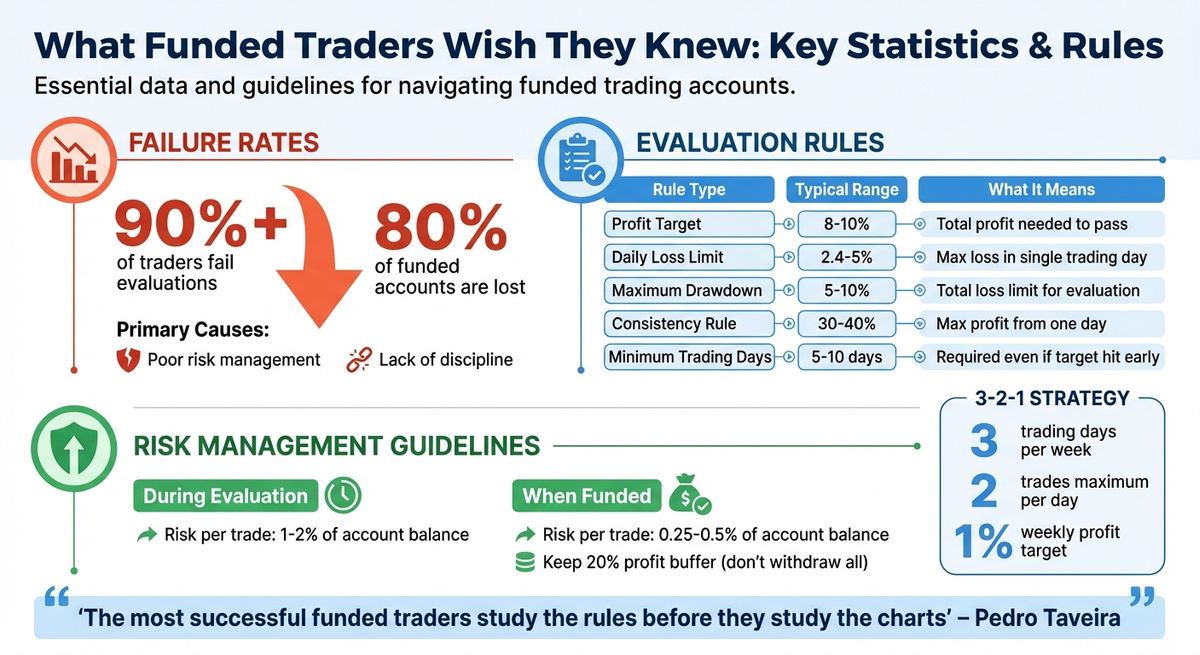
Funded trading offers traders access to significant capital without risking their own money, but it comes with strict rules and high failure rates. Over 90% of traders fail evaluations, and 80% of funded accounts are lost due to poor risk management and lack of discipline. Success requires understanding the rules, testing strategies, and maintaining emotional control.
Key Takeaways:
- Strict Evaluation Rules: Profit targets (8–10%), drawdown limits (5–10%), and consistency requirements must be followed.
- Risk Management: Limit risk to 1–2% per trade during evaluations and 0.25–0.5% when funded.
- Strategy Testing: Backtest and forward-test strategies under conditions identical to the challenge.
- Emotional Control: Avoid overtrading, revenge trading, and rushing decisions near profit targets.
- Preparation: Use tools like TradingView for backtesting and demo accounts to refine your approach.
The path to becoming a successful funded trader is challenging, but preparation, discipline, and a focus on process over profits can significantly improve your chances.
14 Top Tips to Pass a Funded Trader Challenge and Stop Being in the 90% Who Fail
Know Your Evaluation Rules and Drawdown Limits
One of the biggest mistakes aspiring funded traders make is misreading evaluation rules. Surprisingly, it’s not a lack of skill that trips most people up - it’s misunderstanding the guidelines. Over 90% of traders fail evaluations because they overlook key details like profit targets, drawdown limits, or time constraints. These rules aren’t flexible; breaking them can result in immediate termination.
To avoid costly mistakes, it’s crucial to understand how profit targets and drawdowns are calculated and enforced.
How Profit Targets and Drawdowns Work
Most funded trading programs set profit targets in the range of 8–10%. For example, if you’re trading a $50,000 account, you’ll need to generate $4,000–$5,000 in profits to pass. But hitting the profit target is only half the battle - you also need to stay within strict loss limits.
Drawdown limits are typically divided into two categories: daily loss caps (around 2.4–5% of your starting balance) and overall evaluation caps (usually 5–10%), though some prop firms offer low drawdown rules to prioritize capital preservation. Firms calculate drawdowns in different ways:
- Static Drawdown: Fixed to your initial balance.
- Trailing Drawdown: Adjusts as your account grows.
- End-of-Day Drawdown: Assessed at market close.
Another common rule is the consistency requirement, which ensures no single day accounts for more than 30–40% of your total profits. This rule helps identify whether your strategy is repeatable or just a lucky streak.
For instance, if you risk 3% per trade and your daily loss limit is 5%, just two losing trades could end your evaluation. This is why experienced traders typically risk only 1–2% of their account balance per trade.
Read the Terms and Conditions Carefully
Beyond the numbers, the fine print often hides additional rules that can make or break your evaluation. Always review the terms and conditions thoroughly. Some firms, for example, require a stop-loss on every trade. At Alfa Prop Traders, failing to set a stop-loss could lead to your trade being closed - or worse, your account being failed.
You’ll also want to check whether the firm calculates losses based on "floating equity" (which includes unrealized losses) or "closed balance" (only realized losses).
Another important factor is trading restrictions. Many firms prohibit trading two minutes before or after high-impact news events to avoid slippage that could trigger drawdown limits. Restrictions may also apply to positions held over weekends, as unfavorable gaps can lead to unexpected losses.
"Prop firms are mirrors, not miracles. They don't make you disciplined - they expose whether you are." - FundedNest
Finally, most programs require you to trade for a minimum of 5–10 active days, even if you hit your profit target early. Understanding the distinction between soft and hard breaches is also critical. A soft breach might temporarily disable your account or close a trade, but a hard breach - like exceeding your maximum drawdown - results in immediate and irreversible termination.
Test Your Strategy Before You Start
Heading into a funded trading challenge without testing your strategy is like taking off in a plane without running a pre-flight checklist. It’s a recipe for disaster. Confidence without preparation can cost you both the evaluation fee and your time. In fact, over 80% of funded accounts fail, often because traders lack discipline and a solid, tested approach. Many of these failures stem from skipping the crucial step of validating their strategy before putting real money on the line.
The gap between thinking a strategy works and knowing it works comes down to hard data. Backtesting is how you replace guesswork with evidence by running your strategy against historical price movements. For example, if your strategy has a 15% historical drawdown, it’s bound to fail a challenge that caps drawdowns at 10%. This is why professionals recommend that your strategy’s Maximum Drawdown stay within 50–60% of the prop firm’s allowed limit. Testing your strategy thoroughly is essential to avoid making the same mistakes as many inexperienced traders.
Why You Need to Validate Your Strategy
Testing isn’t just a good idea - it’s the foundation of success in funded trading. A strategy that only exists in your head is often a mix of habits and biases. Without proper validation, you’re flying blind. You won’t know critical metrics like your Profit Factor (which should be 1.5 or higher), your actual win rate, or whether you can realistically achieve an 8–10% profit target within the challenge’s timeframe.
Validation happens in two stages: backtesting and forward-testing. Backtesting uses historical data to verify your strategy’s statistical edge, while forward-testing involves live practice in real-time market conditions using simulated accounts. Backtesting can be done in a matter of hours or days, but forward-testing takes weeks or even months, as you can’t skip ahead in live markets. Together, these steps provide a complete picture of your strategy’s reliability. To ensure statistical significance, aim to test your strategy across at least 50 to 100 trades, all executed under the same set of rules.
Tools for Backtesting and Practice
When it comes to backtesting, TradingView’s “Bar Replay” feature is a great tool. It simulates live trading conditions by advancing one candle at a time, forcing you to make decisions based on the information you’d have in the moment. This approach helps eliminate hindsight bias and gives you a clearer sense of how your strategy performs under pressure.
For forward-testing, demo accounts like NinjaTrader SIM or TradingView’s paper trading feature are excellent options. To get the most out of these tools, make sure to mirror the exact conditions of your funded trading challenge - same starting balance, leverage, and loss limits. For example, if your challenge has a 5% daily loss limit, set a personal rule to stop trading at 2%. This buffer helps you avoid emotional mistakes that could breach the firm’s rules.
If you’re looking to practice with realistic conditions, For Traders offers customizable evaluation plans ranging from $6,000 to $100,000 in virtual capital. These plans include a 9% profit target, a 5% maximum drawdown, and unlimited time to complete the evaluation. This flexibility allows you to refine your strategy without the pressure of a ticking clock.
Finally, keep a detailed trading journal for every simulated trade. Record screenshots of your setups, your reasons for entering and exiting trades, and even your emotional state. This habit will help you spot patterns, like overtrading or revenge trading, before they become costly in a real evaluation. Use the expectancy formula - (Win Rate × Average Win Size) - (Loss Rate × Average Loss Size) - to confirm that your strategy has a positive mathematical edge.
Ready to trade funded capital?
Choose your path — Instant Accounts, One-Step or Two-Step Challenges — from just $23, with up to $300,000 in funded capital.
Choose your challengeMaster Risk Management and Stay Disciplined
Even the best strategies can fall apart without disciplined risk management. In fact, 80% to 90% of funded accounts fail - not because the strategies are flawed but because traders often struggle to follow their own risk management rules. The key to success often lies in managing emotions when the market moves against you. This mindset is crucial as we dive into the common mistakes traders make.
One of the biggest traps is what’s known as the "challenge mentality." Many traders take on aggressive, high-risk tactics to pass evaluations quickly, but they often carry these habits into their funded accounts. Once funded, the focus should shift from chasing profits to protecting capital. For example, during evaluations, traders might risk 1% to 2% per trade. However, top-performing prop traders on funded accounts usually lower this to 0.25% to 0.5%, giving themselves more room to handle losing streaks.
Common Risk Management Mistakes
A frequent and costly mistake is over-leveraging - risking too much on a single trade without adjusting position sizes properly. Most prop firms set maximum drawdown limits between 10% and 12%, and even touching these limits once can lead to instant disqualification.
Another issue is overtrading or revenge trading. When traders rush to pass challenges or recover losses, they burn out mentally and rack up unnecessary costs, which often leads to failure. Neglecting stop-loss orders is another major problem; it can result in breaches of drawdown limits.
"If you're not applying stop loss in your prop trading, your prop trading could be a ticking time bomb"
Ignoring major news events like NFP, FOMC, or CPI releases is another risky behavior. Trading during these high-impact announcements can lead to unexpected slippage or violations of trading rules. Additionally, withdrawing all your profits immediately can leave your account vulnerable to future drawdowns. It’s better to keep a 20% buffer to safeguard against potential losses.
To avoid these pitfalls, traders need a structured and disciplined approach.
How to Stay Disciplined
Discipline is the backbone of successful trading. One effective method is the 3-2-1 Strategy: limit yourself to 3 trading days per week, a maximum of 2 trades per day, and aim for a modest 1% weekly profit target. This approach prioritizes quality over quantity, reducing the temptation to overtrade.
Another useful tool is the 3-Level Protection System, which adjusts risk as drawdowns increase:
This system forces you to scale back risk as losses mount, preventing a single bad streak from blowing up your account.
Another helpful rule is to stop trading if you hit 50% of your daily loss limit. For example, if your firm allows a 5% daily loss, stop trading after a 2.5% drop to avoid making emotional mistakes. Keeping a detailed trading journal can also be a game-changer. Documenting your trades and emotional state helps you identify patterns, like revenge trading, before they spiral out of control.
Finally, during your first week with a funded account, focus on micro-risk adjustments. Trade with minimal risk levels (around 0.1%) to ease into the pressure of trading real money. This adjustment period can set the tone for long-term success.
Prepare for the Mental Challenges
Trading with someone else’s capital adds a unique layer of pressure. You’re not just following your strategy - you’re operating under strict rules, drawdown limits, and constant monitoring. This pressure can trigger stress responses that derail even the most well-tested plans. It’s often said that trading success is 90% psychological. Recognizing this truth early on can be the key to joining the top 1% of traders who consistently earn payouts, rather than the majority who don’t. A strong mindset works hand-in-hand with the solid risk management and strategic testing covered earlier.
Managing Emotional Stress
Prop trading often brings two major emotional challenges. The first is the “almost there” syndrome - when you’re close to your profit target, and the temptation to rush trades leads to poor decisions and broken rules. The second is the disproportionate pain of losses. Research shows that losses feel about twice as painful as equivalent gains.
"Under pressure, you don't rise to the occasion - you sink to the level of your training." – Navy SEALs
The goal isn’t to eliminate emotions (which is impossible) but to detach from individual trade outcomes. Professional traders treat losses as a normal cost of doing business, not as personal failures. To stay grounded, practice visualizing disciplined execution and take a 10-minute break to reset after a loss.
Keep an emotional journal alongside your trade data. Write down how you felt before, during, and after each trade. This helps you identify emotional triggers, whether it’s boredom, overconfidence, or something else.
Build Consistency Through Practice
A solid mental framework is essential for refining and executing a tested strategy. Consistency doesn’t happen overnight - it’s built through repeated practice in real market conditions. When you’re ready to trade a funded account, consider using a 7-Day Adaptation Plan. Start by observing the market for two days without placing trades. Then, for the next two days, trade with minimal risk - just 0.1% per position. This small-scale trading phase helps you adjust to the psychological pressure of managing real money while keeping your account safe.
Shift your focus away from outcome-based goals and toward process-based ones. For example, instead of aiming to “pass in 5 days,” commit to something like, “I will follow my trading plan with 100% discipline for 10 consecutive days”. This shift reduces the emotional burden of chasing profit targets and helps you concentrate on executing your strategy with precision.
To reinforce discipline, start each trading day by visualizing successful execution. Use a pre-trade checklist to ensure your setups align with your strategy, check for upcoming news events on the economic calendar, and confirm that your risk per trade is 1% or less. These habits create a buffer against impulsive decisions. Finally, evaluate your performance over a series of 20 to 30 trades rather than focusing on individual results. This allows your statistical edge to emerge over time.
Use Platform Tools and Educational Resources
Before diving into evaluations, take full advantage of your trading platform's built-in tools to sharpen your skills and improve accuracy. Many modern platforms come equipped with features like digital coaching, market replay options, and automated risk controls. These tools are specifically designed to tackle the common pitfalls that cause over 90% of traders to fail their evaluations. By combining these tools with the strategy validation and risk management techniques already discussed, you can streamline your learning process and strengthen your trading approach.
Take Advantage of Educational Materials
Free educational resources are a goldmine for mastering essential trading concepts. Platforms often provide video courses, e-books, and access to community forums that break down topics like the 2% Rule for position sizing and how to interpret footprint chart volume. Community forums and active Discord groups, with tens of thousands of members, can also be invaluable for setup reviews and sharing insights. Additionally, free trials and demo accounts let you practice placing orders and refine your strategy execution without financial risk. When paired with advanced platform tools, these resources can help you build a solid foundation for effective risk management.
Use Advanced Trading Features
Once you've built a strong foundation, advanced platform features can take your trading discipline to the next level. The difference between passing and failing evaluations often lies in how well you use these tools. For instance, bracket orders automatically set stop-loss and take-profit levels when you enter a trade, ensuring your risk plan is locked in. Hard-coded daily loss caps can pause trading automatically if your losses hit a predefined limit, reducing the temptation for revenge trading. Features like order flow analysis and liquidity visualization give you a clearer picture of where real volume is concentrated, helping you validate setups with solid data. Market replay tools allow you to fine-tune your entry and exit strategies, while integrated digital coaching features provide real-time feedback to help you build consistent, disciplined trading habits.
Conclusion
Making it as a funded trader requires more than just a solid strategy - it demands a deep understanding of the rules, careful preparation, and unwavering discipline in risk management. Pedro Taveira, Founder of LivingFromTrading, puts it best:
"The most successful funded traders study the rules before they study the charts".
Even a small misstep, like exceeding daily drawdowns or ignoring news restrictions, can undo all your hard work.
The numbers paint a tough picture: over 90% of traders fail challenges, and nearly 80% of those who do get funded lose their accounts within months. The common culprit? A lack of discipline. But here's the silver lining: success isn't reserved for the most skilled - it belongs to those who prioritize risk management and stick to a consistent, repeatable plan.
Preparation is your foundation. Before diving into a challenge, spend at least two weeks rigorously backtesting your strategy under the same conditions. Leverage demo accounts, market replay tools, and educational materials to refine your approach. Tighten your personal loss limits beyond the firm's requirements to create a safety net.
Beyond the technical aspects, trading success is deeply tied to your mindset. Shift your focus from chasing performance to preserving capital. This mental adjustment, paired with a clear understanding of the rules and disciplined risk management, is key. Specializing in one instrument and trading session, keeping a detailed journal that tracks both your trades and emotions, and using tools like bracket orders to automate risk control will build a framework for consistency.
FAQs
What are the most common mistakes traders make during funded trading evaluations?
Many traders stumble during funded trading evaluations, not because they lack trading knowledge, but due to easily avoidable errors. One of the most common missteps is skipping the rulebook. Each firm has its own set of guidelines - like limits on daily drawdowns, restrictions on overnight positions, or rules about trading during news events. Overlooking these can quickly lead to disqualification. Another frequent issue is over-leveraging. In the rush to meet profit targets, traders may take on overly large positions, only to breach drawdown limits in the process.
Trading without a clear plan is another major roadblock. Without predefined entry points, stop-losses, and risk-per-trade rules, traders often let emotions take over. This can result in revenge trading or exposing themselves unnecessarily during volatile market conditions. It’s important to remember that these evaluations are designed to assess risk management and discipline more than pure profit potential. Impulsive decisions and ignoring risk controls can derail your efforts faster than you think.
To increase your chances of success, steer clear of these common pitfalls: skipping the rules, over-leveraging, trading without a plan, letting emotions dictate actions, and ignoring key economic events. A steady, disciplined approach is your best ally in passing these evaluations.
How can traders stay calm and manage emotions during intense trading situations?
Managing emotions in high-pressure trading demands a thoughtful and disciplined approach to maintain focus and avoid rash decisions. A good starting point is sticking to a pre-defined trading plan. Instead of obsessing over profit targets, concentrate on process-based goals like staying disciplined and executing your strategy consistently. This mindset shift can ease the emotional burden tied to outcomes.
Creating a solid daily routine is another helpful tactic. Kick off each trading session with a short breathing exercise or visualization to center your thoughts and reinforce a calm, focused state of mind. Additionally, keeping a trading journal is invaluable - not just for tracking your trades but also for noting your emotional responses. This can help you spot patterns, such as overconfidence or revenge trading, and adjust your behavior accordingly.
Risk management is equally critical. Limit your risk per trade to a small percentage of your account - think 0.25% to 0.5%. This approach cushions the emotional blow of potential losses, enabling you to remain composed and stick to your game plan. By combining these strategies, you’ll be better equipped to manage emotions and make rational decisions, even when the stakes are high.
What are the key tools and resources for testing and improving trading strategies?
To prepare effectively for a funded trader program, having the right tools in place is essential. Here are three key resources that can help you test and refine your trading strategies:
- Back-testing software: This tool lets you recreate past market scenarios to see how your strategy would have performed. It provides critical metrics like profit/loss, win rates, and drawdowns, helping you fine-tune your approach.
- A trading journal: A detailed log of your trades is invaluable. By recording setups, outcomes, and lessons learned, you can spot patterns, identify strengths, and address weaknesses in your strategy.
- Educational resources and communities: Guides, forums, and other learning materials can offer insights into risk management, evaluation criteria, and common mistakes to avoid. Engaging with trading communities can also provide a support network and fresh perspectives.
Using these tools together can help you refine your strategies, gain confidence, and be better equipped to tackle the demands of funded trading programs.
Ready to trade funded capital?
Choose your path — Instant Accounts, One-Step or Two-Step Challenges — from just $23, with up to $300,000 in funded capital.
Choose your challengeRelated Blog Posts
Trade up to $300,000
Choose challenge